
Airport Lounge Grab-and-Go 2026: 15-Minute Pickup vs Full Lounge Visit
This guide compares 15-minute grab-and-go pickups with full lounge visits in 2026. It shows when waitlists make the counter the better choice.
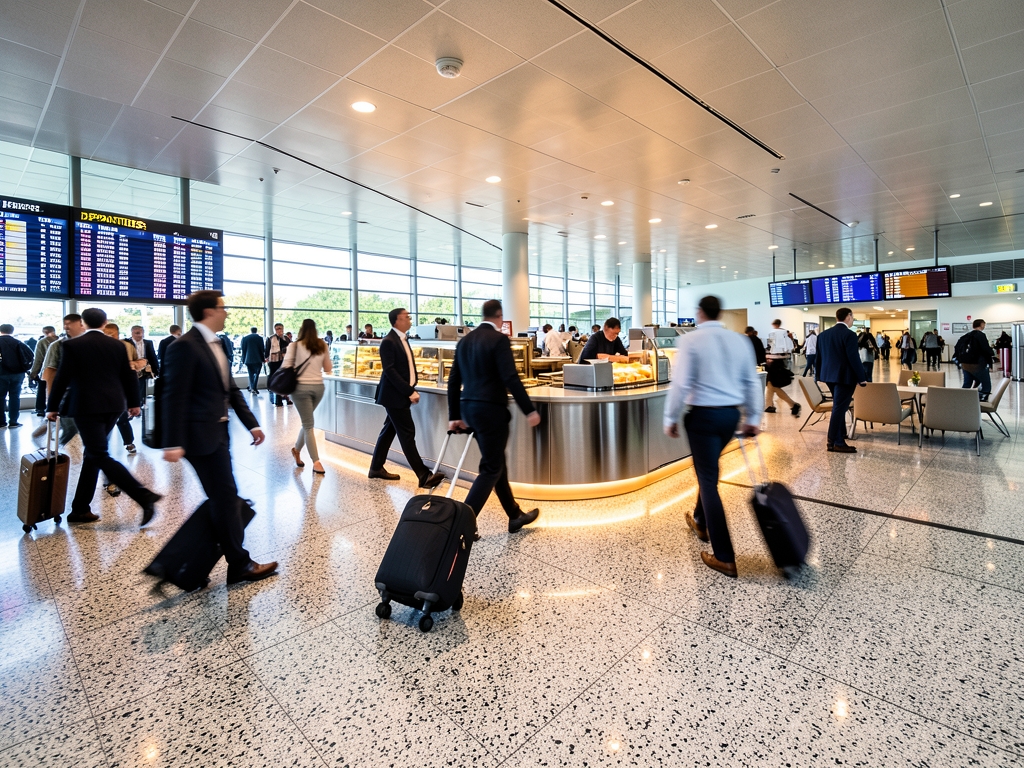
This guide compares 15-minute grab-and-go pickups with full lounge visits in 2026.
It shows when waitlists make the counter the better choice.
How grab-and-go lounges work
Grab-and-go lounges are pickup-only counters: instead of entering a traditional lounge, finding a seat, and serving yourself, eligible passengers take refreshments with them. Your Mileage May Vary's Oct. 28, 2026 deep read describes the format as letting travelers pick up a sandwich, snack, and drink rather than sitting down in the lounge.
The mechanism is speed-first and seatless. There is no lounge seating to claim and no self-serve buffet line to work through; the counter hands over refreshments for the walk to the gate. That is the whole operating idea: a quick pickup, not a visit.
Swikblog, June 7, 2026, reports that United, American, Delta, Air Canada, and American Express are expanding grab-and-go airport lounges as overcrowding pushes airlines to rethink premium travel experiences.
Named formats to look for include United's Club Fly and Delta's Grab and Go; AFAR, Sept. 16, 2026, also points to a Poppin express lounge in Atlanta among the newer quick-stop options. The New York Times, June 5, 2026, expects more of these quick-stop lounges to appear, especially in airports where many passengers are just connecting.
Because the format is pickup-only, the value is in what you can carry, not in where you can sit. A traveler who wants a sandwich, snack, and drink can use the counter as a fast refreshment stop; a traveler who needs a seat, Wi-Fi time, or a longer break is using a different product.
On the concourse, look for the operator's grab-and-go branding rather than a full lounge entrance: United Club Fly, Delta Grab and Go, and American Express formats are the names to scan for, with American, Air Canada, and other operators also expanding the concept. If the sign promises seating, you are at a traditional lounge; if it promises pickup, you are at the counter this section describes.
The evidence: overcrowding drove this
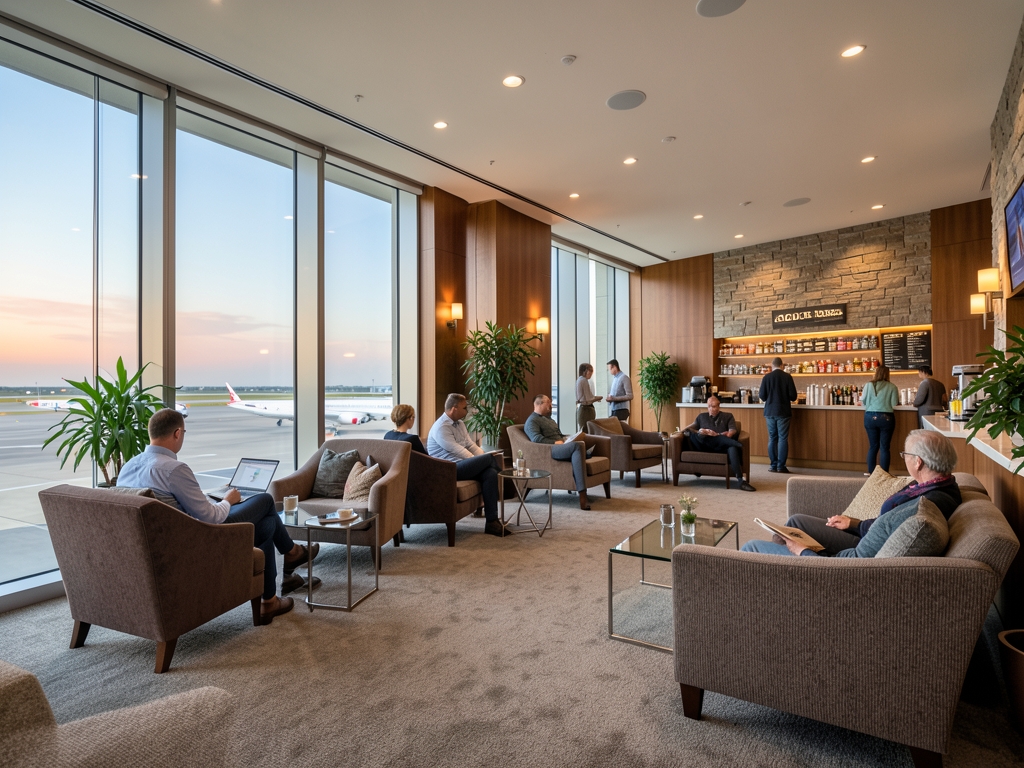
The pressure starts with access. Your Mileage May Vary notes that lounges have become more accessible through first class, elite status, membership, credit cards, and paid one-time visits, so more travelers than ever can enter. The result is that the lounge you want is often full, with a waitlist that may not clear before boarding starts. That is the bottleneck: expanded access turned a premium perk into a capacity problem.
Operators responded by changing the product, not just the queue. Omniflights reports that airlines and card issuers are opening grab-and-go lounges specifically to address overcrowding, prioritizing speed over traditional seating and amenities. The New York Times adds that more quick-stop lounges are expected in coming years, especially in airports where many passengers are just connecting.
The trend is broader than one format. Upgraded Points describes grab-and-go counters, quick-serve markets, and standalone "fly" lounges appearing across the country over the past few years, while the New York Post frames grab-and-go as a new solution after years of credit card perks, day passes, and premium travel upgrades. AFAR points to examples ranging from a Poppin express lounge in Atlanta to United's Club Fly and Delta's Grab and Go, noting that lounges are increasingly acknowledging travelers with limited time before boarding.
The causal chain is direct: broader lounge access increased demand; increased demand created full lounges and waitlists; those waitlists and time pressure pushed airlines and card issuers to launch speed-first pickup formats. In other words, grab-and-go is a response to the capacity problem that expanded access helped create.
For travelers, the practical reading is that lounge entry should be treated as conditional. If the lounge you want is full, the waitlist may not clear before boarding, and the grab-and-go counter exists precisely for that bottleneck. Check the specific lounge's current status before you commit to the queue, and treat a waitlist as a signal to pivot rather than a guarantee of entry.
Grab-and-go vs full visit: winner
When the clock is the constraint, the grab-and-go counter is the safer play; when the clock is generous, the full lounge is the better value. Decide from the time to boarding, not from which logo is on the door.
| Time to boarding | Better choice | Why |
|---|---|---|
| Under 15 minutes | Grab-and-go | It is the only format that reliably gets food and drink in hand before the gate closes. |
| 15 to 44 minutes | Depends on waitlist | A short queue can still favor the full lounge; a long one sends you to the counter. |
| 45 minutes or more | Full lounge, if waitlist is short | The broader food and drink, seat, and work surface justify the extra time. |
Compare the two on three axes: time required, food and drink scope, and seat or work surface. Grab-and-go wins on time because it removes the search for a seat and the self-service loop; the full lounge wins on scope because it offers the broader food and drink selection plus a place to sit and work.
By time budget, the winner is explicit: with under 15 minutes to boarding, grab-and-go wins outright; with 45 minutes or more, the full lounge wins if the waitlist is short. The middle band is not a tie in principle; it is a waitlist test.
The tiebreaker is the posted waitlist. If the traditional lounge shows a waitlist longer than your time buffer, grab-and-go is the only option that reliably gets you fed before the gate closes. Your Mileage May Vary notes that a lounge waitlist may or may not clear before boarding, so treat the posted estimate as a ceiling, not a promise.
This is a comparison of fit, not quality: a full lounge can be the better room and still be the wrong choice when the queue is longer than the buffer. Apply it as a two-step check: read the boarding time, then read the lounge waitlist. If the waitlist exceeds the buffer, skip the queue and take the counter; if it does not, use the full lounge and keep the counter as fallback.

Costs and access rules to check
Traditional lounge access is not one rule. Your Mileage May Vary's Oct. 28, 2026 deep read describes entry through first class, elite status, membership, an eligible credit card, or a paid one-time visit. Those routes describe the full lounge; a grab-and-go counter at the same airport may use a different list.
The verification method is to check the exact counter, not the brand. Before travel, read the entry rules on the operator's own page for that location—United Club Fly, Delta Grab and Go, American Express, or Poppin. Swikblog's Jun. 7, 2026 roundup names American Express among operators expanding grab-and-go lounges, and AFAR's Sep. 16, 2026 piece places a Poppin express lounge in Atlanta alongside United and Delta formats. If the page does not list your card, status, or membership, treat that counter as uncovered.
Coverage is per location, so a yes at one airport does not transfer. A card that opens a full lounge in one city may not open the express counter in another, and an express counter may have its own guest or time rules. The only safe assumption is the one printed for that specific counter.
For day-pass pricing, compare the specific airport and lounge rather than a brand average. Use a directory such as airportloungelist.com to review access details for that airport and lounge, then confirm the same counter on the operator's page before paying. Because the directory and operator can differ, the operator's page should be the final check.
A practical pre-trip routine is to save the counter's rules page, note whether your access method is named, and decide in advance whether a paid one-time visit is worth it for that airport. If access is unclear, the fallback is the full lounge queue or a gate purchase, not an argument at the counter.
The cost of an incorrect assumption is usually time rather than money: if you reach the counter and learn your access method is not accepted, you have spent the minutes you were trying to protect. Verifying first keeps the grab-and-go option a true shortcut.
What the evidence does not establish
The evidence supports a time-based default, not a universal rule. It does not establish exact wait times at individual lounges, what each counter stocks, or whether every grab-and-go location accepts every credential that opens a traditional lounge. Those details vary by airport and operator, so verify the specific location's rules and inventory before you plan around a pickup counter.
The default breaks on a long connection. With two or more hours and an empty traditional lounge, the full visit wins: grab-and-go provides no seat, Wi-Fi, or shower, so the time saved is not worth giving up amenities you can actually use. This is the case where waiting for a lounge seat is rational rather than risky.
It still wins on a tight connection at a connecting-heavy hub. The New York Times reported on June 5, 2026 that more quick-stop lounges are expected where many passengers are just connecting, which is exactly the case where a queue can outlast your connection and a pickup counter protects the boarding window.
| Scenario | Result | Reason |
|---|---|---|
| Long connection (2+ hours) with an empty traditional lounge | Full lounge wins | Grab-and-go offers no seat, Wi-Fi, or shower |
| Tight connection at a connecting-heavy hub | Grab-and-go wins | Queue risk is high; pickup protects boarding time |
| Any airport where rules or stock are unverified | Do not assume | Per-location wait times, item selection, and credential acceptance are not established |
The same caution applies to access and inventory. The evidence does not establish that every grab-and-go counter honors every lounge-access credential, nor that every counter stocks the same items. A card, status, or membership that works at the main lounge may not work at the pickup counter, and the available refreshments may differ by location.
Treat the table as a boundary check, not a replacement for the time rule: when the connection is long and the lounge is empty, use the lounge; when the connection is tight and the airport is connection-heavy, use the counter; when local details are unknown, verify before you plan around either option.
12-minute connection
Picture a tight connection at a connecting-heavy hub where the concourse has both a full lounge and a grab-and-go counter, boarding starts in about 12 minutes, and you hold a card or membership you believe opens the lounge. The decision is not which lounge is nicer; it is which one can actually deliver something before the gate closes.
With about 12 minutes left, walk past the full lounge entrance and look for a waitlist sign or a visible queue. If either is there, do not join it. Twelve minutes is not enough time to clear a list that may or may not move before boarding, and the cost of being wrong is boarding with nothing in hand. If neither is visible, the clock still favors the faster counter.
With about 10 minutes left, be at the grab-and-go counter and confirm that your access method is accepted before you order. Treat the answer as a live check at the counter, not as a guess from the card's marketing; if the answer is no, you still have time to pivot to a paid option or the gate instead of discovering it after you have built a tray.
If the grab-and-go counter has its own line, apply the same test: if it will not clear with about 6 minutes left, leave and go to the gate. With about 6 minutes left, pick up the sandwich and drink and start walking. That leaves a small buffer for a restroom stop or a gate change, and it keeps the pickup from becoming a second queue.
The two ways to be wrong are asymmetric. Joining the full lounge waitlist with 12 minutes can leave you with no food and a boarding group called while you are still in line; skipping it for grab-and-go can mean giving up a seat and a fuller spread if the waitlist would have cleared quickly. On a 12-minute connection, the first error is harder to recover from, because a missed boarding is not fixed by a sandwich.
Your Mileage May Vary's 2026 read on grab-and-go lounges frames the waitlist as the reason speed-first counters matter; on a 12-minute connection, that risk is the whole decision.
Decision rules for your next connection
If boarding is 15 minutes or less away, go straight to the grab-and-go counter and do not join a lounge waitlist you cannot clear. The risk is not just a long line; it is being locked out entirely while boarding starts. In that window, the counter is the option that reliably converts your access into food and drink before the gate.
If your credential is rejected at the grab-and-go counter, treat it as a format-specific coverage question, not a final no. Check the operator's location page for that exact format, because coverage differs between United Club Fly, Delta Grab and Go, and Amex locations. The same card, status, or membership can be accepted at one counter and declined at another, so verify before you walk away hungry.
The one annoying detail, flagged in Your Mileage May Vary's Oct. 28, 2026 deep read, is that the refreshments come in takeaway containers you must carry yourself. That turns a quick pickup into a hands-and-bag problem: if you cannot comfortably carry the container with your luggage, or if you are already in a late boarding group, the speed advantage can disappear.
Between those thresholds, use the same logic: compare the waitlist to your real buffer, not your hoped-for lounge time. The decision is not lounge versus counter; it is whether the queue can clear before your fallback time.
Also worth reading The Most Exciting New Airport Solo Travel Safety How To Avoid Airport Pickup Services An Objective
What to do next
| Step | Action | Why it matters |
|---|---|---|
| 1 | Check the clock against boarding time; with 15 minutes or less remaining, skip the lounge queue and go straight to a grab-and-go counter (United Club Fly, Delta Grab and Go, or Amex formats). | Applies the 15-minute cutoff before boarding. |
| 2 | With 45 minutes or more remaining, join the full lounge waitlist first. | Uses the longer buffer to try the full lounge. |
| 3 | Compare the posted waitlist time with your remaining buffer; if it exceeds the buffer, leave the queue. | Prevents missing boarding while waiting. |
| 4 | If the waitlist locks you out entirely, do not keep waiting; switch to grab-and-go. | Reflects the lockout risk. |
| 5 | At the grab-and-go counter, complete pickup only—no seat search or self-service. | Matches the pickup-only format. |
| 6 | Head to boarding with your item instead of re-entering the lounge queue. | Keeps the decision rule intact. |
Frequently Asked Questions
Which travelers are able to use a grab-and-go lounge counter?
Eligible passengers take refreshments with them instead of entering a traditional lounge.
What does Your Mileage May Vary say travelers pick up at these counters?
It describes the format as letting travelers pick up a sandwich, snack, and drink rather than sitting down in the lounge.
Which companies are expanding grab-and-go airport lounges according to Swikblog?
United, American, Delta, Air Canada, and American Express are expanding grab-and-go airport lounges.
What named quick-stop lounge formats does the article mention?
Named formats include United's Club Fly, Delta's Grab and Go, and a Poppin express lounge in Atlanta.
Why are airlines expanding grab-and-go lounges?
Overcrowding is pushing airlines to rethink premium travel experiences.
Where does The New York Times expect more quick-stop lounges?
It expects more of these quick-stop lounges especially in airports where many passengers are just connecting.
Quick answers
| What does the guide compare? | It compares 15-minute grab-and-go pickups with full lounge visits. |
| What are grab-and-go lounges? | They are pickup-only counters where eligible passengers take refreshments with them instead of entering a traditional lounge, finding a seat, and serving themselves. |
| What does Your Mileage May Vary's Oct. 28, 2026 deep read say travelers pick up? | It describes the format as letting travelers pick up a sandwich, snack, and drink rather than sitting down in the lounge. |
| Which companies are expanding grab-and-go airport lounges, per Swikblog, June 7, 2026? | United, American, Delta, Air Canada, and American Express are expanding grab-and-go airport lounges as overcrowding pushes airlines to rethink premium travel experiences. |
| What does The New York Times, June 5, 2026, expect? | It expects more of these quick-stop lounges to appear, especially in airports where many passengers are just connecting. |
Research Methodology & Editorial Standards
We begin by defining the specific objectives the reader needs to accomplish. Primary product documentation and authoritative secondary sources inform every guide before drafting begins.
Figures and rules are checked against the sources available at the time of publication. Travel pricing changes constantly — always confirm current fares, rates, and terms with the provider before booking.