
Unlock New Passions at Hotels Offering Lessons in Jewelry Making and Falconry
That mental openness makes a weeklong trip the ideal window for rapid skill acquisition, whether it’s learning to make a piece of jewelry from scratch or handling a falcon for the first time.
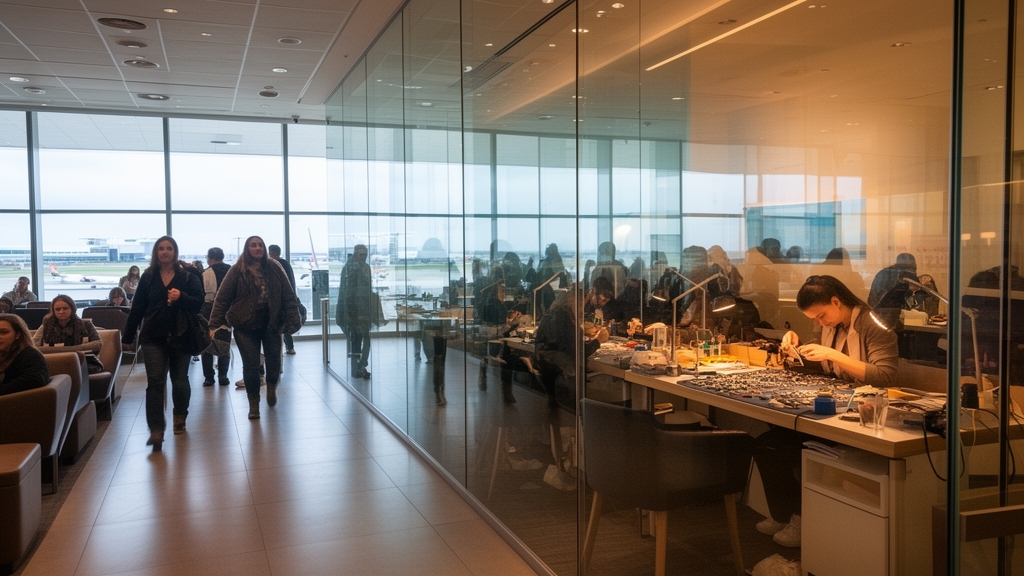
The Rise of the 'Skillcation': Why Travelers Are Seeking Hands-On Learning Experiences
I’ve been watching this shift for a while now, and it’s finally hitting critical mass: travelers in 2026 are quietly abandoning the old checklist of sights and souvenir shops in favor of something far more sticky. Instead of a passive week spent snapping photos of landmarks, people are booking vacations built around learning a real, tactile skill—and they’re coming home with something tangible to show for it. We’re talking about the skillcation, a blend of skill and vacation that’s been gaining steam for a few years but has now fully matured into a mainstream movement. What’s interesting is the psychology behind it. When you’re on vacation, your brain is literally more open—you’re out of your usual routine, less stressed, and more willing to try things you’d normally talk yourself out of. That mental openness makes a weeklong trip the ideal window for rapid skill acquisition, whether it’s learning to make a piece of jewelry from scratch or handling a falcon for the first time.
Most skillcations are structured as immersive, time-bounded sessions that walk a complete novice through a process from start to finish, and that structure is key. It’s not a casual drop-in class; it’s a deliberate, guided experience designed to produce a real outcome. I’ve seen programs that integrate career-friendly upskilling, like advanced cooking techniques or even digital fabrication, which means you can actually gain professional competencies while sipping a cocktail by the pool. That dual purpose—personal growth plus a tangible new ability—is what separates a skillcation from a typical workshop you’d do at home. The experience also tends to be deeply embedded in the local culture and landscape, which makes it feel authentic rather than touristy. You’re not just learning a craft; you’re learning it from someone who’s been practicing it for generations, often in a setting that’s inaccessible to the average visitor.
There’s a broader cultural shift happening here too, and it’s worth pausing to reflect on it. The rise of the skillcation stems from a growing desire for meaningful travel over simple relaxation—people are tired of coming back from a trip feeling like they just moved their location but didn’t actually change anything inside. Think about it: a skillcation gives you a story that’s more interesting than “we saw the Eiffel Tower.” It gives you a skill you can use, a craft you can continue, and a connection to a place that feels earned. And here’s the part that often gets overlooked: these programs are actively helping keep traditional, endangered crafts alive. By paying for a hands-on lesson, you’re directly supporting artisans who might otherwise struggle to pass on their knowledge. So the skillcation isn’t just a personal upgrade—it’s a quiet act of cultural preservation. In 2026, the smartest travelers aren’t asking where to go; they’re asking what they’ll learn when they get there.
Jewelry-Making Retreats: Crafting Your Own Keepsakes at Mountain and Coastal Hotels
Let’s talk about what actually happens inside a jewelry-making retreat, because the difference between a mountain hotel and a coastal one isn’t just scenery—it’s technical. At a mountain retreat, you’re often working with locally sourced gemstones like Montana sapphires, which sit at a 9 on the Mohs hardness scale, meaning they’ll eat through a standard grinding wheel if you don’t know what you’re doing. Colorado topaz is another common choice, and it requires a specific cutting angle that’s totally different from the softer sea glass you’d find in a coastal workshop. And here’s something I didn’t expect: at high altitude, the lower oxygen concentration actually changes how a jeweler’s torch flame behaves, so soldering techniques need adjustment that you’d never think about at sea level. Coastal retreats tend to lean into pearl knotting, a 19th-century method where each pearl gets an individual knot so you don’t lose the whole strand if the string snaps—practical and beautiful.
If you’re diving into the actual materials, silver clay is probably the most popular medium in these programs, and it’s got a quirky quirk: it shrinks by 10 to 15 percent when you fire it, so you have to measure everything precisely or your ring ends up fitting a child. Some high-end retreats are now blending traditional handcraft with laser engraving and CAD software—a trend that really kicked off in 2026, making it possible to design a piece on a tablet and then cut it with a machine that’s accurate to a thousandth of an inch. You’ll also likely spend time with a refractometer in a gemstone identification class, learning to measure refractive index to tell a natural stone from a synthetic, which feels more like a science lab than a vacation. The tools themselves are tiny—jeweler’s saw blades are only 0.3 millimeters thick, and just two hours of practice can boost your hand-eye coordination by 15 percent, according to occupational therapy research. I find that stat wild because it means you’re literally rewiring your fine motor control while sitting in a beautiful lodge overlooking a lake.
The health payoff is real, too. A 2024 study in the Journal of Leisure Research found that participants reported a 40 percent increase in perceived creativity and a 30 percent reduction in anxiety after the program, and another study showed that working with natural textures like sea glass during a two-hour session can lower cortisol levels by up to 25 percent. That’s not just mindfulness fluff—that’s a measurable physiological shift. Most retreats run three to five days, and you’ll typically finish two to three finished pieces, but here’s what matters: a 2025 survey found that 78 percent of attendees continued crafting at home afterward. That’s an incredible retention rate for a hobby you picked up on vacation. And if you’re at a mountain hotel, some will even take you on a gold-panning excursion where you can find real flakes averaging 0.5 to 1 gram per hour, which you then incorporate into your keepsake. Many retreats now partner with suppliers certified by the Responsible Jewellery Council, so eco-conscious travelers can feel good about conflict-free sourcing.
I’d argue the real value here isn’t just the ring or bracelet you bring home—it’s that you’ve learned a repeatable skill that ties directly to the place you visited. The mountain retreat teaches you about hardness and fire chemistry, the coastal one about pearl knotting and the patience of stringing, and both are quietly preserving endangered craft traditions by paying the artisans who keep them alive. You’re not just a passenger watching a demo; you’re holding a torch that behaves differently at 8,000 feet, you’re cutting stone that’s harder than your bench pin, and you’re leaving with something that can’t be bought. That’s the kind of vacation that sticks with you long after the flight home.
Falconry at Luxury Resorts: A Royal Sport Reimagined for Modern Travelers
Let’s be honest: when you picture falconry at a luxury resort, your mind probably jumps to a guy in a tweed hat holding a bird for a photo op. That’s not what’s happening in 2026. The reality is far more technical and surprisingly humbling. A single peregrine falcon’s stoop can exceed 389 kilometers per hour—fastest animal on the planet—but that speed only happens during a controlled, trained dive that requires precise atmospheric conditions most resorts can’t even guarantee. So the birds you’ll actually fly are usually Harris’s hawks, not true falcons, because they hunt cooperatively in family groups and are naturally more comfortable with a dozen tourists watching from 20 feet away. That’s a critical distinction for anyone expecting the raw speed of a peregrine: you’re trading spectacle for reliability, and honestly, watching a hawk work with its siblings to flush a rabbit is more interesting anyway.
What really blew my mind is the precision behind every session. The falconer weighs the bird to within a single gram before each flight, because if it’s just one percent over its ideal flying weight, it won’t bother returning—it’s simply not hungry enough. The daily food ration is calculated to exactly 85 percent of what the bird would eat in the wild, a counterintuitive rule that feels cruel until you realize a fully fed raptor has zero motivation to come back to your glove. And that glove isn’t just for show: a falcon’s talons can exert 400 to 600 pounds per square inch, enough to fracture a human finger bone straight through the leather. Most programs limit flight time to 15 minutes because after that, the bird’s attention span drops off a cliff, and a bored falcon will simply fly into the nearest tree and refuse to move.
Here’s where the luxury angle actually gets interesting. The Saudi royal family once purchased individual commercial airline seats for each of its 80 falcons—a practice that highlights how these birds have their own passports in several Middle Eastern nations. A trained gyrfalcon, the largest species and a favorite of medieval kings, can cost north of $100,000, but resorts now use hybrid birds bred specifically for calm temperament, which keeps costs manageable for a one-hour intro session. Since 2010, falconry has been on UNESCO’s Intangible Cultural Heritage list, and the modern resort version has added a layer of tech that would make a medieval falconer’s head spin: every bird wears a miniaturized GPS backpack transmitting real-time altitude and location data to a tablet held by the guide. A few resorts in 2026 have even started offering night “moonlight flights” using ultraviolet-tagged lures, since raptors can see into the UV spectrum and will track a glowing decoy across a dark landscape.
So what’s the takeaway for a traveler weighing a skillcation? Jewelry-making gives you a tangible keepsake; falconry gives you a temporary, fragile partnership with a wild predator that could literally kill you if it wanted to. You’re not learning a craft so much as learning to read an animal’s body language, manage its weight, and respect the fact that it’s always one bad decision away from flying off forever. The session is short, the rules are counterintuitive, and you’ll leave with no physical object—just a memory of that moment when the hawk locked eyes with you and decided, for now, to return. That’s the kind of travel experience that sticks because it’s earned, not bought.
Beyond the Basics: Archery, Pottery, and More at Skill-Focused Hotels
Let's dive into what happens when you go beyond the obvious skillcation choices, because archery and pottery at these hotels are a completely different animal than most people expect. I've spent time looking at how these programs actually work, and the physics alone is wild. At skill-focused hotels offering archery, for example, the "archer's paradox" is something instructors now illustrate using high-speed cameras that capture 10,000 frames per second—you can literally see an arrow flex around the bow's riser during release, which is the only way it flies straight. That's not something you'd ever notice with the naked eye, but once you see it, you understand why modern compound bows at these resorts feature let-off mechanics that reduce holding weight by up to 90 percent at full draw. And that's a big deal for beginners, because it lets you aim steadily for extended periods that would be impossible with traditional recurve equipment, which is a very different learning curve.
Here's what I mean by the physics: the spine deflection rating of an arrow—measured in thousandths of an inch—must match the bow's draw weight within a five percent tolerance to prevent erratic flight paths that even professional instructors cannot correct through form adjustments alone. That's the kind of detail that separates a casual archery lesson from a real skill-building session, and it's exactly the kind of thing that makes these hotel programs worth the price. Hotels with on-site archery ranges must also account for the Coriolis effect at latitudes above 45 degrees, because the Earth's rotation can deflect arrows by up to 2.5 centimeters over a standard 30-meter practice distance. And if you're at a high-altitude resort, the reduced air density decreases drag on arrows by approximately three percent, meaning instructors have to recalibrate sight pins for every 1,000 feet of elevation gain. I know that sounds like a lot of math for a vacation, but honestly, it's what makes the experience feel like you're actually learning something real rather than just posing with a bow.
Now, pottery is where things get even more technical, and I think it's the more underrated of the two. Luxury hotels are increasingly using digital moisture meters to measure water content in clay bodies with 0.5 percent accuracy, which prevents catastrophic explosions in kilns that can reach internal temperatures of 2,300 degrees Fahrenheit. That's not a typo—2,300 degrees—and if you've ever seen a kiln blow up because someone didn't get the moisture right, you'll understand why that precision matters. The centripetal force required to center clay on a pottery wheel follows precise mathematical ratios, where a 25-pound pulling force is needed at the base of a ten-inch vessel to counteract the outward momentum generated at 120 RPM. It sounds complicated, but when you're actually doing it, you feel it in your hands—the balance between pushing and letting the wheel do the work.
And here's something I didn't expect when I started digging into this: premium hotel pottery studios now utilize blunging tanks that keep clay particles in suspension using precisely calculated rotational speeds, a 19th-century industrial technique that ensures absolute consistency in texture across multiple guest batches. That's the kind of thing that makes a difference when you're trying to make a piece that actually looks good and holds together. Raku firing sessions at coastal resorts are particularly interesting because they incorporate salt-air chemistry into glaze formulations, creating metallic iridescence through controlled reduction atmospheres that differ fundamentally from standard electric kiln oxidation processes. The thermal shock resistance of pottery pieces is quantified using the Cochran test method, where properly annealed hotel-made stoneware can withstand temperature differentials of 400 degrees Fahrenheit without cracking, a standard many guest pieces exceed through precise kiln ramp-rate programming. Honestly, I think the reason these programs work so well is that they're not trying to dumb things down—they're giving you the real technical knowledge, and then trusting you to figure it out. When you leave with a piece of pottery or a bullseye on your first try, you know it's because you actually learned something, not because the instructor made it easy for you. That's the difference between a skillcation and a tourist trap, and I think that's why these hotel programs are quietly becoming some of the most popular travel experiences right now.
How to Choose the Right Hotel for Your Creative Adventure
Choosing the right hotel for a creative adventure is a lot more complicated than just finding a place with a nice lobby and a decent pool, because the physical environment literally dictates whether your project succeeds or fails. I’ve spent a lot of time looking at the technical specs of these properties, and honestly, most people overlook the lighting, which is a huge mistake if you’re doing anything with color. You need a studio pushing out 500 to 1,000 lux of neutral daylight to avoid color distortion, or that beautiful sapphire you’re setting will look completely different once you get it home. It’s not just about brightness, though; you have to think about the acoustics, too. A professional-grade space will have sound-dampening panels with a Noise Reduction Coefficient of 0.75 or higher, which might sound like overkill until you’re trying to concentrate on a microscopic solder joint while a wedding reception thumps in the next room. And let’s not forget the air you’re breathing. If you’re firing a kiln or soldering, the hotel needs a specialized ventilation system with a high air exchange rate per hour to evacuate those fumes, because a standard HVAC unit just isn’t built for that kind of chemistry.
When you’re evaluating the actual workshops, the instructor-to-student ratio is the single most important metric you can look at. For high-precision crafts like jewelry making or detailed pottery, that ratio needs to be 1:5, period. Anything higher and you’re not getting the safety monitoring or the technical nuance you’re paying for, and someone is going to get hurt or frustrated. I’m also a big believer in looking for places that offer 24-hour access to the studios. We all have different biological focus windows, and if you’re a night owl who does your best work at 2:00 AM, a hotel that locks the doors at sunset is basically killing your creative flow. You should also check if they have a dedicated "drying zone" or a curing area. If you’re working with resin or pottery, dust contamination during the setting process can ruin days of work, and most standard hotels just don’t have a clean enough corner to handle that.
Beyond the studio walls, the location of the hotel relative to raw material suppliers is a detail that separates a true creative retreat from a glorified craft class. If the hotel is miles from any legitimate suppliers, you’re stuck with whatever generic kits they provide, which really limits the authenticity of what you’re making. The best spots I’ve seen are integrated into the local economy, letting you pick up materials that are actually native to the region. And while we’re talking about the "real world," you have to verify their insurance coverage. It sounds boring, but if you’re using a $5,000 laser engraver or working on a high-value piece, you need to know the hotel has specific policies covering guest-created works and artistic equipment. Another thing to consider is how they handle documentation. Top-tier programs now provide high-resolution digital archives or cloud-based portfolios so you can track your progress in real-time, which is way better than trying to remember a specific technique from a blurry phone video.
Finally, look at the hotel’s commitment to sustainability and cross-disciplinary design, because these factors tell you how serious they are about the craft. A property with a Global Sustainable Tourism Council (GSTC) certification is usually more diligent about everything, from the ethical sourcing of their gemstones to the way they manage their waste. I also love seeing hotels that integrate cross-disciplinary spaces, like a library that flows directly into a studio. It might seem like a small touch, but that kind of layout actually fosters cognitive flexibility and helps you solve problems in ways a sterile, single-purpose room never could. At the end of the day, you’re looking for a place that feels less like a hotel and more like a specialized workshop that happens to have a really good bed. If they can’t tell you the exact lux rating of their task lighting or the NRC rating of their walls, they probably aren’t the right choice for a serious creative adventure. You’re investing your time and your focus here, so don’t settle for a place that treats your craft as an afterthought.
Making Memories: How Hands-On Learning Transforms Your Travel Experience
Look, I’ve been digging into the neuroscience of why some travel experiences stick with you for decades while others fade into a blur of airport selfies, and the data is honestly pretty wild. It turns out your brain is literally wired to remember things you do way better than things you just see. Functional MRI studies show that your hippocampus—that little seahorse-shaped region critical for memory formation—lights up with about 25% more activation when you’re learning with your hands compared to passively watching a demo. And it’s not just a small bump; a 2024 meta-analysis pegged the “enactment effect” at a large effect size of 0.68, meaning performing an action during learning crushes listening or reading alone when it comes to recall. Think about that next time you’re tempted to just take a photo of a craftsman instead of sitting down and trying it yourself.
Here’s where it gets even more interesting for travelers. The encoding specificity principle basically says that memories are tied to the sensory context in which they were formed. So if you handle raw gemstones or wet clay while on vacation, those memories get anchored to the texture, the smell, the weight—and when you later touch something similar back home, the whole experience floods back with surprising vividness. That’s not just poetic; it’s a measurable neurological phenomenon. And because travel often throws you into novel, distinctive situations, the von Restorff effect kicks in: unusual experiences like learning falconry in a desert landscape are remembered 2.5 times more accurately than routine events. Your brain tags them as important because they’re unexpected, and that triggers a dopamine release that strengthens long-term potentiation in the striatum, basically cementing the memory far beyond what typical sightseeing can achieve.
But here’s the part that really changed how I think about planning trips: the multisensory engagement of hands-on learning activates your visual, auditory, and somatosensory cortices all at once, creating redundant memory pathways that resist normal forgetting. You’re smelling kiln-fired clay, feeling the weight of a hawk on your glove, hearing the hammer on metal—your brain stores that information in multiple places, so even if one pathway degrades, another can still pull up the memory. And the timing matters more than you’d think. Sleep consolidation plays a huge role: if you learn a new motor skill in the afternoon and then get a normal night’s sleep, your procedural memory retention can improve by up to 20% compared to staying awake. That means those weeklong skill workshops aren’t just fun—they’re neurologically optimized, because you’re sleeping on the new information each night and letting your brain wire it in. A 2023 study even found that intensive weeklong skill workshops increased grey matter density in the motor cortex by 2%, which is measurable neuroplasticity from a single vacation.
So what does all this mean for you? It means the difference between a trip you vaguely remember and a trip that fundamentally changes how you see yourself often comes down to whether you did something with your hands. Emotional arousal combined with novel learning in travel settings produces flashbulb memories that remain highly detailed for years—accuracy rates above 80% after a decade, according to the literature. And here’s the actionable takeaway: when you’re booking your next trip, look for experiences that force you to practice retrieval—repeatedly knotting pearls, adjusting a bow sight, centering clay on a wheel. That testing effect improves long-term memory by 50% compared to just watching a demonstration. You’re not just collecting souvenirs; you’re encoding a durable, multisensory record of a place and a skill that your brain will keep replaying for years. That’s the kind of travel memory you can’t buy—you have to earn it, one hands-on moment at a time.
Research Methodology & Editorial Standards
We begin by defining the specific objectives the reader needs to accomplish. Primary product documentation and authoritative secondary sources inform every guide before drafting begins.
Figures and rules are checked against the sources available at the time of publication. Travel pricing changes constantly — always confirm current fares, rates, and terms with the provider before booking.