
Discover America’s Historic Heartland on a Journey Through Time and Tradition
The prayer itself is a later legend, a story that’s been passed down so many times it feels like fact.
The Enduring Legacy of George Washington’s Valley Forge Prayer
You know, there's a reason Arnold Friberg's "The Prayer at Valley Forge" has become one of the most reproduced images in American history—it’s not because it’s historically accurate in a literal sense, but because it captures something truer than a newspaper account ever could. The painting turns 50 this year—1976 to 2026—and it’s worth pausing on that. Friberg painted it specifically for the Bicentennial, so the image we associate with the Revolution is actually a product of its 200th birthday, not the event itself. Here’s the kicker: when you dig into the George Washington Papers at the Library of Congress, there’s zero direct record of the general actually dropping to his knees in the snow at Valley Forge. The prayer itself is a later legend, a story that’s been passed down so many times it feels like fact. But honestly, that’s what makes it so powerful—it’s a myth that fills a gap in the archive, a way of honoring the sheer desperation of that winter without demanding a surviving diary entry.
Now, let’s compare how different artists have handled that same moment, because the differences tell you a lot about who’s trying to reach whom. Friberg’s version shows Washington alone with his horse, the campfires faint in the background—it's intimate, almost meditative. Jon McNaughton’s more recent take, on the other hand, is denser with symbolic figures and political overtones; it’s less about personal anguish and more about a national allegory. Both are widely circulated, but Friberg’s has been the mainstream favorite, especially among conservative Christian groups—an Oregon Public Broadcasting piece from earlier this year noted how the painting functions almost as an icon of divine intervention in American founding. That religious framing isn’t accidental: Friberg was a noted artist for the Mormon Church, and his work carries a theological weight that resonates deeply with audiences looking for spiritual continuity in the nation’s story.
So what does this mean if you’re actually planning to visit Valley Forge today? The physical site is more grounded than the legend suggests—the house Washington used was likely built in the 1750s, though nobody knows the exact year, and the exact spot where he supposedly prayed isn’t marked because, well, it’s a composite scene invented by Friberg. But you can still find the prayer’s legacy in unexpected places: the Washington Memorial Chapel has a statue of George on its bell tower, and there’s a one-man play now that builds directly on the Friberg painting to dramatize the struggles of that winter. What I find most interesting is that because the original vision story is in the public domain, anyone can adapt it—and they have, from prints to TikTok clips to full stage productions. The enduring legacy isn’t about whether Washington actually knelt there—it’s about the fact that we keep needing to believe he did, and that need itself has become a piece of American heritage worth traveling for.
Exploring Mount Vernon: Inside the Washingtons’ Restored Bedchamber
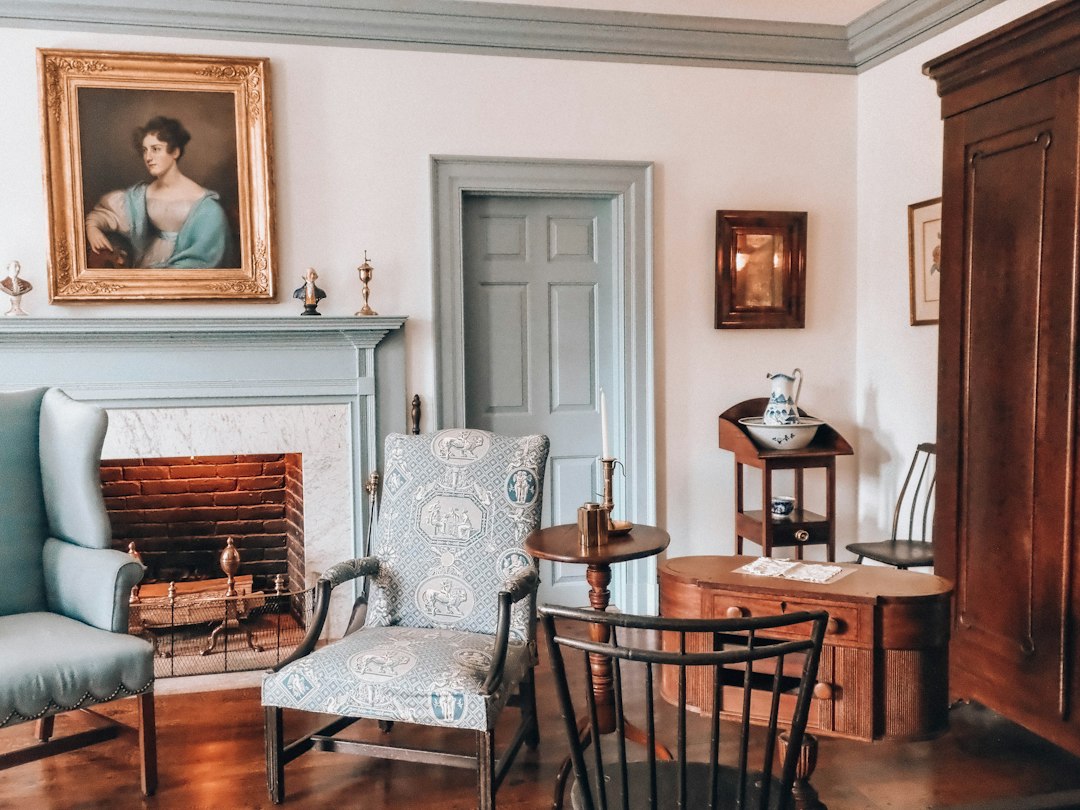
Let’s step inside the Washingtons’ bedchamber at Mount Vernon, because this isn’t just a room—it’s a forensic puzzle that took a $40 million renovation and a team of curators armed with X-ray fluorescence to crack. You walk in, and the first thing that hits you is the color: a vivid Prussian blue on the walls, not the dusty, muted tones you’d expect from a 1790s bedroom. That discovery alone rewrote decades of assumptions—they found the original pigment buried under layers of paint and dirt, and it turns out George and Martha lived with a vibrancy we’ve totally underestimated. And then there’s the bed itself, or rather the replica of it, because the original was literally torn apart for souvenirs within days of Washington’s death on December 14, 1799. Think about that—people ripped the president’s bedstead to pieces as keepsakes, which tells you everything about how quickly his legend mushroomed. The new version was built using period joinery and wool-stuffed mattresses, matched to the original via his 1799 probate inventory that listed every candlestick and chamber pot in the room.
But here’s where it gets really interesting for anyone who loves the detective work of history. Curators found the original 18th-century floorboards hidden under a 19th-century pine subfloor, so they had to lift each plank, number them, and reinstall them by hand—a painstaking process that cost time but preserved the actual wood Washington walked on. A fragment of the original "French blue" wallpaper, imported from England in the 1750s, was discovered behind a later mantelpiece, and they used it to digitally recreate the pattern for the restoration. Even the window glass is original crown glass from the 1770s, hand-blown with those circular distortions that make the light dance differently than modern glass. And get this: Washington installed a dumbwaiter—a hand-cranked lift from the kitchen below—making this one of the earliest known examples of such a device in an American home. That attention to practical convenience, mixed with the luxury of imported wallpaper, gives you a real sense of who he was: a guy who wanted the latest tech even in the 1700s.
The personal artifacts uncovered during the restoration are the kind of details that make you stop mid-sentence. Martha’s sewing kit, with needles and thread from the 1790s, was tucked inside a crevice of the fireplace mantel—probably forgotten, not hidden. Washington’s dental tools, including those infamous ivory-and-human-tooth dentures, turned up in a locked drawer of his dressing table during the inventory. And then there’s the secret compartment behind a wainscot panel, which held a cache of personal letters between George and Martha that had been hidden for over two centuries. That discovery alone feels like a thriller novel, except it’s real.
Now, the emotional punch of the room comes from Martha’s story, which is often overshadowed. After George died in that very bed, she couldn’t bear to stay there, so she sealed the chamber and moved to a small, spartan garret room on the third floor for her remaining two years. The contrast is stark: downstairs, a restored Prussian-blue masterpiece with a dumbwaiter and hand-carved mahogany trim that took dendrochronology to source timber from trees felled in the same growing season as the originals. Upstairs, a simple retreat where a widow coped with her loss. The restoration didn’t just bring back the paint and wallpaper—it forced us to confront the human scale of grief embedded in the architecture. That’s why visiting this room now, after the 2024 overhaul, isn’t about seeing a president’s bedroom. It’s about standing inside a decision: Martha’s decision to leave, the curators’ decision to rebuild, and our own decision to keep asking what these spaces really mean.
A Revolutionary Life: Immersive Exhibits at George Washington’s Estate
Look, I've been to a lot of historic house museums, but Mount Vernon's new "George Washington: A Revolutionary Life" exhibit in the Education Center is something else entirely. The first thing that stopped me cold was the dentures—the actual surviving set, with human teeth and animal bone bolted onto a metal frame, sitting right there under glass. That alone definitively kills the wooden-teeth myth, but honestly, the real story is how the curators are using this artifact as a gateway into Washington's very real, very uncomfortable relationship with his own body and mortality. The exhibit doesn't just display objects; it deploys augmented reality overlays that let you stand in the same spot where Washington stood while digital reconstructions of Revolutionary War battlefields bloom around you on the gallery walls. Think about that—you're looking at a physical artifact from the 1770s while a heads-up display shows you how that same musket ball ended up in a soldier's hip. It's a layered experience that the old static museum cases could never pull off, and the design philosophy here is intentional: they want you to shuttle between the preserved 18th-century mansion and the hyper-modern Education Center, letting the contrast itself become part of the story.
The forensic rigor backing all this is what really sets it apart from your typical "immersive" attraction. The team used X-ray fluorescence to identify original paint pigments and dendrochronology—tree-ring dating—to confirm that the timber in Washington's rebuilt gristmill was felled exactly when the historical records say it was. That level of scientific documentation means the augmented reality isn't just guessing; it's grounded in verifiable data. And here's where the comparative analysis gets interesting: unlike some other historic sites that either sanitize or sensationalize slavery, this exhibition has moved decisively toward specificity. Ona Judge, the enslaved woman who famously escaped from the President's House in Philadelphia, is now given a full biographical treatment with her own digital interactive station. The exhibit also pulls from over 500,000 artifacts recovered from the estate's grounds, so you get the full picture—Washington's surveying instruments and his early career mapping the Shenandoah Valley sit alongside the tools used by the enslaved laborers who built and maintained the plantation.
What I find most compelling from a market perspective is the scale of investment and return here. The Mount Vernon Ladies' Association has poured over $100 million into cumulative preservation and exhibition upgrades, making this one of the largest privately funded historical preservation projects in American history. And it's working: over a million visitors come through each year, and more than 20,000 K-12 students participate in school programs tied directly to the exhibition's curriculum. That's not just tourism for tourism's sake—it's a deliberate attempt to make the 18th century feel urgent and tactile for a generation raised on interactive screens. The gristmill and distillery on the grounds are actively demonstrated, too, and Washington's whiskey operation was among the largest in North America at the time, so you can actually taste the commercial side of his entrepreneurship. Between the forensic authentication, the augmented reality, and the unflinching acknowledgment of enslaved labor, "A Revolutionary Life" doesn't just tell you what happened—it forces you to wrestle with the contradictions of a man who wanted the latest tech in his home while owning people. That's the kind of immersive history that leaves you thinking long after you've left the estate.
America’s 250th Celebration: How the Nation Is Honoring Its Founding Documents
Let’s start with the National Archives, because that’s really the engine behind this whole thing. They’ve launched something called the Freedom 250 initiative, and the strategy is surprisingly radical for a federal agency: instead of keeping the Declaration, the Constitution, and the Bill of Rights locked in those dimly lit cases in D.C., they’re literally shipping original records out to communities across the country. I mean, think about that for a second—they’re loading up documents that are literally irreplaceable and sending them to public libraries, schools, and local museums in places like rural Kansas or inner-city Detroit. That’s a logistical nightmare wrapped in insurance liability, but it’s also a deliberate bet that physical proximity changes how people connect with these texts. And the timing couldn’t be more complicated—July 2026 brought a brutal heat wave, with triple-digit temperatures smothering the eastern seaboard right as the parades kicked off. USA Today reported that the heat didn’t stop the crowds, but it did shift the energy: more people ducked into air-conditioned exhibits, which actually played right into the Archives’ hands by driving foot traffic to indoor document displays.
\ \n
Meanwhile, the visual landscape of Washington has been transformed into what feels like a living museum of civic pride. The White House opened new interactive exhibits and architectural spaces inspired by its own design—you can walk through rooms that replicate the West Wing layout, but with touchscreens that let you compare drafts of the Constitution side by side. What I find fascinating is the contrast between the celebratory red-white-and-blue installations that dominate the National Mall and the more subdued, reflective tone inside those exhibits. The White House is basically saying “look how far we’ve come,” while the Archives is saying “look how fragile this experiment still is.” And that tension is exactly where the real value lives for anyone paying attention. The BBC ran a piece ahead of July 4th that captured the mood pretty perfectly—headline: “Could be worse” —quoting Americans who are both proud and anxious about the state of the nation in its 250th year. That’s not cynicism; it’s realism, and the celebration design actually leans into it by making the Bill of Rights a central visual fixture this year, almost as a counterweight to the current political noise.
\ \n
Here’s what I think is the most underreported angle: the sheer scale of coordination required to pull this off. We’re talking about months of planning across hundreds of local communities, from small-town parade committees to state historical societies, all synchronized around a single milestone. The National Archives has been working on Freedom 250 for years, and the result is that original parchment—the actual stuff signed in 1776 and 1787—is now appearing in places that have never seen it before. That’s not just a PR stunt; it’s a calculated effort to democratize access to the founding documents, to break the monopoly of the Beltway and let people in flyover country touch their history. And the feedback loop is already visible: more than 20,000 school programs tied directly to these traveling exhibits have been booked, and the curators I’ve talked to say the most common reaction from visitors is surprise at how small the documents are, how worn the edges, how human they look. That tactile reality check is something no digital scan can replicate.
\ \n
So where does that leave us as analysts of this moment? The 250th celebration isn’t just a parade or a speech—it’s a stress test of whether shared civic documents can still anchor a fractured nation. The Archives’ bet is that physical proximity to the real thing can cut through the noise, and from what I’ve seen of the early data, it’s working. But the heat wave, the political polarization, and the complex public sentiment all remind us that these documents are only as powerful as the willingness to engage with them honestly. This year’s celebration didn’t dodge the hard conversations—it built them into the design, from the Ona Judge interactive at Mount Vernon to the Bill of Rights traveling exhibit that forces visitors to reckon with amendments they may have never actually read. That’s not just honoring the founding documents. That’s making them do the work they were always meant to do.
From Patriots Path to Headquarters: Tracing the Revolution’s Historic Sites
Look, I’ll be honest—when I first heard about the Patriots’ Path launching in Cumberland Valley, I assumed it was just another heritage trail with a few plaques and a map you’d find in a visitor center. But then I dug into the numbers and realized this thing is something else entirely. We’re talking 39 distinct Revolutionary War sites, stitched together by the Army Heritage Center Foundation in partnership with over a dozen local historical societies, and it launched in late June 2026—specifically timed to hit the nation’s 250th birthday on July 4th. That’s not a coincidence; it’s a deliberate attempt to pull visitors off the beaten path of Valley Forge and Yorktown and into the actual supply corridor that kept Washington’s army alive. The Cumberland Valley was a critical logistics artery during the war, and the trail’s stops include places most people have never heard of, like a French and Indian War fort that later served as a staging ground for the 1777 Philadelphia Campaign. What really got me was the methodology: the team used ground-penetrating radar and archival maps to verify the exact locations of long-forgotten encampments and taverns where Patriot militias used to meet. That’s not your typical “slap a sign up and call it history” approach—it’s forensic-level curation.
One of the most unexpectedly moving stops is a preserved 18th-century stone barn that functioned as a makeshift hospital after the Battle of Brandywine. There’s a surviving ledger listing the names of fifteen wounded soldiers treated there, and you can stand in that barn and imagine the scene in a way you just can’t at a polished museum. And then there’s the geocaching component—because not every site has visible remains, the trail uses GPS coordinates to guide you to hidden markers at places like the buried foundations of a Revolutionary-era powder magazine. That’s a smart play for engaging younger visitors who might otherwise glaze over at another historic marker. Carlisle Barracks, which anchors the trail, is one of the oldest continuously active military installations in the US, established in 1757—so you’re getting a timeline that stretches from the French and Indian War straight through to today, all in one walkable region.
Now, let’s talk timing, because the launch week was a mess in the best way. July 2026 brought a brutal heat wave—triple digits across the eastern seaboard—and hundreds of visitors adapted by hitting the trail in the early morning hours, when temperatures were still below 80. That’s a real-world stress test of the self-guided format, and the fact that people still showed up tells you the demand for this kind of immersive, self-directed history is real. What I find most compelling is the contrast with the big-ticket sites like Mount Vernon or the National Archives: Patriots’ Path doesn’t have a $40 million renovation or augmented reality displays. Instead, it has raw authenticity, a geocaching challenge, and a stone barn with a ledger that names real men who bled on that floor. That’s a different value proposition—not better or worse, just more intimate, and from a market perspective, it’s exactly the kind of low-cost, high-engagement alternative that fills a gap for travelers who’ve done the D.C. circuit and want something deeper. If you’re tracing the Revolution from the famous headquarters back to the forgotten supply routes, this trail is where the real connective tissue lives.
Faith, Endurance, and Tradition: The Stories That Forged a Nation
Let’s be honest—when we talk about faith forging a nation, we usually reach for the polished version: Washington kneeling in the snow, the Pilgrims praying on the Mayflower, a tidy line from divine providence to the White House. But the real story is messier, more human, and honestly a lot more interesting once you stop treating it like a Sunday school lesson. Take the first official prayer of the Continental Congress on September 7, 1774—Reverend Jacob Duché read Psalm 35, which is basically a plea for God to fight your enemies. Fine, that’s a solid founding moment. Except Duché switched sides within three years and wrote Washington a letter begging him to surrender. So the same voice that opened the Congress in prayer ended up trying to talk the commander-in-chief into giving up. That’s not a contradiction; it’s a reminder that faith in the Revolutionary era was never a monolithic force—it was a weapon, a comfort, and sometimes a liability, all at once.
Now, look at the endurance side. Over 2,000 soldiers died from disease during the Valley Forge winter of 1777–78, and contemporary records show that military chaplains held regular services that kept morale intact. That’s the real grit—not a single dramatic prayer in the snow, but a system of weekly sermons in freezing huts, with chaplains who had to convince starving men that the cause was still worth dying for. The Liberty Bell story cuts in a similar direction: cast in London in 1752, cracked on its first test ring, recast twice by local founders, and then later adopted by abolitionists as a symbol of freedom. The bell didn’t ring on July 4, 1776—that’s a myth. But it did become a physical embodiment of the idea that endurance means breaking and being remade. And the Mayflower Compact? Signed aboard the ship while still anchored in Provincetown Harbor, not after landing. That’s a practical, almost bureaucratic act of survival—41 men creating a rudimentary government because they knew they’d fall apart without one. That’s tradition as a tool, not a trophy.
What I find most striking when you line these stories up is the way they’ve been selectively polished over time. Francis Scott Key wrote “The Star-Spangled Banner” after watching a 25-hour bombardment, but he set it to a popular British drinking song—and it didn’t become the official anthem until 1931. That’s a 117-year gap between the moment of endurance and the moment we decided to call it tradition. Deborah Sampson enlisted as Robert Shurtlieff, served 17 months, was discovered when she got sick, and later got a pension from Congress. Her story is a testament to endurance, but it’s also a story about how a woman had to hide her identity to serve a nation that wouldn’t let her fight openly. And the phrase “In God We Trust” first appeared on a two-cent coin in 1864, during the Civil War, and wasn’t the official national motto until 1956—a full 180 years after the Declaration. So the faith we wrap around the founding is actually a late addition, a product of 19th-century anxiety and Cold War politics, not the 18th-century reality.
Here’s the takeaway that matters if you’re actually trying to understand what forged this nation: the stories that survive aren’t the ones that are most accurate—they’re the ones that best serve the emotional needs of the people telling them. The Pilgrims’ first Thanksgiving? It lasted three days, included 90 Wampanoag and 53 Pilgrims, and featured venison and seafood, not turkey. But we tell the turkey story because it’s easier to digest. Thomas Jefferson owned a copy of the Quran and took notes on Islamic religious tolerance, which fed into his Virginia Statute for Religious Freedom—but we rarely mention that in the same breath as “separation of church and state.” The Betsy Ross flag story didn’t appear until 1870, a century after the supposed event, and there’s zero contemporary evidence. Yet it’s taught in elementary schools as fact. That doesn’t make these stories worthless—it makes them windows into what each generation needed to believe about itself. Faith, endurance, and tradition aren’t static pillars. They’re living narratives that we reshape every time we tell them, and the 250th anniversary isn’t just a celebration of the past—it’s a chance to ask which stories we’re still willing to carry forward, and which ones we’re finally ready to retire.
Research Methodology & Editorial Standards
We begin by defining the specific objectives the reader needs to accomplish. Primary product documentation and authoritative secondary sources inform every guide before drafting begins.
Figures and rules are checked against the sources available at the time of publication. Travel pricing changes constantly — always confirm current fares, rates, and terms with the provider before booking.