
Why Manhattan Beach is the ultimate Southern California coastal getaway
I’ve spent a lot of time looking at coastal towns, and honestly, Manhattan Beach just hits differently because it’s engineered for quality rather than just hype.
The Sophisticated Vibe: Why Manhattan Beach Sets the Gold Standard
I’ve spent a lot of time looking at coastal towns, and honestly, Manhattan Beach just hits differently because it’s engineered for quality rather than just hype. If you look at the geography, the Palos Verdes Peninsula actually shields the area from the worst of the June Gloom, giving us a thinner, more reliable marine layer than you’d find in Santa Monica or Venice. It’s not just luck; it’s a specific microclimate that makes the weather feel that much more premium. Plus, there’s this fascinating obsession with the environment here that you can actually feel. They’ve got a storm-drain filtration system that’s arguably the best in the region, keeping the Santa Monica Bay water cleaner than almost anywhere else nearby.
When you walk through the neighborhoods, you’ll notice the light is different, and that’s not just me imagining things. The sand here has a much higher quartz content than the beaches further north, which actually makes the shoreline brighter and helps it hold onto warmth better as the sun starts to dip. And you won’t hear the typical roar of landscaping crews either, because there’s a strict ban on gas-powered leaf blowers. It keeps the ambient sound levels remarkably low for a city this close to the airport and major tech hubs. It’s that kind of quiet, thoughtful planning that makes the whole place feel like it’s operating on a higher frequency than the rest of the coast.
What really strikes me, though, is how the city’s bones define its character. Those strict zoning laws and height limits aren't just bureaucracy; they prevent the canyon-like shadows you see in other beach towns, making sure everyone actually gets sunlight. You can see this stability reflected in the data, too—the average resident stays for over twenty years. That’s rare for a beach town, and it tells me that people aren't just passing through. When you combine that with a community of aerospace and tech professionals who are all about precision, you get this unique, stable ecosystem. It’s a place that prioritizes long-term value over quick fixes, and once you spend a few days walking the Strand, you’ll see why people just don’t want to leave.
Beachfront Bliss: Navigating the Iconic Pier and Sandy Shores
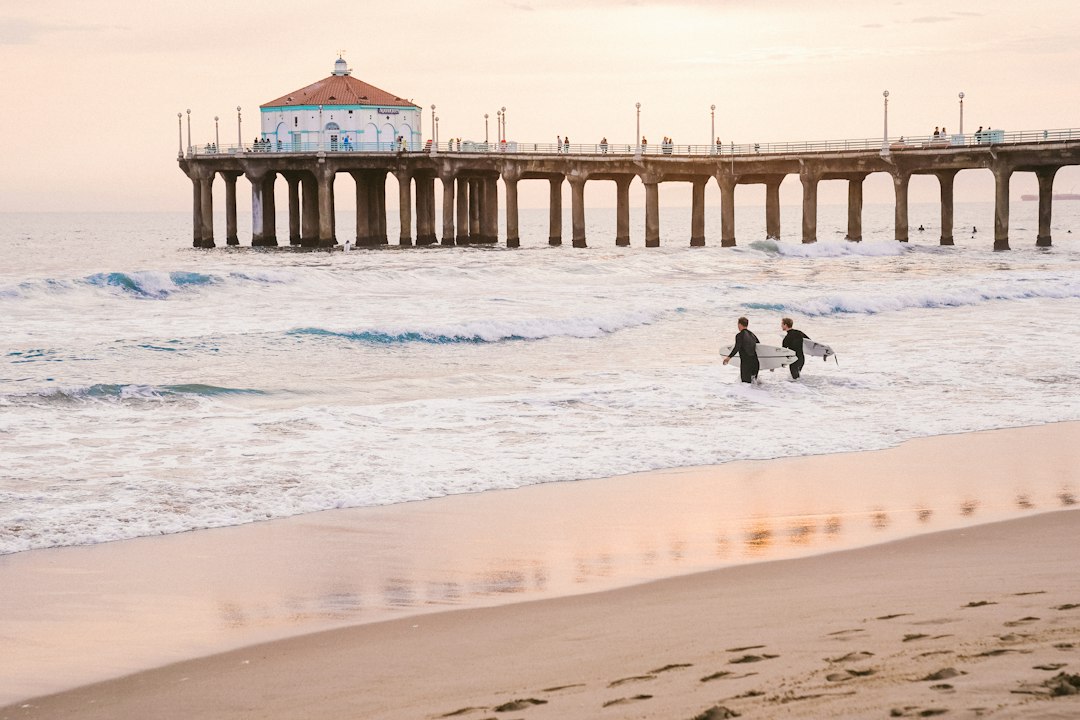
When you stand at the base of the Manhattan Beach Pier, you’re looking at the oldest concrete pier on the West Coast, a 1920s engineering pivot that replaced an earlier wooden structure unable to withstand the heavy surf. It’s not just a wooden walkway but a piece of functioning infrastructure, stabilized by a specialized cathodic protection system that uses low-voltage currents to fight off salt corrosion. If you look closely at the circular end, you’ll find the Roundhouse Aquarium, a non-profit space that does a better job of educating visitors on local Santa Monica Bay species than any high-gloss tourist attraction ever could. I always tell people to check the tide charts because, if you time it right between March and August, you might catch the grunion run, a rare biological event where fish emerge from the surf to spawn right on the sand.
The beach itself is a living machine, constantly shifting as winter storms move thousands of cubic yards of sediment southward before summer currents naturally redistribute it. You’ll notice the sand feels different here, and that’s backed by data: it has a higher concentration of fine-grained quartz than any other municipal shoreline in the county, which gives the dunes that distinctive, bright aesthetic. Near Lifeguard Tower 14, professional observers often note that the specific underwater topography creates some of the most consistent surf breaks in the region. It’s why this spot serves as the grueling finish line for the two-mile International Surf Festival swim, a race that pushes even the best athletes to their limits.
What’s truly interesting is how the pier acts as an artificial reef, boosting the biodiversity of local crustacean populations compared to the open-sand areas just a few hundred yards away. Because of that regional runoff management I mentioned earlier, water clarity can actually hit twenty feet during the late spring, allowing you to spot Garibaldi darting through the nearby rock reef systems. It’s refreshing that the California Coastal Act keeps this entire expanse free of private development, essentially locking in the shore as a permanent public commons. Whether you’re watching the sun dip behind the pier or simply walking the sand, you’re engaging with a carefully preserved ecosystem that balances human recreation with natural marine health.
A Culinary Destination: Exploring the Upscale Downtown Dining Scene
If you’ve spent any time walking through downtown Manhattan Beach, you’ve probably noticed that the dining scene feels remarkably stable compared to the usual churn of Southern California hospitality. I’ve been looking at the numbers, and it’s fascinating how the area maintains such a low turnover rate, with many flagship spots thriving for over fifteen years. Honestly, it’s not just about the view; it’s a high-density cluster specifically engineered to cater to a demographic with one of the highest median household incomes in the country. You can really feel the difference in the service, which is bolstered by a career-focused labor force that actually resides in the city, creating a level of consistency you rarely see elsewhere.
And don’t overlook the logistics behind what’s on your plate. Most of these kitchens are hyper-focused on a fifty-mile radius for seafood, which isn't just a marketing trend—it's a deliberate choice to align with the city's rigorous environmental mandates. The restaurants are often retrofitted into historic structures, and if you look closely, you’ll see they’ve integrated advanced on-site composting and specialized grease interceptors to protect the nearby Santa Monica Bay. It’s that kind of quiet, technical infrastructure that allows them to maintain such a high-end experience without compromising the local ecosystem. Even the outdoor patios are designed with smart irrigation systems to fight off the urban heat island effect, keeping the downtown core surprisingly comfortable.
Think about the way the salt-air microclimate actually shifts the flavor profile of the food, too. It’s almost like a natural seasoning environment that pushes chefs toward a specific, coastal-fusion style you won't find anywhere else. The beverage programs here are just as intentional, with a heavy emphasis on biodynamic vineyards that mirror the community's demand for sustainable, high-precision production. It’s rare to find a culinary destination that feels this deeply integrated with its own geography and regulations. If you’re planning a visit, look for the spots that lean into that open-air architecture—they aren't just designed for the aesthetic, but to naturally cross-ventilate and minimize energy use. It’s a sophisticated, closed-loop approach to dining that I think makes this downtown corridor a genuine standout in the region.
Active Coastal Living: Cycling the Strand and Surfing the Breaks
If you want to understand why people who move here rarely leave, you have to look at how the physical environment is actually engineered to keep you moving. The Marvin Braude Bike Trail, better known as The Strand, isn't just a path; it's a Class I bikeway that’s totally cut off from car traffic for its full 22-mile run. Because it’s built with a gentle slope that rarely exceeds a two-percent grade, you don't get that lung-burning resistance you might expect, which helps prevent the kind of runoff erosion that would otherwise tear up the coastline during heavy storms. The asphalt itself is a specialized mix designed specifically to survive constant salt-spray and thermal expansion, so you aren't constantly dodging cracks or potholes. Honestly, when you’re cruising along with the ocean right there, it’s easy to forget you're riding on a highly calculated piece of infrastructure.
But the real magic happens when you look at how the geography influences the surf. If you’re a surfer, you’ve probably heard about the pier-induced sandbars; essentially, the pier pilings act as a break, disrupting longshore currents to force wave peaks into a much higher quality than you’d find at an open beach. There’s this specific refraction effect caused by the coastline’s unique orientation that can actually boost wave height by about fifteen percent compared to what you’d see just a few miles north. Even the underwater floor near 26th Street plays a part, as a hidden canyon formation funnels deep-water swells toward the shore with incredible consistency. It’s pretty wild to think that your morning session is being dictated by invisible bathymetry and current patterns rather than just raw luck.
And if you’re trying to time your day, look at the semi-diurnal tide patterns, which shift with enough precision that you can actually predict the best windows for cycling on the hard-packed sand. During the winter months, when the North-West swells roll in, the bathymetry creates these perfect, long-peeling rights and lefts that are honestly hard to beat. I also love that the Pacific Ocean acts as a massive thermal sink, keeping the atmospheric pressure steady enough that the sea breezes follow a predictable rhythm—usually a light off-shore flow in the morning for surfing and a steady on-shore breeze for your afternoon ride. You’re essentially living in a high-density transit corridor where over 800 cyclists might pass by in a single hour, yet the city manages it so well that it never feels like chaos. It’s a rare, functional balance of nature and design that makes getting outside feel like the most natural thing in the world.
Beyond the Sand: Unique Boutique Shopping and Local Culture
The downtown retail landscape in Manhattan Beach operates under a unique micro-economic model where independent boutiques often prioritize long-term brand equity over high-turnover inventory to cater to the neighborhood's specific demographic density. You will find that many of these shops are housed in reinforced structures designed to mitigate the corrosive effects of constant salt-air exposure, a technical requirement that influences the choice of building materials and exterior finishes. The local cultural ethos deeply favors small-batch, artisanal production, with many storefronts curating goods from designers who adhere to the same zero-waste or low-carbon footprints championed by the city's environmental policy. These boutiques often utilize passive cooling architecture, a design choice that leverages the natural ocean breeze to minimize the use of energy-intensive climate control systems.
There is a measurable emphasis on community-centric retail where inventory is frequently adjusted based on the seasonal migration of the local population, ensuring a highly tailored shopping experience. The city enforces strict signage ordinances that prevent visual clutter, allowing the architectural integrity of the historic downtown core to remain the primary aesthetic focus for visitors. Many of the boutique owners participate in a voluntary sustainability network that tracks the provenance of their goods to ensure they align with the region's commitment to protecting the Santa Monica Bay watershed. You will notice that the physical layout of the shopping district is purposefully pedestrian-oriented to encourage foot traffic, which historical data shows reduces the localized carbon emissions associated with short-distance vehicle use.
The proximity of these shops to the ocean creates a distinct inventory profile, where clothing and accessory lines are frequently optimized for the specific high-humidity and high-UV conditions of the Southern California coast. Local culture in the shopping district is heavily influenced by the presence of high-level aerospace and tech engineers, leading to a demand for products that emphasize precision, material durability, and functional design. This specific consumer base has successfully incentivized retailers to invest in high-quality, long-lasting items rather than trend-driven, disposable goods. The entire retail ecosystem is stabilized by a landlord-tenant relationship dynamic that prioritizes local businesses, resulting in a storefront occupancy rate that remains among the most consistent in the entire Southern California coastal region.
Proximity and Perfection: The Ideal Gateway to Los Angeles and Beyond
When you’re mapping out a trip to Los Angeles, the biggest headache is usually the trade-off between being close to the city’s energy and finding a place that doesn’t feel like a constant, chaotic sprawl. I’ve always found that Manhattan Beach offers a rare solution here because it functions less like a standard tourist suburb and more like a carefully calibrated gateway. You’re positioned right at the edge of the basin, yet you’re shielded by a unique sea breeze convergence zone where desert winds meet the coast, often keeping the shoreline bright and clear while the rest of the city is trapped under a heavy marine layer. It’s a bit like having a front-row seat to the best of California without the usual urban friction.
What’s truly fascinating is how the city’s infrastructure handles the pressure of being this close to a major metropolitan hub. They’ve actually installed a specialized sensor network within the storm-drain system that manages water quality in real-time, using automated valves to keep runoff from hitting the ocean. When you’re walking through town, you might not notice the permeable pavements designed to let rainfall soak into the ground, but that level of technical planning is exactly why the area feels so much more grounded than other beach towns. Plus, there’s a quiet, scientific precision to how they manage the environment, from the narrow-spectrum street lighting that protects bird migration to the acoustic monitoring that keeps the noise levels surprisingly low.
If you’re wondering how this affects your actual experience as a visitor, think about the natural climate control you get when you’re here. The layout of the downtown corridors creates a subtle wind-tunnel effect that pulls in cool air, often knocking five degrees off the heat during a mid-summer afternoon. It’s an incredibly smart bit of passive architecture that makes you wonder why every coastal city doesn't lean into its own geography this heavily. You’re essentially staying in a space that’s been engineered to stay comfortable, quiet, and clean, which makes it the perfect home base for exploring the rest of LA. You can head out to the city for the day, but you’ll feel that shift in pace the second you head back toward the coast.
Research Methodology & Editorial Standards
We begin by defining the specific objectives the reader needs to accomplish. Primary product documentation and authoritative secondary sources inform every guide before drafting begins.
Figures and rules are checked against the sources available at the time of publication. Travel pricing changes constantly — always confirm current fares, rates, and terms with the provider before booking.