
How to Avoid Jellyfish Stings During Your Next Tropical Beach Vacation
Think of local water reports as your own personal early-warning system before you head out to the beach.

Understanding Jellyfish Behavior and Seasonal Risks
I’ve spent a lot of time looking at how ocean life responds to changing conditions, and honestly, the way jellyfish operate is far more calculated than most people realize. You might think they’re just mindless blobs drifting with the tide, but they’re actually highly sensitive to their environment, especially when the mercury starts to climb. Jellyfish populations are incredibly reactive to water temperatures, and when the thermometer hits that 78 to 86-degree range, it effectively acts as a switch that triggers their reproductive cycles. This leads to those massive blooms we see between May and October, which are often fueled by surges in plankton that act as a primary food source. It’s not just about the heat, either; these creatures are surprisingly good at detecting one another, meaning they can actively coordinate their movements rather than just floating aimlessly.
If you’re planning a trip, keep in mind that they aren't confined to the open ocean. They frequently thrive in brackish waters where changing sea levels have altered salinity, meaning they can show up in places you might not expect, like river estuaries. Data tracking jellyfish hazards from 1960 through 2019 shows a clear upward trend that mirrors shifting climate patterns, which suggests we’re seeing them in more places, more often. It’s also a common mistake to assume that a jellyfish needs to be alive to hurt you. Their stinging cells operate on a mechanical trigger, so even a detached tentacle or a creature that looks like it’s been stranded on the sand for hours can still deliver a nasty sting if you brush against it.
Think of local water reports as your own personal early-warning system before you head out to the beach. Since these animals rely on specific environmental cues like water temperature and nutrient-rich runoff to decide where to congregate, monitoring those conditions can give you a pretty good idea of the risk level before you even get your feet wet. I’ve found that by ignoring the old myth of the passive drifter and instead treating them as active, temperature-dependent organisms, you can make much smarter calls about when to swim. It really comes down to recognizing that these creatures have spent millions of years perfecting their survival, and they’re experts at capitalizing on the exact conditions that make a tropical beach vacation feel perfect to us. Knowing the environment they thrive in is your best bet for staying sting-free.
Essential Protective Gear: Wetsuits, Rash Guards, and More
If you’re heading into waters where jellyfish are a concern, you need to think of your gear as your primary defense system rather than just a way to stay warm or look good. Neoprene wetsuits act as a heavy-duty physical barrier because those tiny jellyfish stinging cells, or nematocysts, simply aren't long enough to penetrate that dense, closed-cell foam. Even if you're in tropical water where a thick suit feels like overkill, a full-body stinger suit made from thinner lycra gives you full mobility while maintaining that critical barrier. I’ve found that the real secret is the fabric's surface; high-quality rash guards made from tight-knit nylon or polyester actually decrease the friction coefficient, which makes it much harder for a wandering tentacle to latch on and fire its barbs.
When you're shopping, keep an eye out for a UPF 50+ rating, as that tight weave is what blocks both UV rays and those microscopic stingers. It’s a common mistake to think that thickness is the only thing that matters, but even a thin, long-sleeve rash guard with flatlock stitching does a great job of preventing barbs from ever finding purchase on your skin. I usually recommend wearing a rash guard under your wetsuit, too, because that extra layer creates an air-trapping boundary that makes it even harder for toxins to reach your body. Plus, it makes pulling that wetsuit on and off a whole lot easier after a long day in the surf.
If you’re really serious about protection, especially in areas where box jellyfish are known to hang out, you might want to look into full-body suits that include integrated gloves and socks. A one-piece suit is honestly mathematically superior to a two-piece setup because it gets rid of that gap at your waistline where water—and loose nematocysts—can easily sneak in and hit your torso. I also love that modern synthetic materials like spandex are hydrophobic, meaning they won't absorb water and hold that venom against your skin like a sponge would. Just remember that long sleeves are non-negotiable; they provide a consistent barrier that stops you from accidentally transferring venom from your gear to your face or neck when you're finally done for the day.
How to Spot and Avoid Jellyfish While Swimming
Visual scanning for jellyfish is most effective when the sun is at a high angle, but keep in mind that the glare bouncing off the surface can actually hide what’s lurking just beneath the waves. Honestly, investing in a pair of high-quality polarized sunglasses isn't just about looking cool; they’re an essential tool for cutting through that surface reflection to spot potential threats before you dive in. You should also watch the horizon for telltale signs, as the presence of seabirds diving in a concentrated area often signals a massive bloom just below the surface. If you notice small baitfish suddenly changing direction or clearing out of an area entirely, take it as a serious warning that a swarm might be nearby. It's a bit like reading the room—when the local wildlife is fleeing, you probably should be, too.
You’ve also got to be mindful of the wind and the moon, which play a bigger role in jellyfish movement than most people realize. Because they’re passive drifters, they tend to pile up along leeward shorelines where surface currents pin them against the beach, so I’d suggest checking the wind direction before you pick your swimming spot. The moon is just as important; stronger tides during new or full moons often act like a conveyor belt, transporting these creatures from deeper water directly into your swimming zone. I’ve learned the hard way that a calm, clear day doesn’t always mean the water is safe. If you’re swimming in a group, remember that all that extra splashing and body heat creates a sensory footprint that can actually attract them, so keep your movements smooth and steady.
If you’re out for a swim, try to avoid areas with heavy coastal runoff after a storm, as the influx of nutrients creates a buffet that jellyfish love to camp out in. It’s also worth noting that some species are so transparent they become practically invisible during the day, so try looking for subtle refractions or distortions in the water rather than trying to spot the jellies themselves. And here is a pro tip I always swear by: wear a nose plug. It sounds minor, but it’s a brilliant way to stop you from accidentally inhaling microscopic, broken-off stinging cells that linger in the water column even when you can’t see a single jellyfish around. It’s all about staying aware of those hidden cues so you can stay focused on the swim instead of worrying about what’s bumping into your legs.
Why You Should Never Touch or Step on Jellyfish on the Sand
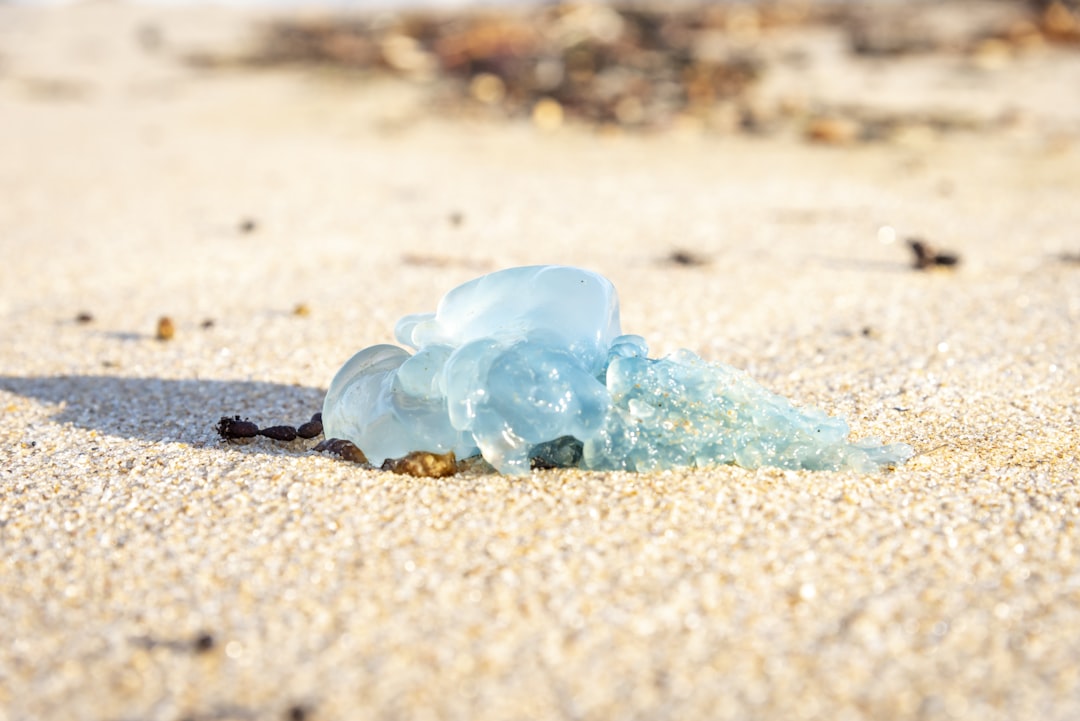
Look, I know the temptation to poke at that weird, blob-like thing washed up on the tide line is real, especially if you’ve got kids who are curious about everything the ocean drops off. But let’s be clear: you need to treat every single jellyfish carcass on the sand as if it’s still fully armed and dangerous. It’s easy to assume that because the creature isn't moving or looks shriveled, the threat has passed, but that is a massive mistake. The stinging cells, or nematocysts, don’t care if the jellyfish is alive or dead; they operate like tiny, spring-loaded biological landmines that are triggered by simple mechanical contact.
Here is the reality of what’s happening at a microscopic level. Those cells are waiting for pressure, and the act of stepping on them—even if the jelly has been drying out in the sun for hours—provides exactly the force they need to fire. Because these capsules rely on osmotic pressure rather than a central nervous system, they can remain volatile for up to 24 hours after death, turning a seemingly harmless piece of debris into a potent delivery system for toxins. If you brush against a fragment or step on one with your bare heel, you aren't just getting a single sting; you’re often triggering thousands of these microscopic barbs at once. It’s a concentrated dose that can lead to a much more severe systemic reaction than you’d expect from a piece of "dead" tissue.
And here is where things get even more frustrating for beachgoers. If you do accidentally step on one, your natural instinct might be to rub the spot or wipe it with sand to clear off the residue, but please, do not do that. Rubbing actually acts as an abrasive agent that provides the exact mechanical friction those un-fired cells are looking for, causing them to discharge directly into your skin. It’s a bit like trying to put out a fire with gasoline. Even if the organism looks completely desiccated, the protein-based venom is remarkably stable and won't just break down because of the heat. You're effectively walking through a minefield of invisible, microscopic weaponry that remains active until the tissue has completely decayed, so it is honestly safer to just give any jellyfish remains a wide berth every single time.
Immediate First Aid: The Truth About Treating Jellyfish Stings
When you’re staring down a jellyfish sting, the sheer volume of conflicting advice—from beach lore to outdated medical myths—can be paralyzing. Let’s get one thing clear: your immediate response determines whether you’re just dealing with a painful nuisance or making a bad situation significantly worse. The first thing you need to do is ditch the idea of using freshwater or, heaven forbid, urine. Freshwater triggers those microscopic nematocysts to fire because of the sudden shift in salinity, effectively dumping more venom into your skin just when you’re trying to find relief. Seawater is your only friend here because it maintains the necessary osmotic balance to keep those stingers dormant while you work.
And here is where the science gets really interesting regarding how you actually neutralize the pain. Most jellyfish venom is heat-labile, meaning those protein-based toxins start to break down and denature if you apply water between 110 and 113 degrees Fahrenheit. I’ve seen people reach for ice packs, but honestly, you should avoid that entirely; cold can actually preserve the venom's structure rather than neutralizing the pain-inducing compounds. If you're dealing specifically with box jellyfish, vinegar is a solid choice to deactivate the stinging cells, but be cautious, because for many other species, vinegar can actually act as a chemical trigger that forces the remaining cells to fire. It’s a delicate balance that highlights why knowing your local species matters as much as your gear.
Once you’ve stabilized the area, the physical cleanup is the next hurdle. You should use a pair of tweezers to carefully pluck off any visible tentacles, as even a thin layer of latex on gloves can sometimes provide enough mechanical pressure to trigger a sting. Whatever you do, stop yourself from rubbing the area with a towel or sand, as that friction acts like a stimulant that encourages any remaining cells to dump their entire load of toxin into your tissue. If the sting feels like it's spreading or covering a large surface area like an entire limb, don't play the hero; get professional medical eyes on it immediately to ensure you aren't dealing with a systemic reaction that could overwhelm your system. It’s all about staying calm and using the right chemistry—not just reacting blindly—to get you back on your feet.
Debunking Popular Myths About Jellyfish Sting Relief
We’ve all heard those campfire stories about how to fix a nasty jellyfish sting, but let’s be real: most of what you’ve been told is not only wrong—it’s dangerous. You’ve likely heard the classic "pee on it" advice, but honestly, urine lacks the specific chemical concentration needed to neutralize toxins and its unpredictable pH levels often act as a trigger, forcing more nematocysts to fire into your skin. It’s a total myth that’s been debunked by researchers time and time again, yet it persists because it’s a quick, accessible solution in an emergency. The same goes for reaching for a bottle of fresh water or rubbing the area with sand, both of which are common mistakes that actually accelerate the damage. Fresh water induces osmotic shock in those microscopic stingers, causing them to dump their entire load of venom, while sand or a towel provides the exact mechanical friction the cells are designed to detect.
If you’re looking for what actually works, we have to move past these old wives' tales and focus on the chemistry of the sting. While you might see people reaching for ice packs, don't follow suit; cold temperatures can actually stabilize the venom proteins, keeping that painful inflammatory response going much longer than it needs to. Instead, think of heat as your best ally, as hot water—ideally between 110 and 113 degrees Fahrenheit—helps denature those protein-based toxins to stop the pain at the source. It’s also important to be selective with vinegar, because while it’s a lifesaver for certain species like box jellyfish, it can be a nightmare for others, like the Portuguese man o' war, where it might trigger a massive, painful release of venom. You have to be smart about what you’re putting on your body, as universal remedies simply don't exist in the ocean.
Finally, we need to talk about the "quick fixes" that end up causing more harm than good. Using meat tenderizer is a classic piece of bad advice that just leads to tissue irritation and potential secondary infections on already compromised skin. Similarly, grabbing a razor to shave away stingers is a major red flag, because the simple act of dragging a blade across your skin provides the physical stimulation needed to fire any remaining dormant cells. Even things like alcohol or pressure bandages often do more damage by either triggering the venom or concentrating it in your limb, increasing your risk of a systemic reaction. My take? Stop relying on "hacks" that sound like they belong in a survival movie and stick to the proven science of heat and saltwater rinses. When in doubt, it’s always better to skip the home chemistry experiment and get professional medical eyes on the site to ensure you’re truly out of the woods.
Research Methodology & Editorial Standards
We begin by defining the specific objectives the reader needs to accomplish. Primary product documentation and authoritative secondary sources inform every guide before drafting begins.
Figures and rules are checked against the sources available at the time of publication. Travel pricing changes constantly — always confirm current fares, rates, and terms with the provider before booking.