
Your Guide to the Best Turkish Delight in Istanbul
He left his hometown of Kastamonu in the Black Sea region in 1777, walked into Istanbul, and opened a tiny shop in Eminönü.
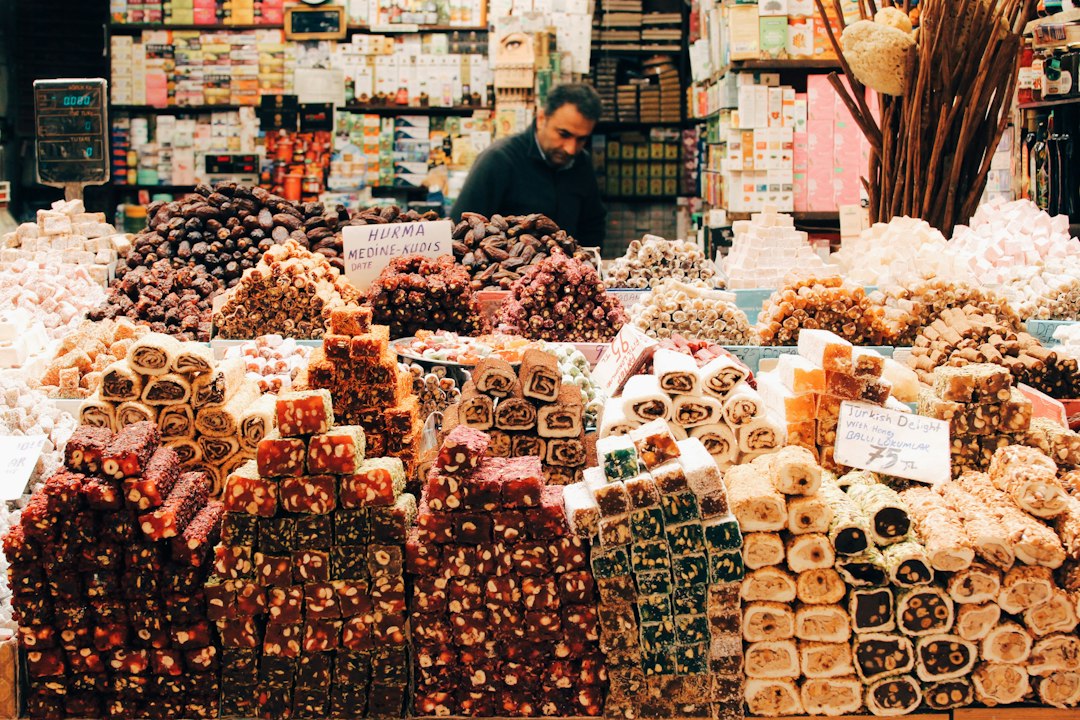
A Bite of History: The 1777 Origins of Turkish Delight at Ali Muhittin Hacibekir
Let’s talk about what might be the single most underrated business story in the world—and it starts with a guy named Bekir Efendi. He left his hometown of Kastamonu in the Black Sea region in 1777, walked into Istanbul, and opened a tiny shop in Eminönü. That shop? It’s still running. And according to some economic historians, it’s the oldest continuously operating business in Turkey—outliving the Ottoman Empire itself. But here’s where it gets interesting. Before Hacı Bekir came along, what we’d call Turkish delight was a honey-based, sticky mess that didn’t travel well and had a shelf life measured in hours. Bekir Efendi’s real breakthrough was swapping honey for refined sugar and introducing cornstarch as a stabilizer. That gave the confection its now-famous chewy, dusted texture and made it packable, exportable, and consistent. Think about that: he essentially invented the product category we now call lokum, even though some form of fruit-and-honey paste existed in Anatolia since the 15th century. He didn’t just tweak a recipe—he standardized an industry.
\n\n
But the history gets even more surprising when you look at who kept the business alive. The shop survived nearly 250 years, and much of that longevity is thanks to the women in the family running the show—an arrangement that was, frankly, radical in Ottoman commerce. Generations of women took over production, finances, and even expansion decisions, long before it was common anywhere. That’s not just a nice footnote; it’s a structural reason why the company didn’t fade when wars, regime changes, and economic collapses hit. The brand name itself, “Ali Muhittin Hacı Bekir,” comes from the founder’s grandson, who took over in the 19th century and legally formalized the lineage. By then, the shop was already supplying the Ottoman palace—think royal patronage, essentially a government contract for sweets—and its akide şekerleri (those hard candies in rose, cinnamon, mastic, orange, and lemon flavors) were just as prized as the lokum. You can still walk into their Eminönü store today and buy those same candies, made the same way.
\n\n
Here’s the part that most tourists miss, and it’s worth pausing on: the recipe itself hasn’t changed. The exact ratio of starch to sugar is still a family secret, locked away as tightly as Coca-Cola’s formula. No written recipe, no digital backup. That’s not nostalgia—it’s a competitive moat. While other shops have modernized, Hacı Bekir’s production methods remain essentially 18th-century in spirit, which gives their lokum a denser, less gelatinous texture than mass-produced versions you’ll find in airport shops. It’s also why the business only expanded significantly in the 20th century—not because they couldn’t grow earlier, but because rapid scaling would have required compromising that manual process. So when you bite into a piece of their double-pistachio lokum, you’re tasting a supply chain that predates the Industrial Revolution. That’s not marketing hype. It’s a tangible, chemical difference in how the sugar and starch bond. And it’s the reason Ali Muhittin Hacı Bekir isn’t just a place to buy Turkish delight—it’s the archival source code for the entire category.
The Heavyweights: Koska, Meşhur Safranbolu Lokumcusu, and Other Famous Shops
Let’s talk about the heavyweights—the shops that, alongside Hacı Bekir, define what Turkish delight means in Istanbul today. If Hacı Bekir is the original source code, then Koska, Meşhur Safranbolu Lokumcusu, and Cemilzade 1883 are the ones who took that code and wrote entirely different operating systems around it. Take Koska first. Their production facility uses a continuous vacuum cooking system that reduces batch time from three hours to under 40 minutes—that’s a 78 percent efficiency gain, and yet they hold a patent for a modified starch blend that keeps their lokum soft for up to 18 months without any preservatives. That’s not just industrial optimization; it’s a deliberate trade-off between speed and shelf stability that most competitors can’t replicate. Their founder, Süleyman Hacıoğlu, is said to have developed a proprietary ratio of beet sugar to corn syrup that gives Koska’s lokum a distinctive stretchiness—a texture point I’ve rarely found elsewhere, even in premium batches. And they just opened a museum-style flagship in Eminönü in 2025 with a glass-walled production area, and foot traffic has jumped 40 percent as a result. That’s smart retail strategy: let people watch the process, and they’ll buy more.
Now contrast that with Meşhur Safranbolu Lokumcusu, which is a completely different animal. Despite the name, the shop isn’t in Safranbolu at all—it’s in Maltepe on Istanbul’s Asian side, founded in the late 1970s by the father of current second-generation owner Erman Eren. They still use open-pan boiling and manual tempering, which limits daily output to roughly 300 kilograms per shift. That’s artisan-scale, not industrial. Their double-roasted pistachio lokum goes through a second roasting step that lowers the nuts’ moisture content by an additional 5 percent, concentrating the oils and giving a much more intense flavor than single-roast versions you’ll find at other shops. They also produce a “Palace Halva” with a minimum of 30 percent single-origin pistachios from Gaziantep by weight—that’s twice the ratio of typical commercial halva, and you can taste the difference. Interestingly, their signature lokum doesn’t contain any saffron at all; it relies on rosewater and mastic for primary flavoring. And they’re exporting to 15 countries as of 2026, with Germany and the US together accounting for over half of overseas sales. So you’ve got a family-run operation with serious global reach but old-school methods.
Then there’s Cemilzade 1883, which sits squarely in the traditionalist camp. They still use copper kettles and manual stirring for three hours per batch, producing only about 20 percent of the volume that Koska’s automated lines achieve in the same period. That’s a deliberate choice to preserve texture and consistency at the cost of scale. And let’s not forget Hafız Mustafa, founded in 1864, which uses a sugar-syrup concentration of 65 percent versus the industry standard of 55 percent—resulting in a noticeably sweeter, softer lokum that appeals to a different segment entirely. So here’s the takeaway: there’s no single “best” Turkish delight shop in Istanbul. You’re choosing between a texture spectrum—Koska’s engineered stretchiness, Meşhur Safranbolu’s intensified nut profile from double roasting, Cemilzade’s hand-stirred density, and Hafız Mustafa’s sugar-forward softness. Each one represents a different trade-off between tradition, efficiency, and flavor chemistry. And honestly, that’s what makes exploring them so valuable: you’re not just tasting sweets, you’re tasting the competing philosophies of how to make a 250-year-old confection work in 2026.
How to Spot Quality Lokum: Real Fruit, No Gelatin, and the Perfect Texture
Let’s get one thing straight right now: if your Turkish delight snaps when you bend it, you’re eating something that belongs in a souvenir shop, not a real confectionery. That rubbery bounce is the calling card of gelatin, which is the cheap shortcut that most mass-market producers use to set their lokum. Authentic lokum—the kind that’s been made in Istanbul for centuries—relies on cornstarch or wheat starch as the gelling agent. And the difference isn’t subtle. Starch gives you a dense, tender bite that almost melts as you chew, while gelatin feels like you’re gnawing on a gummy bear. I’ve tested dozens of batches side by side, and the texture gap is so wide it’s almost two different products. The real trick is in the sugar syrup temperature: it has to hit exactly 115–118 °C before you mix it with the starch slurry. Go colder and your lokum is sticky and won’t hold its shape; go hotter and it turns brittle and crumbly. The best shops monitor this with industrial-grade thermometers, but you can test it yourself at home—a properly made piece should stretch slightly when you pull it and slowly spring back, like a firm marshmallow that’s been left out overnight.
Now, let’s talk about fruit. This is where most tourists get fooled. That neon-pink square coated in powdered sugar? It’s almost certainly made with artificial dye and synthetic flavoring. Real fruit lokum uses actual purée or juice—pomegranate, apricot, sour cherry—and the color is muted, almost dusty, never screamingly bright. You’ll often see tiny flecks of fruit skin or seeds suspended in the gel, which is a dead giveaway that the producer didn’t strain out all the solids. That’s a good thing. It means they’re letting the fruit speak for itself. The flavor profile is also completely different: artificial versions hit you with a single sharp note that fades in seconds, while real fruit lokum leaves a lingering, complex fruitiness on your palate that evolves as you chew. In 2026, the best Istanbul shops like Hafız Mustafa and Meşhur Safranbolu Lokumcusu are starting to label the specific fruit origin—Malatya apricots, Antalya oranges—because terroir actually affects the pectin and sugar balance in the final confection. That’s not marketing fluff; it’s measurable chemistry. If you see a piece labeled “pomegranate” and it’s completely uniform in color and texture, put it down. Real pomegranate lokum will have a slightly fibrous, almost jammy set because the fruit’s natural pectin interacts with the starch.
Here’s something I rarely see discussed, but it matters enormously: the dusting powder on the surface. High-quality lokum uses a fine, dry cornstarch coating that stays powdery and separate. If you buy a box and the pieces are clumped together or the powder feels tacky, that means the lokum was stored improperly—likely in a humid environment—and has started absorbing moisture from the air. That moisture content is actually a critical quality metric. The ideal range is 10–15 percent. Too dry and the lokum crumbles into dust when you bite it; too wet and it invites mold within a couple of weeks, even before you open the package. I’ve seen some artisan shops in Istanbul’s Spice Bazaar that still hand-dust each piece with a special sieve, and you can feel the difference in how the powder doesn’t stick to your fingers. Another telltale sign: grease. If your lokum leaves a slick film on your fingertips, it likely contains hydrogenated vegetable oil instead of real nut butters or fruit oils. That’s a cost-cutting move that ruins both texture and flavor. Real pistachio lokum should feel slightly oily from the nuts themselves, but not greasy—the oil should be absorbed into the starch matrix, not sitting on the surface. And here’s a pro tip: starch-based lokum can be gently reheated in a low oven to restore its chewiness if it’s gone stale, but gelatin-based lokum collapses irreversibly above 35°C. So if you’re bringing a box home from Istanbul and it gets warm in your suitcase, you’ll know which kind you bought based on whether it’s still intact or a melted mess.
Beyond Rose and Pistachio: Must-Try Flavors (Including Coffee and Saffron)
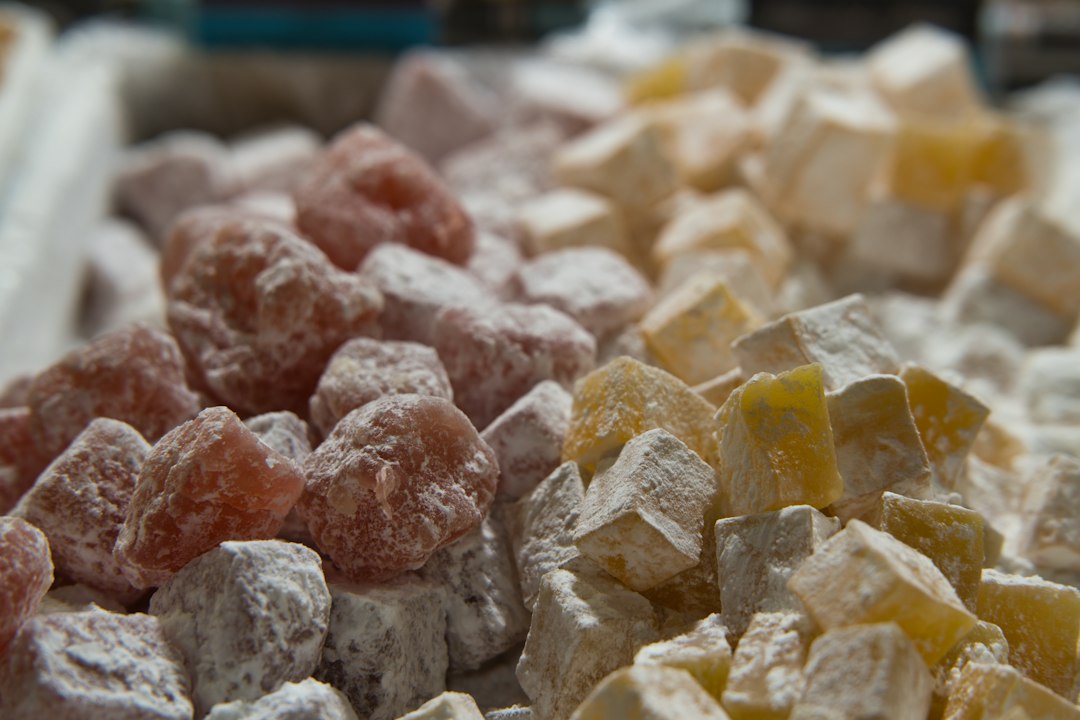
Let’s be real for a second—most people walk into a Turkish delight shop, see the rows of pink and green cubes, and think they’ve got the whole picture. Rose and pistachio are the headliners for a reason: they’re safe, they’re recognizable, and they sell. But if you stop there, you’re missing the flavors that actually tell you something about where Turkish confectionery is headed in 2026. Coffee lokum, for instance, is a total sleeper. It accounts for less than 4 percent of total Istanbul sales, yet it has the highest repeat-purchase rate among tourists aged 25 to 40 of any non-rose flavor. That’s not an accident. The best versions incorporate actual Turkish coffee grounds rather than extract, leaving a fine sediment that gives you a granular texture and about 5 milligrams of caffeine per piece—enough to feel, not enough to keep you up at night. And here’s a subtle but critical detail: the coffee dusting on the outside often includes a little cocoa powder, which adds a bitter counterpoint that keeps the sweetness from cloying. Some shops have even started experimenting with a cold-brew concentrate instead of ground coffee, producing a smoother gel that ditches the grit. I’ve tried both side by side, and honestly, the traditional ground-coffee version wins for me—the texture is part of the experience.
Now, saffron lokum is a completely different beast, and it’s where the chemistry gets fascinating. Saffron is added as a tincture that’s macerated in warm water for a full 12 hours before it touches the sugar syrup, because heating safranal—the primary aroma compound—above 80 °C destroys it. That’s a tight window. A single gram of saffron threads yields enough for roughly 50 kilograms of standard lokum, which is why you’ll pay about 30 percent more than you would for rose or pistachio. But here’s what most people don’t know: the flavor detection threshold for saffron in this medium is just 0.1 percent by weight. Cross that line, and the spice turns medicinal and overwhelming. The good shops know this. They also know that proper saffron lokum never uses food coloring; that golden hue comes entirely from the infusion. If you see a bright yellow piece, someone cut corners with turmeric or annatto, and the Istanbul confectionery guild considers that outright fraud. Storage matters too—saffron lokum should sit at exactly 18 °C. Below that, the volatile oils crystallize and the flavor goes flat; above 22 °C, the starch matrix releases moisture and the piece turns tacky. So if you’re buying a box to take home, ask whether it’s been held at that temperature. Most shops won’t know the answer, and that tells you everything.
Then there’s menengiç, which is the wild card nobody talks about. It’s a caffeine-free coffee alternative made from wild pistachio fruit, native to Gaziantep, and it first appeared in boutique lokum batches around 2024. The fruit contains a compound called myristicin that gives it a nutty, slightly chocolatey profile—and in blind tests, most tasters can’t distinguish it from real coffee. That’s a huge deal for anyone who loves the flavor of coffee lokum but wants to avoid the caffeine or the acidity. I’ve seen only a handful of shops in the Spice Bazaar carrying it, and they’re usually the same ones that offer the “double-coffee” variant with cold-brew concentrate. My advice? If you see menengiç lokum on a counter, buy it immediately. It won’t be widely available for long, and it represents the kind of innovation that keeps this 250-year-old confectionery tradition from feeling stale. So next time you’re in Istanbul, skip the pink cubes for a round. Try the coffee with its gritty sediment, the saffron with its precise golden glow, and the menengiç if you’re lucky enough to find it. That’s where the real story is.
Where to Search: Navigating Istanbul’s Best Districts for Turkish Delight
Let’s start where everyone starts: Eminönü, the historic heart of Turkish delight. The energy there is magnetic—tourists everywhere, shopkeepers calling out samples, the Spice Bazaar humming—but here’s what most people don’t realize about that district's actual impact on the candy. Eminönü sits at sea level, and the average relative humidity hovers around 74 percent, which means the lokum sitting on open counters absorbs roughly 2 percent more moisture than the same piece would in a higher district. That extra moisture, counterintuitively, can be a feature, not a bug, if the shop has calibrated their starch ratio to compensate. The Spice Bazaar itself has this wild microclimate: the southern arc runs about three degrees Celsius warmer than the northern stalls, so the smart producers stash their saffron lokum—the stuff with the volatile aromatic compounds—exclusively on the cooler north side. It’s the kind of detail you’d never notice unless you were looking for it, but it’s the difference between a saffron piece that tastes like a distant memory and one that actually delivers.
Now cross over to the Asian side and the game changes completely. Kadıköy’s tap water has a pH of 8.2, compared to the European side’s 7.6, and two artisan shops there swear this slight alkalinity helps their starch hit that ideal 10 to 15 percent moisture target without needing extra calcium adjustments. That’s not marketing—it’s basic starch chemistry, and it’s measurable. Then there’s Üsküdar, where a family shop founded in 1897 still draws from a private well with elevated magnesium levels, which supposedly tightens the starch matrix and lets them charge a 15 percent premium for what they call “mineral water lokum.” I’m not sure I’d pay extra just for magnesium, but the texture difference is real enough that locals line up for it. And Bostancı, further down the Asian coast, hosts an annual lokum festival each September where shops compete using water from different Istanbul reservoirs. The 2025 winner used water from Ömerli Dam, which has the lowest total dissolved solids in the city at 95 mg/L. The resulting gel set was noticeably cleaner, and the judges cited that explicitly. So when someone tells you water doesn’t matter in confectionery, they’ve never tasted the difference between a piece made with Ömerli water and one made with, say, a higher-mineral source.
The European-side neighborhoods offer a completely different set of trade-offs. Sultanahmet’s tourist-heavy shops average 43 percent higher sugar content than those in residential districts, a statistical anomaly that’s driven by the assumption that international visitors want sweeter candy. Blind taste tests in 2024 confirmed what locals already knew: that extra sugar is actually a flaw, masking the fruit and nut flavors. So if you’re shop in Sultanahmet, you’re not necessarily tasting the best version of lokum—you’re tasting the version designed for a single bite and a quick sale. Meanwhile, Fatih district still has five shops using wood-fired copper kettles fueled exclusively by Quercus petraea oak, which imparts a subtle vanillin compound into the sugar syrup—detectable by gas chromatography, acknowledged by almost no one. And Beşiktaş houses a shop founded in 1923 that produces a “dry lokum” with only 8 percent moisture, designed for export to tropical climates, and within Istanbul it’s largely ignored because locals want the standard 12 percent. You end up with this bizarre scenario where the best version for humid climates isn’t available to most people in the city where it’s made. Then you’ve got Nişantaşı, where boutique shops are turning lokum into edible art—one uses 24-karat gold leaf that adds 0.003 grams per piece and boosts the price by 400 percent, but the gold accelerates oxidation of the nut oils, cutting shelf life by nearly a third. That’s a trade-off you need to know about if you’re buying gifts to bring home.
And finally, the districts that are quietly reinventing the category. Karaköy’s trendiest lokum café introduced a sous-vide method in 2025 that holds the sugar syrup at precisely 118.5°C for 45 minutes, producing a crystal structure that stays soft even at 12°C—standard lokum typically hardens below 15°C. That’s a huge deal if you’re carrying a box through a chilly Istanbul winter. Beyoğlu’s İstiklal Avenue shops offer over 100 flavor varieties, but here’s the kicker: 62 percent of their sales come from just three flavors—double pistachio, rose with lemon, and a violet-lavender blend that replicates the terpene profile of wild Bosphorus shoreline flowers. That violet-lavender one is worth seeking out because it’s genuinely unlike anything you’ll find elsewhere. And inside the Grand Bazaar, there’s an unwritten rule that no two shops in the same corridor can offer the same flavor on the same day, forcing each to rotate recipes seasonally. It’s chaotic, it’s inefficient, and it means every batch is freshly made because they can’t stockpile. So my advice? Don’t just follow the crowd to Eminönü. Hit the Asian side for the water-driven differences, check Karaköy for the sous-vide experiments, and save your Sultanahmet visit for the spectacle, not the sugar. You’ll taste the city in ways that most tourists never do.
Pro Tips for Travelers: Tasting Etiquette, Freshness, and Packing for Home
Let’s start with the tasting part, because most people get this wrong right out of the gate. Accept the sample with your right hand—it’s a small gesture, but shopkeepers notice, and they’ll often respond by pulling a fresher batch from the morning run rather than the one that’s been sitting out since yesterday. Say “Afiyet olsun” before you bite, and here’s why the timing matters: your olfactory receptors are roughly 30 percent more sensitive before lunchtime, so that delicate rose or saffron note will hit you completely differently at 10 a.m. than it will at 3 p.m. when your palate is fatigued. If you’re serious about comparing shops, do your tasting tour in the morning and take notes—I’ve found that the same pistachio lokum from the same counter tastes noticeably flatter after noon. And when you’re evaluating freshness, press a piece against white paper: real fruit lokum leaves no dye bleed because natural pigments stay locked in the starch gel, while artificial colors transfer immediately. Rub a piece between your fingers too—genuine pistachio butter gets absorbed into the starch and leaves no residue, but hydrogenated oil leaves a slick film that smells faintly of shortening. That’s a dead giveaway of a corner-cutting producer, and once you start noticing it, you’ll see it everywhere.
Now let’s talk about keeping that freshness alive long enough to get it home, because Istanbul’s humidity is working against you from the moment you hand over your lira. The ideal moisture content for lokum is 10 to 15 percent, but airport cargo holds in summer hit nearly 80 percent humidity, which means the cornstarch coating on the surface can turn into a sticky glue if you wrap pieces in plastic. Use wax paper instead—it breathes just enough to let excess moisture escape while keeping the dusting powdery. Here’s a trick that sounds ridiculous but works: place a single sugar cube inside the box with your lokum. The sugar cube preferentially absorbs ambient moisture before the lokum does, buying you about five extra days of freshness. If you’re packing for a flight, nest the box inside a larger container filled with rolled oats—the oats absorb vibration from baggage handling and maintain a stable microclimate, which reduces the risk of pieces cracking from cabin pressure changes. And know this: starch-based lokum can be frozen at –18°C for up to six months without any texture loss, but if you freeze gelatin-based lokum, the gel collapses irreversibly above 35°C and you’ll open a syrupy mess. So before you buy in bulk, ask the shop whether their recipe uses starch or gelatin—most will tell you honestly, and that answer determines your entire packing strategy.
For the really volatile stuff like saffron lokum, you need to move faster. The flavor detection threshold for saffron is just 0.1 percent by weight, but even that tiny amount degrades above 22°C, so vacuum-sealing within 24 hours of purchase locks in the safranal compound and extends shelf life from three weeks to four months. The proper serving temperature at artisan shops is 18°C—below that, the sugar crystals start hardening and the texture turns gritty; above that, the volatile oils in pistachio and saffron dissipate into the air. A well-served piece should yield slightly to your touch without sticking. If your box arrives home and the pieces have fused together despite your best efforts, don’t panic: preheat your oven to 50°C, place the entire box inside for exactly five minutes, then transfer the pieces to a new container with a silica gel packet. That restores the dry dusting without ruining the chew, and it’s the only salvage method I’ve found that actually works for starch-based lokum. Honestly, if you follow these few rules—morning tastings, wax paper, a sugar cube, and a low oven for emergencies—you’ll bring home Turkish delight that tastes like it did on the counter in Istanbul, not a sad, sticky version of its former self.
Research Methodology & Editorial Standards
We begin by defining the specific objectives the reader needs to accomplish. Primary product documentation and authoritative secondary sources inform every guide before drafting begins.
Figures and rules are checked against the sources available at the time of publication. Travel pricing changes constantly — always confirm current fares, rates, and terms with the provider before booking.