
Why You Should Visit Munich Now That the Iconic Eisbach River Wave Has Reopened
The Eisbach wave isn't just a quirky local spot; it’s a masterclass in how cities can balance public safety with the things that actually give a neighborhood its soul.
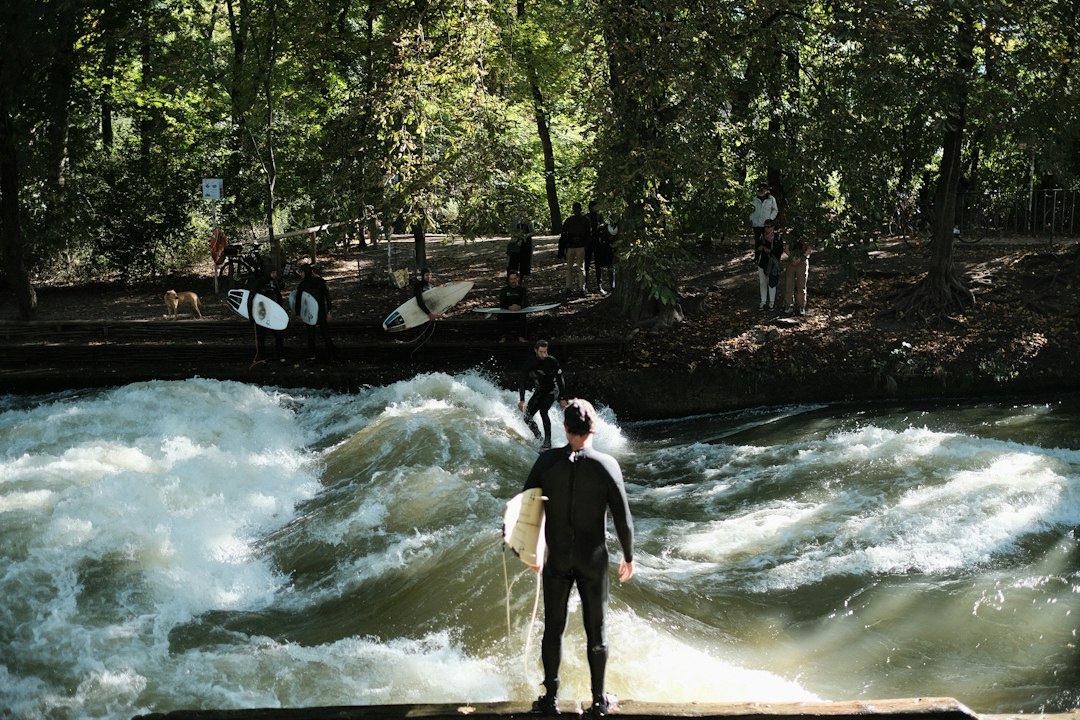
The Resurrection of an Urban Icon: Why the Eisbach Wave Matters
I’ve spent a lot of time thinking about why a patch of water in the middle of Munich captures our attention the way it does. The Eisbach wave isn't just a quirky local spot; it’s a masterclass in how cities can balance public safety with the things that actually give a neighborhood its soul. When the wave disappeared after that tragic accident in 2025, it felt like the city lost a piece of its heartbeat, but the reopening isn't just a win for surfers. It represents a massive technical achievement where fluid dynamics finally met urban planning. We aren't just talking about a ledge in the river anymore. We're looking at a carefully calibrated hydraulic jump that relies on a new modular underwater weir system to keep things both surfable and safe.
Think about the sheer engineering behind this. The water here is coming from the Isar through a 19th-century tunnel system, which is wild to consider when you're watching someone carve a turn in five-degree water. To get the wave back, planners had to model the flow to keep it stable while integrating a sensor network that watches for debris in real-time. It’s a delicate dance between maintaining a standing water column that requires serious skill to ride and ensuring that no one gets caught in the machinery again. Honestly, it’s refreshing to see a city treat a "novelty" spot with such rigorous scientific attention. It changes the way you look at the canal; it’s no longer just a bit of water, but an active piece of infrastructure that actually helps aerate the river and supports local ecosystems.
But why does this matter to you as a visitor? Because it proves that places don't have to be sterile to be safe. The Eisbach has transformed into an unofficial laboratory where municipal planners are testing how human recreation can coexist with urban hydrology. You’re seeing a site that’s arguably the most monitored artificial wave on the planet, yet it still feels like the same wild, unpredictable spot that made Munich famous. It reminds me that progress doesn't always mean erasing the past to make things safer. Sometimes, it just means getting the math right so we can keep playing in the water, even when the world around us gets a bit more complicated.
A Spectator’s Guide: Watching the World’s Best River Surfers
When you stand on the bank watching someone ride the Eisbach, it is easy to get caught up in the rhythm, but try to notice how different this is from watching a break at the beach. Ocean waves are moving toward you, while river surfing relies on a standing wave that stays locked in one spot relative to the bank. You are seeing a hydraulic jump in action, where the water transitions from supercritical to subcritical flow, creating that stationary face. It is fascinating to realize that the surfers are actually fighting a constant battle against the current to stay in the sweet spot of the pressure zone. They do not have an infinite power source like the ocean, so every slight shift in body weight is a calculated move to keep from being washed downstream.
Take a look at the boards they are using, and you will notice they are noticeably shorter and wider than what you would see at a coastal break. Since freshwater is about two and a half percent less dense than saltwater, these boards are specifically designed to maximize buoyancy and agility in a thinner medium. Without the salt providing that extra lift, the surfers have to lean on the pure kinetic energy of the river to perform their maneuvers. It is a technical dance that requires them to master the eddy fence, which is that invisible, messy border between the fast main current and the calmer water near the edge. Watching how they pivot at that boundary to re-enter the flow really shows you the level of precision involved.
If you are lucky enough to visit during the meltwater season, pay attention to how the wave shape changes almost daily as the volume from the Alps shifts. The water velocity usually needs to stay between 15 and 25 kilometers per hour to hold a clean face, and even minor fluctuations in that flow can change everything. It is why some surfers seem to make it look effortless while others struggle to find their line. You are watching a high-stakes experiment in fluid dynamics where the rider is constantly adjusting to the geometry of the underwater weir. My advice? Grab a spot on the bridge, ignore the crowd for a second, and really focus on how the surfer’s feet are moving. It changes your whole perspective once you realize they are effectively surfing on a stationary mountain of water that could collapse if they lose their focus for even a second.
Essential Safety Protocols for Navigating the Eisbach
If you’re planning to head down to the Eisbach, we need to have a serious talk about safety because this isn't your typical beach break. First off, leave your leash at home, as the use of ankle leashes is strictly prohibited here; the current is so aggressive that a snagged cord can pin you against the riverbed with terrifying force. You really need to respect the clock, too, with surfing restricted to the window between 5:30 AM and 10 PM to accommodate essential maintenance and hydraulic stabilization. Honestly, never consider jumping in alone because the mandatory buddy system is the only thing standing between you and a genuine emergency if you get caught in the flow.
Think about the physical environment for a second, because the water is hiding some serious hazards. The riverbed is packed with 19th-century structural remnants and concrete baffles that create unpredictable turbulence, which is why wearing a helmet is non-negotiable if you’re still learning the ropes or just being smart about your gear. Even on those hot Munich afternoons, the water temperature stays low enough that a proper wetsuit isn't just about comfort, but a primary defense against cold-water shock. If you’re under 16, you aren’t allowed out there without an experienced adult to keep a close eye on your entry and positioning in the high-flow zone.
It’s also worth noting that this wave is strictly for experienced riders who know how to handle the specific physics of a stationary hydraulic jump. One wrong move and you’re hitting concrete banks, so you’ve got to keep your situational awareness dialed in to avoid colliding with other surfers or losing your board into the high-velocity canal downstream. Even if you’re just there to watch, stay on the designated observation bridges because the riverbanks get incredibly slick with algae, and a simple slip can turn into a nasty fall. Finally, if you see the automated safety system signaling for an exit, clear the water immediately, as the new sensor network is there to catch hazards we can’t always see from the surface.
Understanding the Skill Level Required for Munich’s Famous Break
If you’re planning to tackle the Eisbach, let’s be real about the technical gap you’re facing compared to a day at the coast. Surfers here must master a perfect pop-up in a channel only about 12 meters wide, demanding immediate equilibrium the second their board hits the water. Unlike ocean surfing where you can paddle into a rolling swell, this spot requires a precise leap from a concrete ledge directly into a high-velocity current. The shift from standing on dry ground to balancing on a moving board in a fraction of a second requires a level of core stability that even seasoned coastal surfers often lack during their first attempts.
Success at this break is entirely dictated by your ability to read the turbulent vortex patterns that form at the edges of the standing wave. These eddies create inconsistent pressure zones that can flip an unweighted board in an instant if you aren't perfectly centered. Because the water volume is dictated by the upstream weir, you have to adjust your stance angle by mere millimeters to account for constant shifts in hydraulic pressure. The boards here usually feature significant rocker profiles, which are essential for navigating the steep, compressed face of the wave without catching a nose-dive.
Ultimately, your skill is measured by your capacity to hold a line in the center of the flow, where the water velocity hits its peak intensity. Mastery also involves learning to exit the wave safely by using the side eddy currents to prevent the river from dragging you into the concrete banks. Experienced riders use specific fin setups, often opting for smaller, stiffer fins that provide hold in freshwater without creating too much drag. Maintaining your position requires a constant, rhythmic oscillation of the ankles—a micro-adjustment technique that prevents you from being pushed backward out of the sweet spot. It’s a high-frequency training ground where the lack of buoyancy in freshwater forces a technical style characterized by rapid, high-intensity maneuvers that will humble even the best ocean riders.
Beyond the Surf: Exploring the Iconic Haus der Kunst and English Garden
After you’ve had your fill of the surf, you really owe it to yourself to wander just a few steps away into the quiet, heavy history of the Haus der Kunst. It’s impossible to walk past that massive, windowless limestone facade without feeling its weight; it was built in 1937 with over 15,000 cubic meters of stone to act as a pure, light-controlled gallery space, and it still holds a certain stern intensity today. I find it fascinating how such a building—born from such a dark political chapter—has shifted into a home for boundary-pushing contemporary work, including major retrospectives on immersive art that feel worlds apart from its original intent. Think about the irony here: you’re moving from the kinetic, high-velocity chaos of the river directly into these massive, 12-meter-high acoustic chambers that were designed to strip away the outside world entirely. It’s a jarring, necessary transition that helps you appreciate just how layered this corner of Munich actually is.
Once you step out the back doors, you’re suddenly in the English Garden, which is honestly one of the most brilliant pieces of urban engineering I’ve ever come across. While it looks like a wild, sprawling forest, it’s actually a carefully managed 900-acre laboratory that has been cooling the city since 1789. You’re walking on gravel-rich, alluvial soil left over from prehistoric riverbeds, and those streams you see aren't natural accidents—they’re a complex, subterranean network of diverted water from the Isar. If you head toward the Monopteros temple, you’re standing on a hill built entirely from the city’s own rubble, which is a wild thought to hold while you’re looking out over the park’s canopy.
It’s worth paying attention to the smaller details here, like the Japanese Teahouse placed on its island to perfectly mirror the water, or the way the Chinese Tower has been engineered over centuries to keep its exact geometric footprint while meeting modern fire codes. I usually tell people to check the thermal difference for themselves; on a hot afternoon, the park acts like a massive AC unit, often keeping the air two or three degrees cooler than the asphalt streets just blocks away. This place is a living, breathing machine that handles everything from managing urban heat to providing a hunting ground turned public space. It’s a lot to process, but that’s the beauty of it—you’re basically traversing a 200-year-old experiment in how to balance nature, engineering, and art right in the middle of a modern city.
How the Eisbach Wave Shaped Munich’s Modern Culture
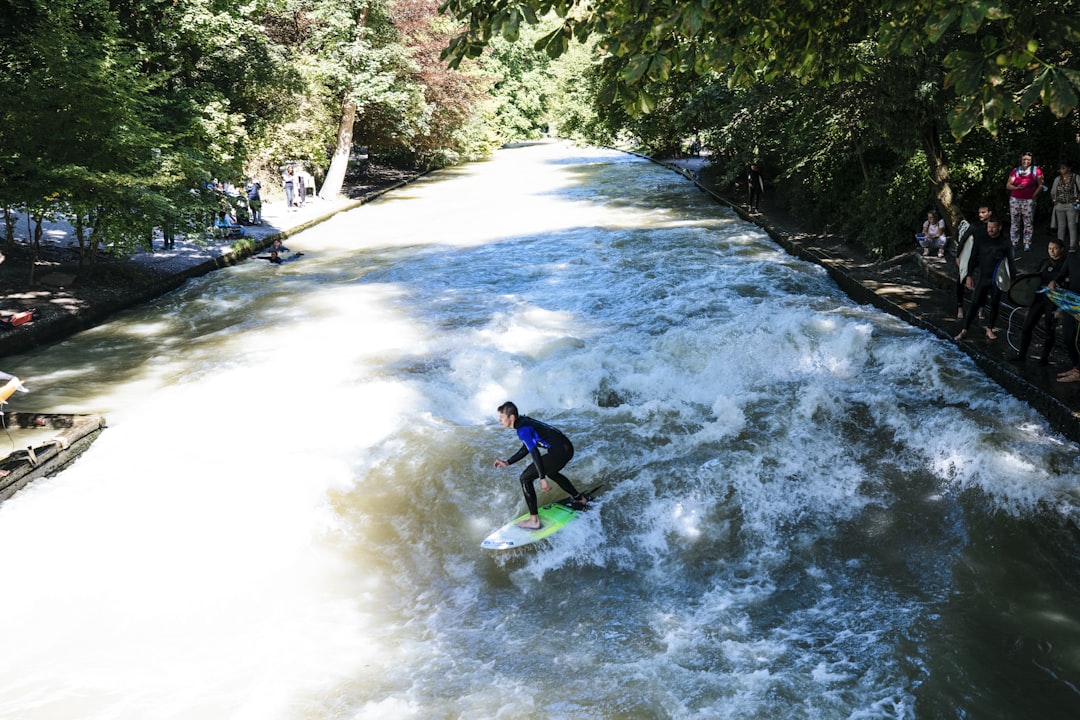
If you're wondering how a simple patch of river water became the heartbeat of a major European capital, you have to look past the spray and the wetsuits. The Eisbach Wave isn't just a quirky local attraction; it’s a masterclass in how a city’s industrial plumbing can be repurposed to define its modern identity. Back in the 1970s, city planners dropped concrete blocks into the canal to manage flow, never intending to launch a global surf movement, yet that accidental engineering created the standing hydraulic jump we see today. It’s honestly wild to think that Munich’s reputation as a surf mecca is anchored to 19th-century riverbed remnants and a 12-meter-wide channel that requires absolute precision to navigate.
Here’s the thing about this spot: it forces a collision between the old world and the hyper-kinetic present. You’re watching surfers carve turns on a stationary mountain of water just steps away from the Haus der Kunst, a building that was once a symbol of rigid monumentalist architecture. That contrast isn't just aesthetic; it’s a perfect metaphor for Munich’s evolution. While the surf community has had to adapt to the lower buoyancy of freshwater compared to the ocean, the city has had to adapt its own infrastructure to keep the water flowing safely through the English Garden. It’s a delicate balance, and that's why the recent integration of real-time sensor networks and modular weir systems is such a big deal.
We aren't just talking about a place to play; we’re looking at a functional piece of hydrology that serves as an aeration system for the canal while cooling the surrounding urban heat island. The wave forces you to recognize that when you get the math right, urban spaces don't have to be sterile to be safe. It’s a high-stakes experiment where municipal planners and athletes are essentially co-managing a living, breathing machine. For me, the real takeaway is that Munich hasn’t sanitized its history to keep up with modern demand—it’s just learned how to work with the flow. If you’re planning a visit, take a moment to stand on that bridge and consider that you're watching a 200-year-old experiment in how to blend nature, engineering, and raw human expression into one cohesive city block.
Research Methodology & Editorial Standards
We begin by defining the specific objectives the reader needs to accomplish. Primary product documentation and authoritative secondary sources inform every guide before drafting begins.
Figures and rules are checked against the sources available at the time of publication. Travel pricing changes constantly — always confirm current fares, rates, and terms with the provider before booking.