
JetBlue First Class 2026: Pay Cash or Redeem Points at 1.4¢
JetBlue's BlueFirst domestic first class is bookable in 2026, and choosing cash or TrueBlue points depends on a 1.4¢-per-point target.
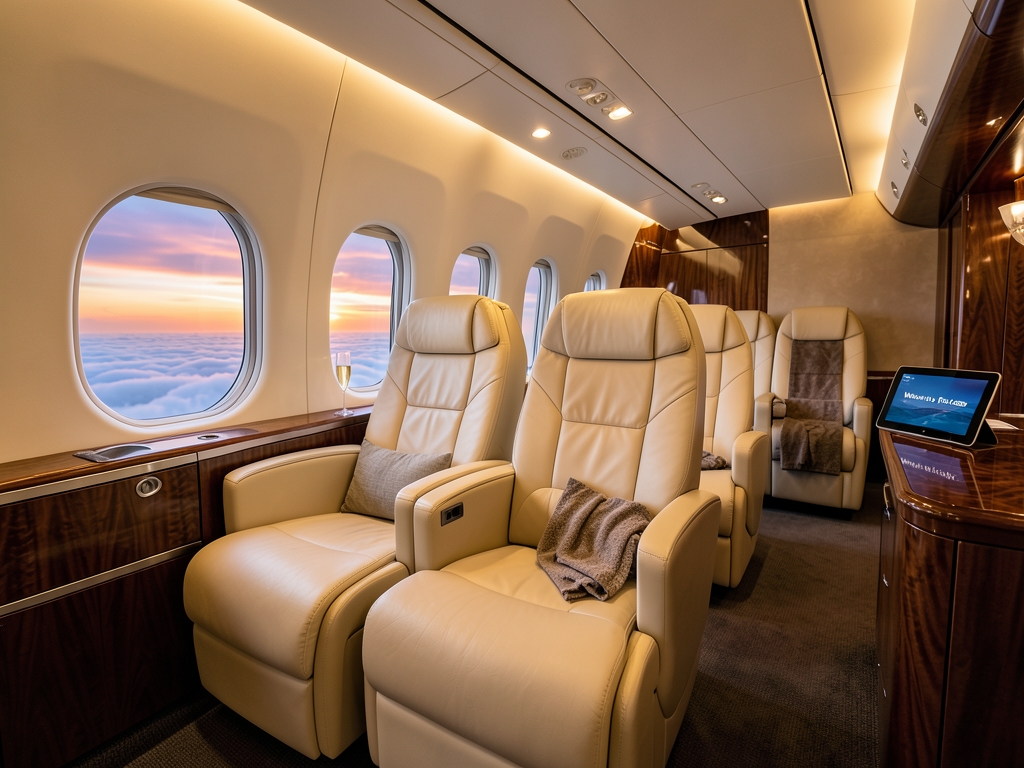
JetBlue's BlueFirst domestic first class is bookable in 2026, and choosing cash or TrueBlue points depends on a 1.4¢-per-point target.
Compute (cash first-class fare − cash economy fare) ÷ (points for first − points for economy) one-way. If the implied value exceeds 1.4¢ per point, the points are buying more value than your target, so redeem them; if it falls below 1.4¢, pay cash and save the points for a redemption that clears the bar.
How BlueFirst Booking Actually Works
JetBlue's domestic first class, BlueFirst, is a 2026 product for aircraft that do not offer Mint, according to JetBlue's rollout statement reported via LinkedIn. That separation matters for booking: a Mint-equipped transcontinental aircraft and a BlueFirst-equipped domestic aircraft are not the same fleet, so aircraft type is the first filter before you assume a route has the new cabin.
The same LinkedIn-reported statement says about 25% of the non-Mint fleet is scheduled for retrofit in 2026, with most of the work finished by the end of 2027. In practice, that means early-2026 BlueFirst availability is route- and aircraft-dependent rather than a network-wide guarantee; a non-Mint route may still be flying an unretrofitted cabin.
AwardWallet reports that BlueFirst seats are now on sale, with introductory fares. Because the retrofit is partial, the practical booking sequence is to confirm the aircraft and cabin on your specific flight before comparing prices or points; a seat-map or aircraft-type check is more useful than assuming every non-Mint route has the new cabin.
Because the retrofit timeline runs through 2027, treat 2026 BlueFirst as a growing subset of routes. Recheck aircraft and prices close to booking, and do not assume that a route with BlueFirst today will have the same fare or award availability later in the year.

The Evidence: Dates, Fares, Fleet Counts
The evidence converges rather than conflicts: AwardWallet, the JetBlue statement reported through LinkedIn, and UpgradedPoints all point to the same launch year and retrofit share, while Condé Nast Traveler adds independent corroboration. That convergence is the useful signal; it means the product is not a single-source announcement.
AwardWallet's deep read is the only source in this set confirming that BlueFirst seats are purchasable now, under a "JetBlue BlueFirst Seats Now On Sale" headline with a dedicated introductory-fares section. Other outlets in this set announce or preview the product; AwardWallet is the one that frames it as on sale.
The LinkedIn-reported JetBlue statement is the only source in this set that states the fleet-count figure, and it frames the product as starting on aircraft that do not offer Mint. Treat that fleet count as a planning number rather than a route guarantee, because the same statement does not publish a route list.
UpgradedPoints and Condé Nast Traveler are independent of both the airline statement and AwardWallet's sales confirmation. Their role in this evidence set is corroboration of the product's existence and timing, not fare data or fleet counts.
None of the sources in this set supplies a verified fare table, so any cash-versus-points comparison must be built from live quotes. That absence is not a gap in the thesis; it is the reason the reader rule uses your own quotes. Keep the units consistent: one-way cash premium divided by one-way points premium, with taxes and fees handled the same way on both sides.
Before treating any source as a booking trigger, verify three things: that the flight is on a retrofitted non-Mint aircraft, that the cash and points quotes are for the same cabin and date, and that both quotes use the same one-way or round-trip basis. If any check fails, the implied value is not comparable to the 1.4-cent target.
| Source | Unique contribution in this set |
|---|---|
| AwardWallet | Confirms seats are on sale and has an introductory-fares section |
| JetBlue via LinkedIn | Supplies the fleet-count figure and the non-Mint aircraft framing |
| UpgradedPoints | Independent corroboration of the product and timing |
| Condé Nast Traveler | Independent corroboration of the product and timing |

Cash vs Points: The Comparison Table
Pay cash wins when the cash premium is small relative to the points gap. Suppose the one-way BlueFirst fare runs $90 above the one-way economy fare, but the points upgrade costs more than 20,000 TrueBlue points over economy on the same one-way flight. Dividing $90 by 20,000 gives 0.45¢ per point — nowhere near the 1.4¢ target. In that scenario, buying the upgrade with cash is the clear play, because you're preserving points that are worth far more elsewhere than they're worth on this seat.
Redeem points wins when the implied value clears 1.4¢ per point — that is, when the one-way cash premium is large relative to the extra points required. AwardWallet notes that BlueFirst launched with introductory fares, and the Decision Rules section warns that introductory cash fares can suppress the implied value of points, which favors paying cash early on; it suggests rechecking the same one-way calculation two to three weeks after a route launches before redeeming. Run the division on live quotes, and only hand over points when the result tops 1.4¢.
| Scenario | What you see | Implied value | Move |
|---|---|---|---|
| Cheap cash premium, big points gap | $90 one-way premium; 20,000+ extra points one-way | 0.45¢ per point | Pay cash |
| Inflated cash fare, anchored points price | Introductory cash pricing; points track economy | Above 1.4¢ per point | Redeem points |
| Premium not worth it at any price | Upgrade value below your personal bar | Irrelevant | Skip the upgrade |
Two discipline checks before you commit. First, keep the units matched: both fares one-way, both point prices one-way, same route, same date. Dividing a round-trip premium by a one-way points gap will silently inflate the implied value and push you into a bad redemption. Second, run the division on the actual prices in front of you at booking time — introductory fares move, and a comparison that favored points last week can favor cash today.
The table above is the whole decision. Compute the ratio, compare it to 1.4¢, and let the number pick the winner rather than your attachment to the front cabin.
Costs and Numbers That Matter
JetBlue reported a US$247 million net loss for the second quarter of 2026, about £186 million, according to findcheaphotels.co.uk, which describes the loss and the premium expansion as connected rather than separate developments. On that reading, introductory BlueFirst fares may be aggressive early and repriced later. Treat any launch fare as a snapshot: price the same one-way itinerary again before you assume the first number you saw will hold.
| Q2 2026 net loss | US$247 million (about £186 million) | findcheaphotels.co.uk |
| 2026 retrofit share | About 25% of the non-Mint fleet | LinkedIn-reported JetBlue statement |
| Retrofit completion | Most work by end of 2027 | LinkedIn-reported JetBlue statement |
| BlueFirst on sale | Reported October 15, 2026 as now on sale | AwardWallet |
| Originally announced debut | Second half of 2026 | AwardWallet |
The same cost pressure sits behind the retrofit pace. JetBlue's statement reported through LinkedIn puts the 2026 retrofit share at about 25% of the non-Mint fleet, with most work finished by the end of 2027. In 2026, that means BlueFirst should be expected on roughly a quarter of non-Mint aircraft, so filter by equipment before you price a route rather than assuming the cabin is available on every flight.
AwardWallet's October 15, 2026 article says BlueFirst seats are now on sale, while its earlier coverage described the originally announced debut window as the second half of 2026. Use the on-sale status as a current check, not as proof that every route or date has inventory; verify the aircraft and fare for your specific one-way search.
If a search does not show both cabins, or shows points only for one, stop and reprice in the same session with the same passenger count and date. The formula needs four comparable one-way numbers; without them, the 1.4-cent target cannot be tested and the loss-driven fare volatility makes guessing expensive.

What the Evidence Does Not Establish
Even as BlueFirst seats become bookable in 2026, several variables that determine the product’s real value remain undocumented in available reporting. AwardWallet’s coverage of JetBlue’s domestic first class rollout, along with the JetBlue statement reported via LinkedIn and reporting from UpgradedPoints, establishes the product’s arrival but leaves gaps that directly affect whether a cash purchase or a TrueBlue redemption makes sense. Before committing, treat each of the following as an open question to resolve at the point of sale.
| Unverified variable | What the evidence does not establish | Check to run before booking |
|---|---|---|
| Award pricing | No source in this grounding states BlueFirst award pricing in TrueBlue points or whether pricing is dynamic or fixed; do not assume any award chart. | Search the specific BlueFirst flight on jetblue.com with points selected and record the one-way points required alongside the one-way cash fare. |
| TrueBlue earn rates | No source confirms whether BlueFirst earns at Mint-level TrueBlue accrual or under a new earn tier. | Review the fare’s earn table on the JetBlue booking page before crediting the flight to confirm how many points the ticket will accrue. |
| Change, cancel, no-show, and Mosaic perks | No source documents BlueFirst change, cancellation, or no-show rules, or whether Mosaic complimentary upgrade perks apply to this cabin. | Read the full fare rules at checkout and compare them against current Mosaic benefit terms in your TrueBlue account before purchase. |
Award pricing is the most consequential unknown for anyone weighing cash against points. Because no published chart or fixed rate is confirmed in the available sources, the only reliable method is to pull live results for your exact itinerary: select points on jetblue.com, note the one-way points total for BlueFirst and for the comparable economy option, and pair those figures with the corresponding one-way cash fares shown in the same search. Only with those verified numbers can you calculate the implied value of the points you would spend.
Earning and flexibility carry similar uncertainty. If BlueFirst posts to TrueBlue under a different accrual tier than you expect, the effective rebate on a cash ticket changes; likewise, restrictive change, cancellation, or no-show terms can erase the apparent advantage of a lower fare. Mosaic members should also confirm at checkout whether any complimentary upgrade benefits extend to BlueFirst, rather than assuming parity with other JetBlue products.
Treat these checks as mandatory pre-booking steps, not afterthoughts. Document the live points price, earn details, and fare rules for your specific flight before you pay, so your comparison rests on verified, itinerary-specific data rather than assumptions about how BlueFirst will be priced or managed.

One-Way BlueFirst Check
This section walks the full arithmetic for one hypothetical one-way BlueFirst booking, with three checkpoints and the cost of choosing the wrong payment method. The check is to divide the cash fare premium over economy by the extra points required, then compare that implied value with a 1.4¢ TrueBlue target. No other section repeats this example.
The inputs are illustrative and should be replaced with live prices: a one-way BlueFirst cash fare of $349, the same flight in economy at $199, a BlueFirst points price of 25,000 TrueBlue points, and an economy points price of 12,500 points. Keep every figure one-way so the cash and points premiums describe the same trip. The arithmetic is stable even though fares and award prices move.
| Checkpoint | Calculation | Result |
|---|---|---|
| 1. Cash premium | $349 − $199 | $150 one-way |
| 2. Points premium | 25,000 − 12,500 | 12,500 points |
| 3. Implied value | $150 ÷ 12,500 | 1.2¢ per point |
Checkpoint 3 is the decision point. At 1.2¢ per point, the implied value is below the 1.4¢ target, so redeeming points for BlueFirst is the weaker use of points on this booking. Pay cash for the first-class seat, or take economy and save the 12,500 points for a redemption that clears 1.4¢. A result above 1.4¢ would flip the answer to redeeming points.
The cost of being wrong runs both ways. Redeeming the 12,500 points here would convert them at 1.2¢ instead of the 1.4¢ target, a 0.2¢ shortfall worth $25 on this one-way. Paying cash when a booking's implied value is above target has the opposite cost: you spend cash for an upgrade that points could have covered at better-than-target value. Either way, the loss is the gap between implied value and target multiplied by the points premium. The check is cheap; skipping it is what makes either mistake expensive.
Before booking, rerun the same three checkpoints on the live one-way fare and points prices. Do not mix one-way and round-trip figures, and treat the 1.4¢ figure as your comparison point rather than a guaranteed redemption value. If the result is exactly 1.4¢, the two options are roughly equivalent before taxes and fees.
Decision Rules for BlueFirst Bookings
If the flight is on a Mint-equipped aircraft, BlueFirst rules do not apply. Mint is a separate product with its own cash fares and award pricing behavior, so you should price the itinerary as Mint and run the same 1.4¢-per-point check independently. Mixing assumptions between BlueFirst and Mint can distort the premium you are measuring and lead to an apples-to-oranges comparison.
If the route is newly added to the BlueFirst map, expect introductory pricing to skew the result. AwardWallet notes an "Additional routes available" list for BlueFirst, and newly launched routes may carry introductory cash fares that suppress the implied value of points. In that case, run the one-way cash-versus-points calculation again two to three weeks after launch before redeeming, as early promotional pricing can make a redemption look weaker than it will once fares normalize.
If the seat map shows fewer than two BlueFirst seats remaining, treat the pricing as highly fluid. Limited inventory can cause cash fares, award prices, or both to shift quickly, which can flip the outcome of your calculation between search and checkout. Recompute the implied cents-per-point value immediately before ticketing, using the same one-way cash premium and one-way points difference, to confirm the decision still holds.
Apply these rules in sequence for every booking: confirm the aircraft type, account for route-launch timing, and verify availability-driven price changes. By rerunning the same one-way calculation at each checkpoint, you can decide whether to pay cash or redeem points based on current conditions rather than an outdated snapshot.
Also worth reading JetBlue Unveils New Domestic JetBlue Domestic First Class 2026 Book Virgin Atlantic Upper Class
What to do next
Frequently Asked Questions
How do I compare a cash BlueFirst fare with a points redemption?
Compute (cash first-class fare minus cash economy fare) divided by (points for first minus points for economy) one-way and compare it with the 1.4¢-per-point target.
When should I redeem TrueBlue points instead of paying cash?
Redeem points when the implied value exceeds 1.4¢ per point, because the points are buying more value than the target.
What should I do if the implied value is below the target?
Pay cash and save the points for a redemption that clears the bar.
Is BlueFirst just another name for Mint?
BlueFirst is a 2026 product for aircraft that do not offer Mint, so Mint-equipped transcontinental aircraft and BlueFirst-equipped domestic aircraft are not the same fleet.
How much of the non-Mint fleet is scheduled for the BlueFirst retrofit in 2026?
About 25% of the non-Mint fleet is scheduled for retrofit in 2026, with most of the work finished by the end of 2027.
Can I assume every non-Mint route will have BlueFirst in early 2026?
Early-2026 BlueFirst availability is route- and aircraft-dependent rather than a network-wide guarantee, so a non-Mint route may still be flying an unretrofitted cabin.
Quick answers
| What determines whether to pay cash or redeem TrueBlue points for JetBlue BlueFirst? | The choice depends on comparing the implied value per point to the target value per point mentioned in the article. |
| How do you calculate the implied value per point for a BlueFirst redemption? | Subtract the cash economy fare from the cash first-class fare, then divide by the difference between the points required for first class and economy one-way. |
| When should you redeem points for BlueFirst instead of paying cash? | You should redeem points if the implied value exceeds the target value per point, and pay cash if it falls below that target. |
| What is the first filter to consider before assuming a route has the new BlueFirst cabin? | Aircraft type is the first filter because Mint-equipped transcontinental aircraft and BlueFirst-equipped domestic aircraft are not the same fleet. |
| Is BlueFirst availability guaranteed across all non-Mint routes in the launch year? | No, early availability is route- and aircraft-dependent rather than a network-wide guarantee, as a non-Mint route may still be flying an unretrofitted cabin. |
Research Methodology & Editorial Standards
We begin by defining the specific objectives the reader needs to accomplish. Primary product documentation and authoritative secondary sources inform every guide before drafting begins.
Figures and rules are checked against the sources available at the time of publication. Travel pricing changes constantly — always confirm current fares, rates, and terms with the provider before booking.