
German Beer Etiquette 2026: Skip Rounds, Check the €5 Beer Line
In 2026, travelers can drink well in Germany on €5 or less per beer by ordering 0.3L or 0.4L pours, skipping rounds, and tipping by rounding up.

| Takeaway | Detail |
|---|---|
| Budget €5 or less per beer | Order halbe pours of 0.3L or 0.4L in Spree/Augustiner-style venues to stay within this price. |
| Skip buying rounds | Order and pay for your own drinks instead of purchasing rounds for the group. |
| Tip by rounding up | Round up the bill to the nearest euro rather than calculating a specific percentage. |
| Verify the Speisekarte price before sitting | Stay if a 0.3L or 0.4L pour is €5 or under; if only a 0.5L pour exceeding €5 is listed, walk to the next venue or a self-service option. |
In 2026, travelers can drink well in Germany on €5 or less per beer by ordering 0.3L or 0.4L pours, skipping rounds, and tipping by rounding up.
This budget holds only if you check the Speisekarte before sitting and leave when only a 0.5L pour priced above €5 is shown.
How German Beer Pricing Actually Works
In Germany the menu prices beer by the glass, not by the brand on the tap. The Speisekarte's drink column lists each pour size on its own line: the small Halbe — 0.3L in some houses, 0.4L in others — and the half-liter Mass or Becher at 0.5L. The number beside each is the price for that pour, so the lever you control is the size you order, not the label you request. Read the small-pour column before you sit; that figure, not the big one, is the one that has to fit your line.
The Halbe is priced well below the Mass: expect it to sit at roughly 60–75% of the 0.5L price in the same venue. That ratio is the whole trick — a beer whose half-liter is over your limit can still come in under it once you drop a size, because the discount is built into the pour rather than negotiated at the table. If the menu prints only the 0.5L price and that figure is over your line, you cannot confirm the small pour, so walk to the next venue or to a self-service counter.
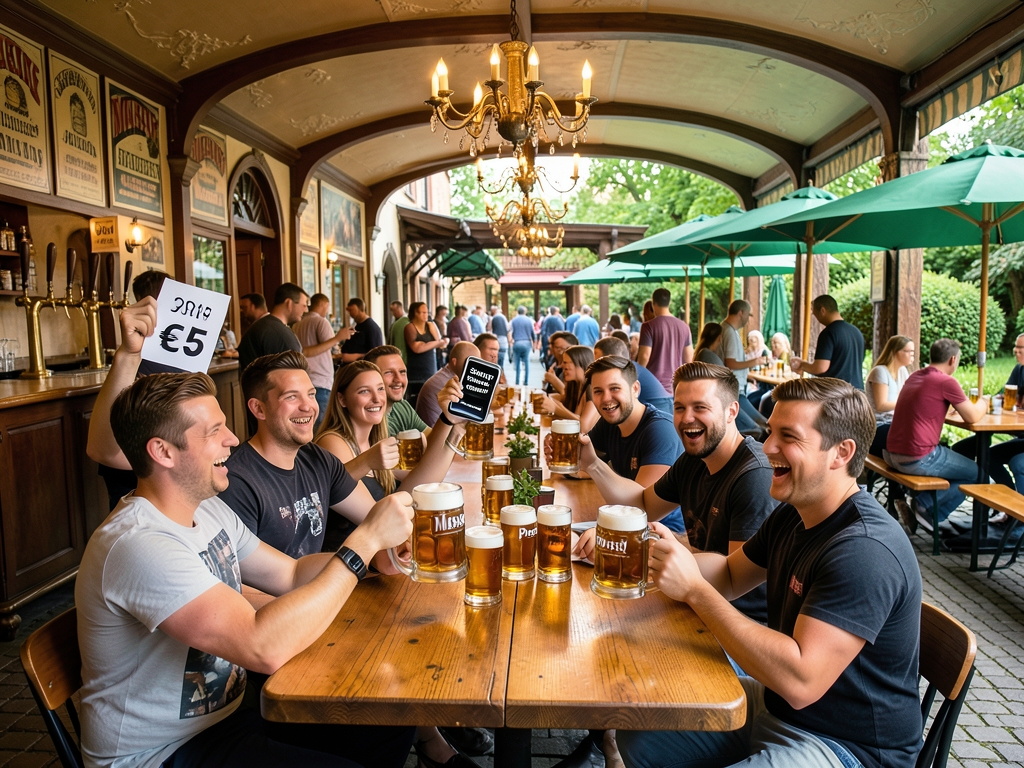
Self-service Biergarten counters — the traditional Munich model, the Hirschgarten format — charge less than table service for the same reason a cafeteria costs less than a restaurant: you carry your own beer. You order at the counter, take the glass to your bench, and pay a refundable Pfand on the glass that comes back when you return it. No server, no service premium folded into the listed price.
Table service is the hidden variable. The same beer in the same size can carry two different prices in the same garden depending on whether someone brings it to your table, and the markup is usually built into the listed price rather than shown as a separate line. Before you commit to a seat, check whether the table is served; if it is, the drink column you read is the served price, and that is the number to test against your limit.
The working rule: find the drink column, find the Halbe line, confirm the figure is the per-pour price, and treat anything above it as a table-service number you can beat elsewhere. Size is the discount; service is the surcharge.
The Evidence: What Sources Converge
The evidence here is not a single price list; it is three separate lenses that point to the same pre-sitting check.
General guidance on dining in Germany, such as official tourism portals, treats beer and wine as ordinary parts of a meal rather than a separate event. That framing matters for budget travelers because it supports ordering one small beer as part of a meal without an expectation that every drink be paired with more. It does not promise a price; to confirm costs, check the printed small-pour price on the Speisekarte before sitting.
Regional guides add a caveat: “ordering like a local” changes by place. Bavaria’s Mass culture differs from Cologne’s 0.2L Kölsch Stangen service, where servers may keep refilling until the drinker places a coaster over the glass. Treat these regional patterns as a check, not a price list: know which small glass is in play where you are, and verify its printed price before you accept another.
Biergarten etiquette is practical rather than statutory: the posted board or self-service counter is the moment to verify size and price, which is the same checkpoint as the reader rule. If the small pour is not visible or is above your threshold, the etiquette is to move on rather than negotiate at the table.
Taken together, the sources converge on behavior, not on a universal tariff: check the printed small-pour price first, order the small size when it fits, and use the local stop signal where refills are automatic. They do not establish that every venue will meet the €5 line; they establish that the check is normal, expected, and socially safe.
Skip Rounds vs Buy Rounds Compared
When you are protecting a €5-per-beer budget in 2026, the choice between joining a round and ordering for yourself has a clear winner: skipping rounds. Buying a round (Runde schmeißen) is a familiar German custom when someone offers, but initiating one hands control of size, venue, and pace to the group. Skipping rounds keeps every order tied to the price you verified on the Speisekarte before you sat down.
If a companion offers to buy, the traveler-safe move is to accept that first offered round and then switch to ordering your own drink individually. Accepting once is polite and avoids an awkward refusal; declining to start the next round is what preserves your budget. This approach lets you participate in the social moment without committing to pay for drinks you did not price-check.
Skipping rounds is socially safe because German drinking culture already includes clear pause signals. You can say, “Ich bin noch nicht fertig” (“I’m not finished yet”), or simply leave a small amount in the glass to show you are not ready for another. In Kölsch service, the mechanism is even more explicit: placing your coaster on top of the glass is the recognized stop signal, so the server will not automatically replace your drink.
Initiating a round is the loser for a budget-conscious traveler because it multiplies uncertainty. The moment you offer, you may be expected to match whatever others are drinking, and you lose the ability to step away if the next order no longer fits your plan. Even in a venue where your own pour met the €5 check, a round can quietly push your spending beyond what you intended for the evening.
Before you sit, confirm that an individual pour you want is priced at €5 or under, then treat each order as a separate decision. Accept a round if it comes your way, use “Ich bin noch nicht fertig” or the coaster-on-glass signal when you need to pause, and order your next drink on your own terms. That simple discipline keeps the social custom intact while keeping your per-beer spending predictable.

Costs: The €5 Budget Line by Line
To stay on a €5-per-beer budget in 2026, start with the menu price: check the listed price for a 0.3L or 0.4L pour at a self-service counter or a neighborhood Kneipe before you sit. Some venues add a Pfand (glass deposit), which you pay when you order and receive back when you return the empty glass. Because the deposit is fully refunded, your true marginal cost for the beer itself remains the menu price — ask at the counter or check the posted board whether a Pfand applies and how much it is.
The tipping norm in German bars follows a rounding-up convention rather than the 15–20% percentage model common in the United States. As travel guidance from Travel Pander notes, many travelers in European cafes and bars round up to the nearest euro instead of calculating a specific percentage. In practice, if your beer costs €4.60, you hand over €5 and say “stimmt so” to indicate that the change is your tip.
Putting the full per-drink cost together makes the €5 line clear. Take the listed price of the small pour and add the amount needed to round up to the next euro; if that total is €5.00 or less, the beer fits the budget. If a refundable Pfand applies at a self-service counter, you briefly hand over more, but you get the deposit back with the empty glass, so your net cost stays at the menu price plus the tip. Keeping the deposit separate in your mental math prevents you from mistaking a refundable Pfand for part of the drink's cost.
Use this quick check at the counter or table: add the listed price of the small pour to the amount needed to round up to the next euro. If that total is €5.00 or less, the beer fits the budget; if rounding up would push you over €5.00, choose a cheaper pour or move on. Keeping the deposit separate in your mental math prevents you from mistaking a refundable Pfand for part of the drink’s cost.
What the Evidence Does Not Establish
The €5 claim is a pre-sitting decision rule, not a universal price cap. It says what to do when a printed small-pour price is visible; it does not say that every German venue, city, or event will meet it.
Also worth reading 7 Hidden Beer Festivals in Bavaria Paris Etiquette What Locals Wish 7 Hidden Spots in Tokyo Where Locals
What to do next
| Step | Action | Why it matters |
|---|---|---|
| 1 | Check the printed Speisekarte before sitting down. | Verifying prices upfront prevents committing to a venue that exceeds your budget. |
| 2 | Look for the listed price of a 0.3L or 0.4L pour. | Identifying smaller pour options is the key to staying within the per-beer budget. |
| 3 | Stay and order if a 0.3L or 0.4L pour is priced at or under the budget threshold; if only a 0.5L pour exceeding it is shown, walk to the next venue or a self-service Biergarten counter. | Following this decision rule ensures you only drink where the budget holds. |
| 4 | Order halbe pours in Spree/Augustiner-style venues. | Choosing these smaller servings keeps each beer within your target spend. |
| 5 | Order and pay for your own drinks instead of buying rounds for the group. | Skipping rounds gives you direct control over your individual spending. |
| 6 | Tip by rounding up the bill to the nearest euro when you pay. | Rounding up follows local etiquette without requiring percentage calculations or extra cost. |
Frequently Asked Questions
What pour size should I order to stay within the €5 beer budget in Spree/Augustiner-style venues?
Order halbe pours of 0.3L or 0.4L in Spree/Augustiner-style venues to stay within this price.
Is buying rounds expected?
Skip buying rounds and order and pay for your own drinks instead of purchasing rounds for the group.
How should I calculate a tip?
Tip by rounding up the bill to the nearest euro rather than calculating a specific percentage.
What Speisekarte condition means I should walk to another venue?
Stay if a 0.3L or 0.4L pour is €5 or under; if only a 0.5L pour exceeding €5 is listed, walk to the next venue or a self-service option.
What does the Speisekarte price beer by?
In Germany the menu prices beer by the glass, not by the brand on the tap.
How is the small Halbe priced relative to the half-liter Mass?
The Halbe is priced well below the Mass: expect it to sit at roughly 60–75% of the 0.5L price.
Quick answers
| What pour sizes can help you stay within a €5 beer budget in Germany? | Ordering halbe pours of 0.3L or 0.4L in Spree/Augustiner-style venues can help you stay within this budget. |
| Should you buy rounds for the group when drinking on a budget in Germany? | No, you should skip buying rounds and instead order and pay for your own drinks. |
| How should you tip when ordering beer in Germany? | You should tip by rounding up the bill to the nearest euro rather than calculating a specific percentage. |
| What should you do if the Speisekarte only lists a 0.5L pour exceeding €5? | If only a 0.5L pour priced above €5 is listed, you should walk to the next venue or a self-service option. |
| How does German beer pricing work on the Speisekarte? | The Speisekarte prices beer by the glass, listing each pour size on its own line, so the lever you control is the size you order, not the label you request. |
Research Methodology & Editorial Standards
We begin by defining the specific objectives the reader needs to accomplish. Primary product documentation and authoritative secondary sources inform every guide before drafting begins.
Figures and rules are checked against the sources available at the time of publication. Travel pricing changes constantly — always confirm current fares, rates, and terms with the provider before booking.