
Frontier $129 upgrade: Check seat map and all-in one-way delta
The practical rule is narrow: compare the all-in one-way per-segment total. If the seat map confirms the upgraded product and the checkout delta is no more than $129 one-way with no added fee, the upgrade passes this test.
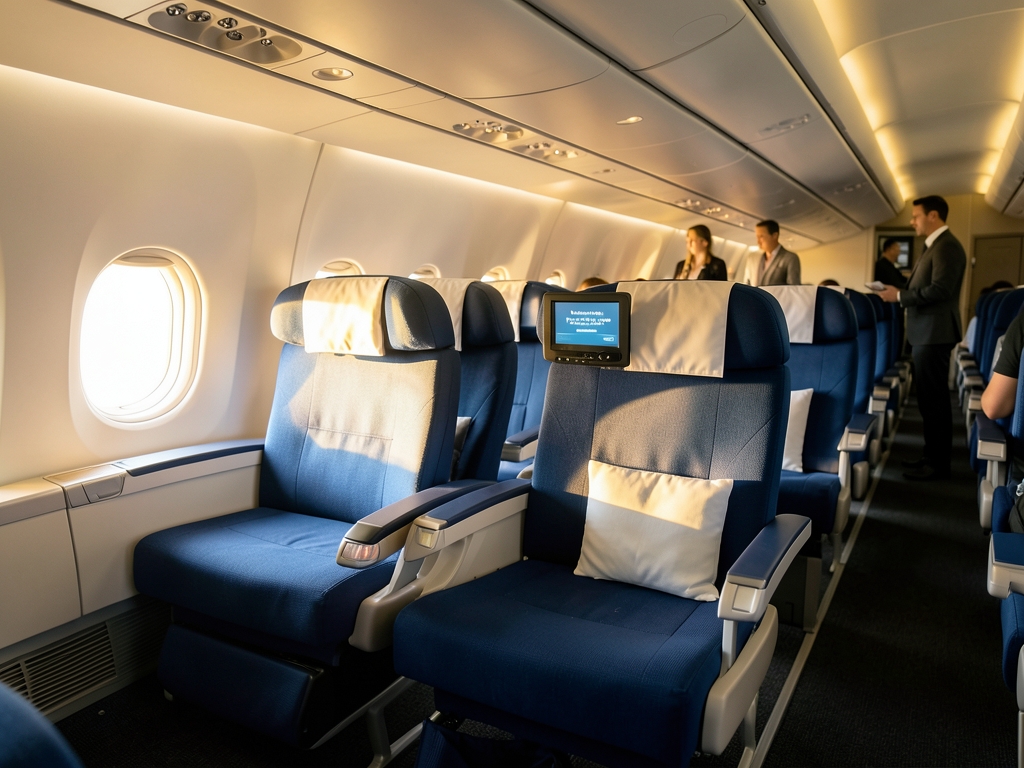
The practical rule is narrow: compare the all-in one-way per-segment total. If the seat map confirms the upgraded product and the checkout delta is no more than $129 one-way with no added fee, the upgrade passes this test. If the delta is higher, or the product is only extra legroom, the number fails the test. The myth to kill is that $129 one-way is automatically a cheap upgrade; the number that settles it is the all-in checkout delta for the exact seat and segment you are buying.
Standard, extra legroom, or $129
| Option | Check at checkout | Cash unit | Wins when |
|---|---|---|---|
| Standard seat | Is seat assignment included? | $0 incremental one-way | The $129 one-way offer is not a true first-class seat |
| Extra legroom | Row/pitch and price | Extra-legroom fee one-way | Fee is below $129 one-way and you only need legroom |
| $129 first class/Upfront Plus | Seat map product label and all-in total | $129 one-way plus any fees | Total is ≤$129 one-way and label is true first class/Upfront Plus |
Use the standard seat as the baseline for every comparison. At checkout, check whether a seat assignment is included in your fare or offered as a separate add-on, and count its incremental cost as $0 one-way only when no added seat fee appears. As Going.com’s 2026 guide to Frontier explains, the airline’s real cost emerges after fees are added at checkout, so the standard seat remains the cash winner whenever the $129 one-way offer does not deliver the confirmed upgraded product or when any alternative seat costs more than the comfort is worth to you.
Evaluate extra legroom as a narrower, purpose-built purchase. Review the seat map for the specific row and pitch being sold, confirm the price shown for that exact seat, and compare the extra-legroom fee on a one-way basis with the $129 one-way upgrade. When that fee is below $129 one-way and additional space is the only benefit you need, extra legroom provides the better value because it addresses the comfort gap without paying for a higher-tier seat.
Costs that change the $129 math
GoWild is a season pass, not a fare. Business Insider reports that Frontier's GoWild! pass costs $299 for the winter season and that travelers pay a $0.01 fare plus taxes and fees for domestic flights, so the $299 should be spread across the one-way segments you will actually fly before you compare it with a $129 one-way seat upgrade. Divide $299 by your planned one-way segment count: at 10 segments the pass works out to $29.90 per segment, while at 5 segments it is $59.80 per segment. That amortized figure is the number to set beside $129, not the $299 sticker price.
Keep every comparison in one-way, per-segment terms. The $129 figure is a one-way upgrade, so an extra-legroom quote must be converted to the same unit before you decide. If an extra-legroom fee is quoted for a round trip, halve it before comparing it with $129; if a fee covers more than one one-way segment, divide the total by the number of segments it covers.
If the $129 one-way offer appears only after you select a seat, screenshot the checkout line item and verify that the all-in one-way total is still $129. The screenshot should show the upgrade as its own line item, with no separate seat-selection or other fee added on top. Treat the offer as failing the test if the checkout delta is higher than $129 one-way.
| Cost item | Normalization to one-way per segment |
|---|---|
| GoWild pass | $299 divided by one-way segments flown |
| Round-trip extra legroom | quoted fee divided by 2 |
| $129 upgrade | already one-way |
Do not compare a pass, a round-trip seat fee, and a one-way upgrade until all three are expressed as cost per one-way segment; otherwise the larger-looking number can hide the cheaper per-segment cost.
Use the same one-way per-segment denominator for GoWild, extra legroom, and any seat fee: total cost divided by one-way segments covered. That keeps a season pass, a round-trip seat fee, and a one-way upgrade on the same scale.
Where the evidence stops
Here is the hard limit of what the available reporting can support: there is no current 2026 inventory count for $129 first-class seats, no verified seat pitch, and no measured recline angle in the available sources. If you want to know whether the upgrade is real, open the live seat map and read the product label on your own itinerary. A review from two years ago describing an older cabin cannot confirm what will be assigned to your flight today.
Going.com’s 2026 Frontier review sets out the right questions: what the ticket actually costs after fees, what the flight feels like, and how reliable the operation is. None of those resolves into a fixed number in the source material. Record your own route’s all-in one-way checkout total, then check the airline’s on-time performance for your specific flight number separately. A general review can tell you what to inspect; it cannot supply the figures for your trip.
The same gap applies to ancillary charges. The available sources gives no verified 2026 amounts for checked bags, carry-ons, or seat assignments on the itinerary you are pricing. Do not carry a fee from an older example into a new checkout. Instead, add each charge exactly as it appears on the payment screen and compare that total with the base fare. If a fee appears after you select the upgraded seat, it belongs in the comparison.
Frontier’s first-class plan is described as a fleet rollout scheduled for next year, not as a guarantee that every aircraft in 2026 will have the product. That distinction matters when the seat map shows only extra legroom under a premium label. Confirm that the checkout identifies the seat as first class or Upfront Plus and that the one-way delta is no more than $129. If the map shows only extra legroom, treat it as a different product and judge it on the cash difference.
One Mile at a Time documents Frontier’s tiered close-in award fees, including $50 for tickets booked 7–20 days before departure and $75 closer in. Those are award-booking figures, not proof of what your cash upgrade will cost, but they show why the timing of the purchase belongs in your notes. Business Insider’s $15 Vegas–Orlando example is likewise a one-way fare under a specific pass scenario, not a universal price. Keep each figure attached to its own source and scenario.
$129 one-way
At $129 one-way, treat the offer as a checkout test, not a seat label. Compare the current seat cost, the quoted $129 one-way upgrade, and the live extra-legroom price shown for the exact itinerary. Use the checkout total for that segment as your comparison number, then decide whether the confirmed product is worth the additional amount.
Checkpoint 1 is the seat map product label. Before you pay, open the map and read what Frontier calls the seat being sold. If the label says first class or Upfront Plus, record that exact wording. If the map only shows extra legroom, or if the label is vague, do not promote it to a true upgraded product in your notes. The decision depends on the product shown for that seat on that flight, not on how the offer was described elsewhere.
Checkpoint 2 is the checkout total. The all-in one-way per-segment total must show $129 one-way for the upgrade, with no added seat charge or separate tax line pushed on top. Compare the final total with the $0 incremental one-way seat option and with your live extra-legroom figure. If the checkout delta is higher than $129 one-way, the offer fails the reader rule; if it is $129 one-way or less and the product label matches, it passes this cash test.
Checkpoint 3 is inventory. Count the remaining seats in that cabin before deciding. A cabin with very few seats left can make the product label less useful if the seat you want is gone or if the map changes when you refresh. A cabin with open inventory gives you a cleaner check that the $129 one-way purchase is actually for the labeled product, not a last-seat scramble that leaves you paying for a different outcome.
The cost of being wrong cuts both ways. If you buy and the seat turns out to be only extra legroom, you have paid $129 one-way for a product that should have been compared at your live extra-legroom quote, not at the upgraded-product price. If you skip a real first-class or Upfront Plus seat whose checkout delta is $129 one-way or less, you give up the upgraded product for no cash savings. Run the three checkpoints in order, then pay only when the label, total, and inventory all support the same conclusion.
If/then rules for the $129 call
This section alone turns the guide into five if/then decisions. Use them in order, one segment at a time, and keep the comparison in the same unit: the all-in one-way total for that segment. Do not compare a one-way upgrade price with a round-trip fare, and do not treat a bundle, a tax line, or a seat-map label as the same thing as the checkout total.
If the all-in delta exceeds $129 one-way by any added fee, then skip the upgrade and price extra legroom separately. The check is simple: compare the final amount due with the seat assignment included against the final amount due without it. If the difference is above $129 one-way, the upgrade fails even if the seat looks close to the advertised product. Added fees belong in the delta, not in a separate mental bucket.
If you are paying with miles and the booking is 7–20 days out, then add the $50 close-in award fee before comparing. One Mile at a Time reports that Frontier charges $50 for tickets booked from 7 to 20 days before departure. Keep that fee labeled as an award-booking fee, not as airfare. If adding it pushes the all-in one-way comparison above $129, skip the upgrade under this rule.
Use the same discipline with any low base fare you see. Business Insider describes a GoWild! winter-season pass costing $299, with travelers paying a $0.01 fare plus taxes and fees for domestic flights, including a $15 one-way Vegas-to-Orlando example. That $15 is a one-way fare example, not the full upgrade math. Put it into the checkout comparison only as the fare component Frontier actually shows for your segment.
The practical rule is to let the checkout screen decide. Confirm the seat product, total the one-way delta, include any award fee that applies to the booking window, and only then pay $129. If any step turns the upgraded seat into a higher one-way total or a lesser product, take the cheaper confirmed seat instead.
Also worth reading Frontier first class seats 2026 Vietnamese Airlines Boost Lunar New How to Actually Select Seats on
What to do next
| Step | Action | Why it matters |
|---|---|---|
| 1 | Open the Frontier checkout for your one-way segment and confirm the seat map shows a true first-class or Upfront Plus seat. | The $129 upgrade qualifies only when the upgraded product is confirmed; extra legroom alone does not count. |
| 2 | Check that checkout shows the $129 one-way total with no added fee attached. | The $129 Frontier upgrade is worth buying only at a true $129 one-way total with no added fee. |
| 3 | Compare the all-in one-way per-segment delta at checkout against $129. | Pay $129 only when the checkout delta is at or below $129 one-way. |
| 4 | If the delta is higher than $129, skip the upgrade and price extra legroom separately. | A higher delta favors extra legroom or a standard seat instead of the $129 upgrade. |
| 5 | If checkout shows only extra legroom, choose extra legroom or a standard seat on cash. | Extra legroom alone does not meet the rule for buying the $129 Frontier upgrade. |
| 6 | Buy the $129 upgrade only after the seat map, product label, and checkout delta all match the rule above. | This keeps the decision tied to the confirmed Frontier product and the all-in one-way per-segment total. |
Frequently Asked Questions
What baseline should be used for every comparison?
Use the standard seat as the baseline for every comparison.
When can a seat assignment's incremental cost be counted as $0 one-way?
Count its incremental cost as $0 one-way only when no added seat fee appears.
What two conditions must be met for the upgrade to pass the test?
The seat map must confirm the upgraded product and the checkout delta must be no more than $129 one-way with no added fee.
What causes the $129 one-way number to fail the test?
The number fails if the delta is higher or the product is only extra legroom.
What myth does the article say to kill?
The myth to kill is that $129 one-way is automatically a cheap upgrade.
What should be checked at checkout regarding seat assignment?
At checkout, check whether a seat assignment is included in your fare or offered as a separate add-on.
Quick answers
| What is the practical rule? | Compare the all-in one-way per-segment total. |
| When does the upgrade pass the test? | If the seat map confirms the upgraded product and the checkout delta is no more than the $129 one-way figure with no added fee. |
| What myth should be killed? | That the $129 one-way figure is automatically a cheap upgrade. |
| What number settles it? | The all-in checkout delta for the exact seat and segment you are buying. |
| What baseline should be used for every comparison? | Use the standard seat as the baseline for every comparison. |
Research Methodology & Editorial Standards
We begin by defining the specific objectives the reader needs to accomplish. Primary product documentation and authoritative secondary sources inform every guide before drafting begins.
Figures and rules are checked against the sources available at the time of publication. Travel pricing changes constantly — always confirm current fares, rates, and terms with the provider before booking.