
Flying with Thanksgiving leftovers: TSA's squeeze test decides carry-on vs checked
Gravy counts as a liquid under TSA's year-round 3-1-1 rule. A container of 3.4 ounces (100 ml) or less can travel in carry-on inside your quart bag, but a typical serving of gravy exceeds that limit, so plan on a checked bag or freeze it solid before security.
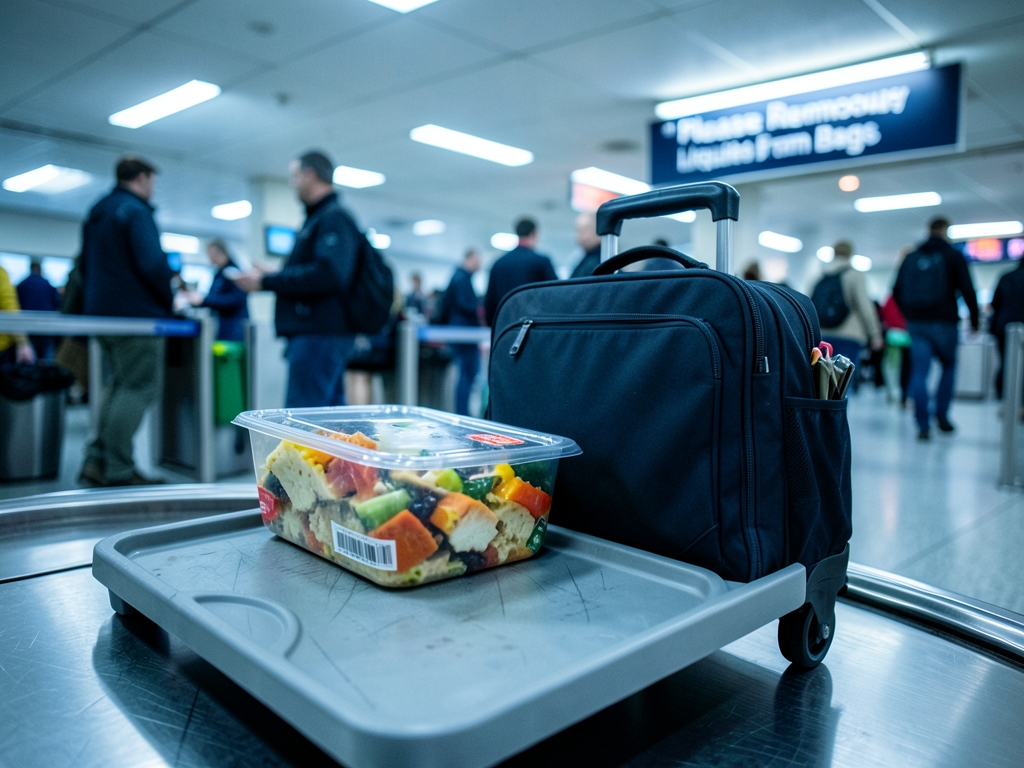
| Takeaway | Detail |
|---|---|
| Gravy and other liquid leftovers need a checked bag unless frozen solid. | TSA's year-round 3-1-1 rule covers gravy, cranberry sauce, soups, and mashed potatoes with liquid, even in containers under 3.4 oz. |
| Use the squeeze test to identify a TSA liquid. | If a leftover spreads, pours, or “squirts, smears, or slumps” when squeezed, treat it as a liquid under the 3-1-1 rule. |
| Freezing solid is the carry-on exception for liquid leftovers. | A liquid leftover must be frozen solid for carry-on; otherwise, put it in a checked bag. |
| Refrigerated leftovers have a USDA 4-day limit. | Eat refrigerated Thanksgiving leftovers before the USDA's 4-day fridge window closes. |
Gravy counts as a liquid under TSA's year-round 3-1-1 rule. A container of 3.4 ounces (100 ml) or less can travel in carry-on inside your quart bag, but a typical serving of gravy exceeds that limit, so plan on a checked bag or freeze it solid before security.
The answer changes if the gravy is frozen solid before security, allowing it in a carry-on.
The 3-1-1 rule applies to your stuffing
The Thanksgiving menu does not change airport security rules. For ordinary carry-on packing, the Transportation Security Administration’s (TSA) year-round 3-1-1 rule limits each liquid container to 3.4 ounces (100 ml). Gravy, cranberry sauce and soup face the same container limit as shampoo; there is no holiday carve-out. A small portion in a compliant container can qualify, but a larger container of the same food does not qualify under the ordinary liquid limit.
TSA’s own guidance classifies food by how it behaves under pressure, not by whether it looks solid. If an item “squirts, spreads, smears or slumps” when squeezed, it counts as a liquid. Apply that squeeze test to the portion you actually packed: a dry bread roll passes as a dry food, while mashed potatoes with gravy mixed in do not. The gravy changes the classification, so treat the mixture as a liquid rather than relying on the potatoes’ appearance.
Check the container as well as the food. For anything that fails the squeeze test, measure the amount in the container you plan to bring; the limit applies to each container, not to the food’s name or the size of the original serving dish. If it exceeds 3.4 ounces (100 ml), portion it into compliant containers before packing. Thick foods such as cranberry sauce still need this check because thickness alone does not make them dry.
Frozen-solid liquids receive a conditional pass. TSA allows fully frozen liquids through security, but the exception depends on the item remaining fully frozen at screening. If it has thawed or become slushy, it must meet the ordinary liquid restrictions. Pack it to stay solid and expect that screeners may inspect it; calling it “frozen” is not a substitute for its actual condition.
Before leaving for the airport, run a simple check: squeeze the food, measure each liquid container and confirm that anything relying on the frozen exception is still solid. Keep those items accessible for inspection and follow any request for additional screening. A container that met the limit at home still has to satisfy TSA’s assessment at the checkpoint, so do not pack a liquid leftover loose and expect its holiday origin to excuse it.
What the sources actually converge
When food-safety outlets cover Thanksgiving leftovers, they differ on storage tips and recipes, but they converge on one calendar number: the U.S. Department of Agriculture consume-or-freeze deadline of November 30. As WLNS reported from USDA guidance, leftovers should be eaten or frozen by that date to avoid an increased risk of food poisoning. Measured from the Thursday holiday, that deadline creates a four-day refrigerator window, giving travelers a clear cutoff instead of a guess based on smell or appearance.
The same limit appears in independent coverage. USA TODAY's food-safety experts and People's storage guide align on a three-to-four-day refrigerator window for turkey and sides, with freezing as the only way to extend safe storage beyond that period. The convergence matters because the clock starts at Thanksgiving dinner, not when leftovers go into the fridge, not when they are packed, and not when you arrive at your destination. A long holiday weekend can use most of that window before a return trip even begins.
Montgomery Advertiser's freezing guide confirms the mechanism behind that extension: turkey, stuffing, and sides can be frozen safely. Freezing stops the refrigerator countdown, which makes it the only food-safety move for leftovers you plan to keep past November 30. Timing matters as much as method. Freezing on day four preserves the food, while waiting until after the deadline means the refrigerator window has already closed.
For travelers, the pre-flight check is simple. Count forward from Thursday and compare November 30 with your travel day: refrigerated leftovers should be consumed within the four-day window, and anything you want to keep longer should be frozen by that date. The sources vary in format, but the food-safety boundary is the same, and it gives every post-holiday plan a hard stop before the trip home.
Carry-on vs checked vs eat-it-now
The practical choice for Thanksgiving leftovers is not which container to use but which channel to use. Anything that spreads, pours, or slumps belongs out of carry-on; the workable alternatives are checked baggage or eating it before you leave.
| Food type | Winner | Why |
|---|---|---|
| Gravy, soup, cranberry sauce | Checked bag | No 3.4-ounce cap, no freeze requirement, and no checkpoint confiscation risk |
| Cooked turkey slices, rolls, pie, dry stuffing | Carry-on | Solids are exempt from 3-1-1; TSA explicitly allows a whole pie |
| Leftovers you cannot eat soon after landing | Eat or freeze before flying | Checked baggage is not refrigerated, so transit time still counts against safe holding time |
For liquids, checked baggage is the clear winner. There is no 3.4-ounce (100 ml) container limit, no need to freeze the item solid, and no risk of losing it at the security checkpoint. Use sealed, leakproof containers, and keep the bag cold with frozen gel packs or ice if the food will sit for hours. Checked liquids should be in sealed, leakproof containers; if a container opens in transit, it can ruin clothing and other packed items.
For solid foods, carry-on is the better channel. Cooked turkey slices, rolls, pie, and dry stuffing are not treated as liquids under 3-1-1, and TSA explicitly allows a whole pie in carry-on. Pack solids where an officer can inspect them without unpacking the whole bag. Rigid containers also protect pies and rolls from being crushed, and an officer may ask to see solid food during screening.
For the time problem, the winner is to eat or freeze before you fly. A leftover that sits in checked baggage through a delay and a flight is still aging on the food-safety clock; if you cannot eat it soon after arrival, freeze it before travel or plan to finish it before departure. Decide this before packing, because a checked bag is not refrigerated and airport delays are outside your control.
Match the food's state to the channel: liquids go checked, solids go carry-on, and anything with a short safe window gets eaten or frozen before the trip.
The real cost of a confiscated gravy boat
I price a leftover before I pack it. The question is not whether a gravy boat fits in the carry-on; it is what the fit will cost if I am wrong. At the checkpoint, the bill arrives as a surrendered container. At the airline counter, it arrives as a fee. At a foreign arrival hall, it can arrive as a penalty. Those are three different prices for the same spoonful, and only one of them is quoted before you leave the house.
The documented worst case belongs to a traveler reported by Engoo Daily News: a passenger flying from Hong Kong to Taiwan carried airline-meal leftovers through customs and was fined $6,200. That is the number I use when someone says taking food across a border is harmless. It was not a security confiscation; it was a customs penalty at arrival. The meal was already paid for, and the leftover produced a separate bill at the door.
For domestic travel, the baseline cost is the checked bag. Check your airline's current first- and second-checked-bag fee before you decide, because that figure is knowable and the checkpoint outcome is not. A fee you can look up is a cost you can budget; a container of gravy taken away at security is a cost you absorb with no receipt. If the checked-bag charge is less than the value you place on the food, the math is settled before you reach the gate.
Being wrong in carry-on carries no citation. TSA does not issue a fine for a leftover that fails screening; the agent removes the item and you keep walking. The penalty is the food itself, gone in full. That is why I treat the carry-on as the expensive option even when it looks free: there is no charge at the checkpoint, but the loss is the entire container, not a dent in it.
So run the cost check before you zip. Ask what the airline charges today for the first and second checked bag, ask whether the route ends at a customs desk, and ask whether the container is worth replacing at the other end. If the answer includes a border, that customs case sets the outer limit; if it stays domestic, the checked-bag fee is the floor and the confiscated gravy boat is the ceiling. Either way, the cheap move is the one you can price in advance.
Where the freeze-solid trick breaks
The freeze trick is not a blanket pass. I use one edge-case table to separate when frozen carry-on food passes screening from when it fails, because the checkpoint test and the arrival-country test are different questions.
| Situation | What happens |
|---|---|
| Nonstop domestic flight, food frozen hard at the checkpoint | Passes screening as a frozen solid item |
| A frozen gravy, soup, cranberry sauce or mashed-potato portion that has softened into slush in a security line or on the tarmac | Fails: TSA treats slushy or partially melted food as a liquid and removes it |
| International connection or arrival | Customs rules, not TSA, decide whether the food may enter |
The first failure is timing. A frozen gravy cube that is rock-hard when you leave home can soften during a long tarmac delay or a slow security line; once it is slushy, TSA's frozen-solid exception is gone and the cube is pulled out. The check is tactile: press the container through the bag. If it dents, slumps, or leaves a wet edge, do not count on the exception.
The second failure is geography. On an international connection, clearing TSA does not settle the question; the arrival country's customs and agriculture rules govern what can come in. Engoo Daily News reported a Taiwan leftover case in which a passenger's airplane meal led to a penalty, a reminder that agricultural and food restrictions can produce fines far beyond the value of the food.
The win condition is narrow: nonstop domestic, frozen hard at screen. That means packing the item so it stays solid from the last freezer before the airport to the checkpoint, with no reliance on a cooler that warms unevenly. If your itinerary adds a connection, a border, or an uncertain gate hold, the freeze-solid trick stops being a carry-on strategy and becomes a gamble.
Before you commit, run the squeeze test before you leave: if it spreads, pours, squirts, smears, or slumps, it does not belong in your carry-on. If it still feels like a block, keep it frozen until the bin; if you cannot guarantee that, choose the option that does not depend on a checkpoint exception.
Flying 4 leftovers home
For this nonstop domestic return the Sunday after Thanksgiving, use one worksheet for the four leftovers in the cooler: 1 cup turkey gravy, 2 cups sliced turkey, 1 pumpkin pie, and 1 cup cranberry sauce. The worksheet is not a recipe or storage guide; it is a packing record that gives each dish one decision after two checkpoints, and it should be completed before the bag is zipped.
Checkpoint 1 is the squeeze test. Gravy and cranberry sauce fail because they spread, pour, or slump; at 1 cup each, or 8 fluid ounces, they are above the 3.4-ounce carry-on liquid limit and are checked-bag only. Sliced turkey and pumpkin pie hold their shape, so they pass and are carry-on eligible. The amount matters only for the liquids: 2 cups of sliced turkey does not become a liquid because the slices are solid, and one pie is a solid dessert.
| Leftover | Amount | Squeeze test | Packing decision |
|---|---|---|---|
| Turkey gravy | 1 cup | Fail (liquid) | Checked bag only |
| Sliced turkey | 2 cups | Pass (solid) | Carry-on eligible |
| Pumpkin pie | 1 pie | Pass (solid) | Carry-on eligible |
| Cranberry sauce | 1 cup | Fail (liquid) | Checked bag only |
Checkpoint 2 is the clock. The USDA consume-or-freeze deadline reported by WLNS is November 30, which gives roughly a four-day refrigerator window from Thursday's dinner. Any of these four items that has not been eaten or frozen by the day before your flight — and in any case by November 30 — should be discarded instead of flown. That check comes first in practice: a dish that fails it gets no bag decision, even if it would otherwise pass the squeeze test.
Run the worksheet top to bottom: squeeze test, Saturday-night clock check, then the single recorded decision. A liquid that fails either check stays out of carry-on; a solid that fails the clock check stays home. If a liquid passes the clock check but fails the squeeze test, it still goes only in a checked bag.
Keep the completed worksheet with the travel documents so the choice is settled before security. The value of the sheet is that it prevents a last-minute decision at the checkpoint, when a 1-cup container of gravy or cranberry sauce would have to be surrendered or moved.
For this specific four-item load, the worksheet yields two checked-bag items and two carry-on items, assuming all four pass the Saturday-night clock check.
Worked Example: Run the Numbers
Here is the one worked example this section runs end to end. Illustration only: a family of four finishes Thanksgiving dinner on Thursday, November 26, 2026, and flies home on Sunday, November 29, 2026. The leftovers in question are a small container of gravy, a container of cranberry sauce, and a container of mashed potatoes with enough liquid to slump when the container is squeezed. No fare, fee, or route figure is needed to work the numbers; the only inputs are the calendar dates, the container count, and the rule already established elsewhere in this piece.
Step one is the calendar. Take the example of dinner on Thursday, November 26, 2026, with the flight home on Sunday, November 29, 2026, and the USDA consume-or-freeze date reported by WLNS of November 30. Counting elapsed days from dinner to the flight gives three days: November 27, 28, and 29. The flight therefore lands one calendar day before the November 30 deadline. That is the entire date arithmetic; it does not turn the leftovers into a carry-on item, and it does not extend the deadline past what the USDA guidance supports.
Step two is the container count. The example uses three leftover containers, each holding a spreadable, pourable, or slumping food. Under the squeeze test, each one is treated as a liquid for carry-on purposes, so all three containers fail the carry-on test unless each is 3.4 ounces (100 ml) or less and fits in the quart bag. The point is the classification, not the volume: even a small container counts when the food behaves like a liquid when squeezed. If one of those containers were replaced by a dry, non-slumping item, the count would change; this example does not assume that replacement.
Step three is the clock-to-rule comparison. In this example the family has one day between arrival on November 29 and the November 30 consume-or-freeze date. The check is whether they can eat the three containers before that date or freeze them before that date. If they eat all three by November 30, the carry-on question disappears. If they freeze all three solid before that date, the carry-on question changes from a liquid-container problem to a frozen-state check. If neither happens, the deadline has passed and the safe move is to discard rather than pack.
For this illustration, the winner is eat-it-now: three containers consumed before November 30 beats packing them, because it resolves both the food-safety clock and the carry-on classification without relying on a freezer or a checkpoint outcome. The break-even trigger is the deadline itself. If the family cannot finish the three containers by November 30, the result flips to freeze-before-the-deadline or discard; it does not flip to carry-on just because the flight is earlier than the deadline. Recheck the date on your own trip against the USDA date reported by WLNS, then apply the squeeze test to each container before you decide.
Five rules for the post-Thanksgiving flight
Run these five checks in order before you pack any Thanksgiving leftover. Each one turns a screening rule, a food-safety date, or a bag choice into a yes-or-no decision, so you are not guessing at the checkpoint.
| If... | Then... |
|---|---|
| It pours, spreads, or slumps | Treat it as a liquid: checked bag or frozen solid; no container above 3.4 oz in carry-on |
| Container is 3.4 oz (100 ml) or less and item stays firm | Carry-on can work in the quart bag |
| Flight is after November 30 | USDA window closed: freeze before flying or leave it |
| Connecting to an international flight | Skip leftovers; arrival rules can exceed food value (Taiwan $6,200 fine) |
| Any check is uncertain | Default to checked bag or eat before boarding |
The first check is physical, and it is the same squeeze test applied throughout this article: if the food pours, spreads, or slumps after chilling, treat it as a liquid. Test it cold, because a warm dish can slump even if it looked firm on the table. The physical test matters more than the recipe name.
The second check is size. A container at or below 3.4 ounces (100 ml) can still work in carry-on if the item stays firm and fits in your quart bag; if the container is larger, do not test the limit. Measure the container, not the portion inside it. Keep the quart bag accessible for screening.
The third and fourth checks are date and itinerary. If your flight is after November 30, the USDA consume-or-freeze deadline has passed, so freeze the item before flying or leave it behind. If you are connecting to an international flight, skip leftovers entirely; arrival-country rules can cost more than the food is worth, as the Taiwan $6,200 fine shows. A domestic checkpoint decision does not protect you from a destination-country inspection.
The fifth check is the default. If any detail is uncertain—container size, firmness, date, or destination rule—choose the conservative option: checked bag or eat it before boarding. When two rules conflict, remove the item from the checkpoint or from the trip rather than hoping for an exception. Do not rely on an agent's discretion.
Also worth reading Carry-on liquid limits: ~$15 TSA kit TSA carry-on screening: the 3-1-1 Mastering the TSA 311 liquid rule
What to do next
Frequently Asked Questions
What should I do if my Thanksgiving gravy is not frozen before a flight?
A liquid leftover must be frozen solid for carry-on; otherwise, put it in a checked bag.
How does the squeeze test classify a liquid Thanksgiving leftover?
If a leftover spreads, pours, or “squirts, smears, or slumps” when squeezed, treat it as a liquid under the 3-1-1 rule.
How much gravy can I bring in a carry-on?
A container of 3.4 ounces (100 ml) or less can travel in carry-on inside your quart bag, but a typical serving of gravy exceeds that limit, so plan on a checked bag or freeze it solid before security.
How long can I keep refrigerated Thanksgiving leftovers before eating?
Refrigerated leftovers have a USDA 4-day limit, so eat refrigerated Thanksgiving leftovers before the USDA's 4-day fridge window closes.
Is there a Thanksgiving TSA holiday exception for cranberry sauce?
The Thanksgiving menu does not change airport security rules, and there is no holiday carve-out.
Are mashed potatoes considered liquids under TSA rules?
TSA's year-round 3-1-1 rule covers mashed potatoes with liquid, even in containers under 3.4 oz.
Quick answers
| How does TSA's squeeze test identify a liquid leftover? | If a leftover spreads, pours, or “squirts, smears, or slumps” when squeezed, treat it as a liquid under the 3-1-1 rule. |
| When can a liquid leftover go in a carry-on? | A liquid leftover must be frozen solid for carry-on; otherwise, put it in a checked bag. |
| Does gravy count as a liquid under TSA's rules? | Gravy counts as a liquid under TSA's year-round 3-1-1 rule. |
| Which Thanksgiving leftovers does TSA's year-round 3-1-1 rule cover? | TSA's year-round 3-1-1 rule covers gravy, cranberry sauce, soups, and mashed potatoes with liquid, even in containers under 3.4 oz. |
| Does the Thanksgiving menu change airport security rules? | The Thanksgiving menu does not change airport security rules. |
Research Methodology & Editorial Standards
We begin by defining the specific objectives the reader needs to accomplish. Primary product documentation and authoritative secondary sources inform every guide before drafting begins.
Figures and rules are checked against the sources available at the time of publication. Travel pricing changes constantly — always confirm current fares, rates, and terms with the provider before booking.