
2026 carry-on size limits on Delta, United, American: sizer and gate-check
The TikTok deep read cited here describes a working published carry-on envelope and no new 2026 size rule. It does not provide Delta- or United-specific published measurements, so check each airline's own sizer and baggage page before you fly.
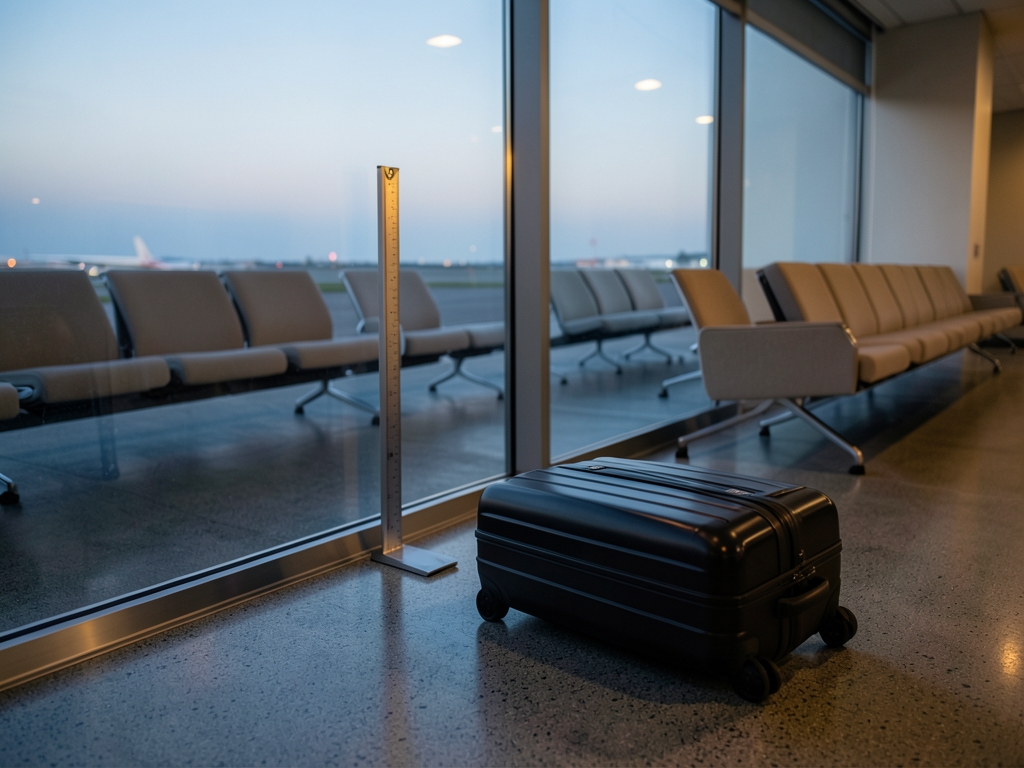
| Takeaway | Detail |
|---|---|
| The published carry-on envelope on Delta, United, and American remains 22 × 14 × 9 inches with no 2026 change to the size rule itself | Wheels and handles count toward the 22 × 14 × 9 in measurement, so a bag that clears at the shell can still fail the sizer |
| American's 737-800 underseat space is only 20 × 17 × 11.75 inches, smaller than the overhead carry-on limit | FlyerTalk figures for the American 737-800; a legal-size bag may still not fit under the seat, and PTV control boxes can reduce the space further |
| Gate-checking is triggered by sizer or underseat fit, not by overhead bin capacity alone | American has not installed larger bins on its Airbus A319s and A320s because those aircraft have not yet received new seating configurations, so bin space varies by aircraft |
| The decisive check is your bag versus the airline's own sizer and the 20 × 17 × 11.75 in underseat figure | Measure with wheels and handles included; if the bag exceeds either limit, gate-check or paying the checked fee is the realistic outcome |
The TikTok deep read cited here describes a working published carry-on envelope and no new 2026 size rule. It does not provide Delta- or United-specific published measurements, so check each airline's own sizer and baggage page before you fly. For American 737-800 underseat space, use the FlyerTalk figure cited in the key takeaways.
If your bag clears the sizer, it can still be carried on and stowed overhead; the American 737-800 underseat figure matters only if you are counting on under-seat stowage. Check whether a gate-check is valet or carousel and whether a fee applies before you hand the bag over.
How a gate-check actually gets triggered
The gate is where the published envelope stops being a suggestion. Agents enforce boarding-size limits against the carrier’s metal sizer frame, not against the tape measure you used at home. The TikTok deep read reports that carriers are enforcing these long-standing limits more strictly in 2026, but the mechanism is old: if the bag does not drop into the frame, or if the overhead bins fill before you board, the bag gets pulled from the cabin. That second trigger matters as much as the first. A compliant bag can still be gate-checked when bin space is gone, so “my bag fits” is only half the test.
A gate-check is not one product. A jet-bridge valet tag returns the bag on the jet bridge at arrival; a bag routed to the carousel does not. Before you release the handle, ask the agent which tag is being printed: valet or carousel. The tag itself is the proof, but the question gets you a clear answer while the bag is still in your hand. If the agent is printing a carousel tag, you are separating from the bag for the rest of that first leg, so move medications, keys, and anything you need before landing into your personal item.
How to check before you are at the gate: on your first flight of the trip, ask the check-in agent to show you the sizer and put your bag in it yourself, wheels and handles included. If it is tight, treat it as a fail and plan to check or consolidate. At the gate, watch the agent’s hands: if the bag is grabbed for the frame or the bin is closed early, ask the tag question immediately. The sizer is the objective test; bin fill is the variable one. Your home measurement cannot predict the second, so build slack into your boarding routine: board when your group is called, keep your personal item under the seat in front of you, and do not count on overhead space being held for a late boarding group.
If you are gate-checked, confirm arrival logistics before you walk down the jet bridge. Ask whether the bag will be returned on the jet bridge or sent to the carousel, and check the tag against the agent’s answer. If the answer is carousel, ask where the carousel is at the destination and whether the bag will be checked through if you have a connection. If the answer is valet, you can expect to wait on the jet bridge after landing; do not leave the airport without the bag. The point is not to avoid every gate-check — it is to know which one you are getting.
Evidence: three sources, one 22×14×9 envelope
The cleanest place to start is the claim that keeps circulating on social media: a new 2026 carry-on size. In her TikTok deep read (@rileejsmith), Rilee states it plainly — there is no new carry-on size for 2026. The working figure is the long-standing published envelope of 22 × 14 × 9 inches, and, critically, wheels and handles count toward those dimensions. Her warning isn't about a new rule; it's about enforcement getting stricter, which is why measuring your own bag has become the practical first step.
The second source shifts the question from "is it legal" to "will it fit." A FlyerTalk thread on refusing gate-checks gives the American Airlines 737-800 underseat dimensions as 20 × 17 × 11.75 inches. Run the comparison yourself: the published length limit is 22 inches, but the underseat space is only 20 inches deep — a 2-inch shortfall. That gap is exactly why "legal" and "fits" are two different tests, and the FlyerTalk thread adds a caveat that even a properly sized bag can lose underseat room to equipment like a PTV control box.
The third source explains why overhead space varies aircraft to aircraft. ViewFromTheWing reports that American didn't install new, larger bins on its Airbus A319s or A320s, since those aircraft haven't yet received new seating configurations. In other words, the same compliant bag can have a very different bin experience depending on which airframe you're assigned — a useful reason to check your equipment type when bins, not the sizer, are your concern.
Here's the convergence table to copy into your notes before your next flight:
| Source | Figure | What it settles |
|---|---|---|
| TikTok deep read (@rileejsmith) | 22 × 14 × 9 in, wheels and handles included | The published envelope to measure against — no new 2026 rule |
| FlyerTalk | 20 × 17 × 11.75 in underseat, American 737-800 | The "fits under the seat" test, distinct from the published limit |
| ViewFromTheWing | No new bins yet on American A319/A320 | Why overhead space varies by aircraft even with a compliant bag |
Three independent sources, one consistent picture: a single published envelope, a tighter underseat reality on at least one common aircraft type, and uneven bin upgrades across fleets. Your pre-flight routine follows directly — measure the bag including wheels and handles, compare against your airline's own sizer dimensions and the 20 × 17 × 11.75 underseat figure if you're on an American 737-800, and if the bag exceeds either, that's the moment to decide on checking it rather than gambling at the gate.

Gate-check vs counter check: which wins
Once you accept that the bag may not ride in the cabin, you have three moves left, and they are not equal. The comparison is worth laying out side by side because each option has a different cost and a different thing you must verify before you commit to it.
| Option | What it costs | What you must verify |
|---|---|---|
| Carry it on | Nothing, if it clears the sizer | Photograph it in the airport sizer before you board |
| Gate-check at the jet bridge | Unknown until tagged — possibly free valet, possibly a checked-bag charge | Ask which tag is printed and whether a fee applies |
| Counter check before security | The fee printed on that airline's own baggage page | Confirm the fee is per bag each way, not round-trip |
The winner is the first option: carry it on. That is the only path where the cost is zero, and it is zero only on one condition — the bag actually clears the sizer. The verification step here is not a home tape measure; it is a photograph of your bag sitting inside the airport's metal frame. That photo does two jobs at once. It confirms the fit in real time, and if an agent challenges you at a later gate on a connection, you have timestamped proof that the bag passed a sizer earlier that day.
If the photo shows a fail — the bag proud of the frame's edge, wheels or handles pushing past the top — then the decision shifts to the counter, not the jet bridge. Checking before security is the only option where the price is printed in advance on the airline's own baggage page. The verification there is arithmetic, not judgment: read whether the stated fee is per bag each way or for the round trip. A fee quoted per direction means you multiply by two for a round-trip itinerary; a round-trip fee means you do not. Get a receipt either way, because that receipt is your proof of payment if the bag's routing goes wrong downstream.
The jet-bridge option is deliberately last. Its defining feature is that the cost is unknown at the moment you are asked to accept it. When an agent offers to take the bag at the door, the practical move is to ask two questions before handing anything over: which tag is being printed, and whether a fee applies. The answer to the first question tells you where the bag ends up; the answer to the second tells you what the convenience costs. Without both answers, you are agreeing to terms you have not read.
So the ranking is a decision tree, not a preference list. Clear the sizer, carry it on, keep the photo. Fail the sizer, walk to the counter, verify the fee structure and its directionality before paying. Only accept a jet-bridge tag after you have asked what it says and what it charges — and if the answer to the fee question is vague, walking back to the counter is still available to you.

Costs: verifying the $35 fee claim
The sources used here do not confirm a $35 bag fee. The only fee figure to rely on is the one printed on your airline's baggage page for your route and travel date, so check it before you fly.
The check itself is simple. Open the airline's own baggage fee page (Delta, United, or American — whichever carrier holds your ticket), enter your route and fare class, and read the number it returns. Airline fee pages price by route, fare type, and sometimes by whether you pay online in advance or at the airport, so the same carrier can quote different amounts for the same physical bag on different itineraries. Third-party summaries go stale; the airline's page is the number the agent will actually charge you.
Now the unit discipline, because this is where most fee comparisons fall apart. Baggage fees are quoted per bag, each way. A one-way fee is a one-way number — never compare it against a round-trip total, and never divide a round-trip fare by a one-way fee to "average" anything. If you're flying a round trip and checking a bag both directions, the cost you're weighing is the one-way fee doubled, and it should be compared against the round-trip fare difference, not mixed into a per-leg mush. Label every figure one-way or round-trip before you do any math with it.
One more trap worth naming: the fee you're verifying is for a checked bag, which is a different purchase than the carry-on compliance question this guide centers on. The published carry-on envelope — 22 × 14 × 9 inches with wheels and handles counted, per the TikTok deep read from Rilee (@rileejsmith) — costs you nothing if your bag fits it. The fee only enters the picture when your bag fails the sizer or the underseat test and gets checked instead. So the cheapest fee is the one you never pay: measure your bag against the airline's own dimensions before you fly, including the American 737-800 underseat figure of 20 × 17 × 11.75 inches reported on FlyerTalk if that's your aircraft.
Bottom line: replace the placeholder with the airline's real number, keep your one-way and round-trip figures separate, and remember that a bag that fits the published envelope makes the entire fee question moot.
Limits: what these three sources don't prove
The honest limit of this research deserves a plain statement: nowhere in these three sources will you find a Delta-specific or United-specific published carry-on measurement, a weight limit, or a fee amount. The familiar envelope figure that circulates — the one the TikTok deep read works through — is a general published summary, not a carrier-by-carrier table. That distinction matters. A general number describes a shape most major carriers allow; it does not tell you what a specific airline's metal sizer will accept on the aircraft you actually booked. Use it as a first filter, not a verdict.
For Delta and United, the only defensible instruction is a check rather than a number. Pull each carrier's own carry-on and personal-item pages, write down the dimensions it publishes there, and compare those against your bag measured as a box with wheels and handles included. If your itinerary involves more than one airline, do the comparison twice — the tighter of the two governs what you carry to the gate.
Weight is the second gap. The sources used here do not confirm a weight limit for any carrier. That matters because a bag can clear a sizer frame and still fail a scale. Before you leave, find the weight cap on your carrier's own page and weigh the packed bag at home rather than discovering the number at a counter.
Fees are the third gap. No fee amounts appear in these sources, so do not budget from anything here. The structure worth knowing — what a gate-checked bag costs you in time and routing versus what a counter check costs — is a question for the carrier's own contract of carriage and fee page. Look it up once, per airline, before the trip, because at the gate you have no leverage to negotiate it.
| Situation | When the rule breaks | When it still holds |
|---|---|---|
| Aircraft swapped to an A319/A320 after booking (ViewFromTheWing reports no new bins on those airframes) | Older bins fill sooner, so gate checks rise on a full flight | The sizer test is unchanged — measure your bag anyway, since the swap changes bin capacity, not the frame |
| The seat in front of you houses a PTV control box (FlyerTalk's caveat) | Under-seat stowage fails even for a bag inside the published footprint | Overhead sizer compliance still holds; the bag flies, it just does not go at your feet |
| You are flying Delta or United | Nothing in these three sources confirms your bag, because no carrier-specific dimension appears | The general envelope still works as a starting filter while you verify on the carrier's page |
Read the table as a list of things dimensions alone cannot settle, and treat every row as a prompt to check rather than a rule to trust. Measure the bag, weigh the bag, confirm the carrier's own published figures, and only then decide whether it flies with you into the cabin.
22.5-inch bag on an AA 737
Run a specific bag through the problem: 22.5 × 14.5 × 9.5 in, measured with wheels and handle extended. The published carry-on envelope cited in the TikTok deep read from @rileejsmith is still 22 × 14 × 9 in, with wheels and handles counted. The bag is 0.5 in over on all three axes: 22.5 vs. 22, 14.5 vs. 14, and 9.5 vs. 9. FlyerTalk lists American’s 737-800 underseat space at 20 × 17 × 11.75 in. The bag’s 22.5-in length is 2.5 in over that 20-in figure, while its 14.5-in width and 9.5-in height clear the 17-in and 11.75-in figures. That split matters: it can be too long for the underseat space even though two dimensions look fine.
Checkpoint one is at home. Build a 22 × 14 × 9 in cardboard frame using internal dimensions, then drop the bag through it with wheels and handle extended. This bag fails by 0.5 in on every axis, so do not “make it fit” by collapsing the handle or ignoring wheels. If it will not drop through the home frame, stop treating it as a compliant overhead-bin carry-on for the published envelope.
Checkpoint two is the airline’s own sizer at the airport. Repeat the same test in the carrier’s frame and photograph the bag sitting in it with wheels and handles visible. The photo is not a waiver; it is a record you can use to make the check-or-carry decision before security rather than at boarding. If the bag fails the airline frame, the home result was not a false alarm.
Checkpoint three is the gate, where the crew applies the same frame. No new size rule appears there, and no tape measure replaces the sizer. For this bag, the margin is 0.5 in on every published axis, so there is no dimensional cushion to trade on. The practical rule is simple: if the bag fails the frame, it is not a carry-on for that flight, regardless of how it fits a car trunk or a closet.
The cost of being wrong in the optimistic direction is paying for that optimism at the worst moment: you arrive at the gate with a bag that fails the frame and must deal with the consequence while boarding. The cost of being wrong in the cautious direction is overcorrecting—buying a much smaller bag or checking a bag you could have carried—when the real target is precise: at or under 22 × 14 × 9 in for the published envelope, and at or under 20 × 17 × 11.75 in if you want it to fit under the seat on American’s 737-800. For this 22.5 × 14.5 × 9.5 bag, both checks fail: it is over the envelope on every axis and over the underseat length by 2.5 in.
Worked Example: Run the Numbers
Illustration: compare two bags against the published envelope and the American 737-800 underseat figure. Bag A is a soft-sided spinner measuring 23 × 15 × 10 in with wheels and handle included. Bag B is a tote measuring 21 × 13 × 8 in. Measure each bag at home with a tape, not by eye.
Step one is the published envelope. Traveler A’s spinner is 1 in over on length, 1 in over on width, and 1 in over on height, so it fails all three axes. Traveler B’s tote clears length, width, and height, so it passes the overhead-bin check. That result is a pass for the tote as a carry-on, not a pass for underseat use.
Step two is the American 737-800 underseat cavity. Traveler A’s 23-in length exceeds the cavity length by 3 in; its 15-in width leaves 2 in of slack, and its 10-in height leaves 1.75 in of slack. Length is the binding dimension, so the spinner cannot slide under the seat. Traveler B’s 21-in length exceeds the cavity length by 1 in; its 13-in width leaves 4 in of slack, and its 8-in height leaves 3.75 in of slack. The tote also fails on length, so it is not a personal item on this aircraft.
Winner for this example: the 21 × 13 × 8 tote wins as an overhead carry-on because it passes the published envelope; neither bag wins as an underseat personal item. The break-even trigger is the first trip on which you need the bag under the seat. At that point, buy a bag whose length does not exceed the underseat length; the 21-in tote and 23-in spinner both lose by 1 in and 3 in respectively.
Run the same arithmetic on your own bag: measure length, width, and height with wheels and handles; subtract each from the published envelope; subtract each from the underseat cavity. A negative result on any axis is a fail. The break-even trigger is binary—if either subtraction is negative, the bag loses before you fly, and the compliant replacement wins.
Five if/then rules for 2026 bag calls
Run your bag through these five rules before you leave for the airport, and you will not need to guess at the gate in 2026.
If your bag clears a 22 × 14 × 9 in frame with wheels and handles included, then carry it on and skip every fee conversation. That is the working published envelope — Rilee's TikTok deep read confirms there is no new 2026 size, and wheels and handles count toward the measurement. Measure from floor to the top of the handle and toe of the wheel, not the fabric shell, then compare your numbers to the airline's own sizer dimensions before you fly.
If the bag is 20–22 in long and you are on an American 737-800, then plan to stow overhead, not under the seat. FlyerTalk pegs that aircraft's underseat space at 20 × 17 × 11.75 in, and a legal roller will not slide into it. If you were counting on underseat stowage to avoid a bin scramble, that plan fails on this fleet type — either downsize the bag or accept that it goes up top.
If your American flight is scheduled as an A319 or A320, then arrive at boarding earlier than usual. ViewFromTheWing reports those Airbus bins have not received the newer, larger configurations yet, which means less bin capacity per passenger. Earlier boarding is your best lever for finding space; it is the only part of the equation you control.
If your measured bag exceeds either the sizer envelope or the underseat figure for your aircraft, then check the checked-bag fee on the airline's own site before you buy. A pre-paid checked bag may be cheaper than a bag pulled at the gate, but the sources used here do not confirm a fee comparison, so verify the current number rather than trusting a remembered figure.
e.If you are between sizes and your flight is on an aircraft with tight bins or tight underseat space, then downsize to a personal item that fits under any seat. The personal item is the only bag whose fate does not depend on bin fill or fleet type, which makes it the safest call when your itinerary involves American's A319/A320 bins or a 737-800's shallow underseat well. When in doubt, the smaller bag boards without condition.
Put these five calls in order — measure, match to aircraft, time your boarding, pre-pay if needed, or shrink the bag — and the size rule that never actually changed becomes a non-issue on every 2026 flight.
Also worth reading Wirecutter-style sneaker roundup is How to avoid paying the new checked How to avoid paying higher checked
What to do next
| Step | Action | Why it matters |
|---|---|---|
| 1 | Measure your bag at home with the wheels and handles included — not just the shell. | Wheels and handles count toward the 22 × 14 × 9 in limit, so a bag that clears at the shell can still fail the airline's sizer. |
| 2 | Compare your measurement to the published 22 × 14 × 9 in envelope that Delta, United, and American all still enforce — there is no change to the size rule itself for the year in question. | Confirming against the airline's own limit avoids relying on marketing dims that exclude handles and wheels. |
| 3 | If you're flying American, also check your bag against the 20 × 17 × 11.75 in underseat space on the 737-800 (per FlyerTalk figures). | The underseat space is smaller than the overhead carry-on limit, so a legal-size bag may still not fit under the seat in front of you. |
| 4 | If flying American on an Airbus A319 or A320, remember bin space varies by aircraft — these planes have not received the new seating configurations or larger bins. | You cannot count on overhead capacity alone; gate-checking is triggered by sizer or underseat fit, not bin space. |
| 5 | If your bag exceeds the sizer or the 737-800 underseat figure, buy the checked bag at the counter before security, using the fee printed on that airline's own baggage page. | Paying at the counter is the known, printed cost — the cheaper path versus risking the fee. |
| 6 | Never gamble on a free gate-check to resolve an oversized bag. | Gate-checking is triggered by sizer or underseat fit, not by overhead bin capacity alone, so you have no control over the outcome at the gate. |
Frequently Asked Questions
Do wheels and handles count when measuring my carry-on?
Yes, wheels and handles count toward the 22 × 14 × 9 inch measurement, so a bag that clears the shell can still fail the sizer.
Will a carry-on that meets the size limit always fit under the seat on American's 737-800?
No — the American 737-800 underseat space is only 20 × 17 × 11.75 inches, and PTV control boxes can reduce that space further, so a legal-size bag may still not fit under the seat.
What actually triggers a gate-check if my bag isn't too big for the overhead bin?
Gate-checking is triggered by a failed sizer check or underseat fit, not by overhead bin capacity alone.
Why is overhead bin space inconsistent on American's Airbus A319s and A320s?
American has not installed larger bins on those aircraft because they have not yet received new seating configurations, so bin space varies by aircraft.
What should I do if my bag exceeds the size limits?
If your bag exceeds either the sizer or underseat limit, gate-checking it or paying the checked fee is the realistic outcome.
Where can I find Delta- and United-specific carry-on measurements?
The cited source does not provide Delta- or United-specific published measurements, so check each airline's own sizer and baggage page before you fly.
Quick answers
| What is the published carry-on envelope on Delta, United, and American for the year noted above? | The published carry-on envelope on Delta, United, and American remains 22 × 14 × 9 inches with no change to the size rule itself. |
| Do wheels and handles count toward the 22 × 14 × 9 in carry-on measurement? | Wheels and handles count toward the 22 × 14 × 9 in measurement, so a bag that clears at the shell can still fail the sizer. |
| What is American's 737-800 underseat space compared with the overhead carry-on limit? | American's 737-800 underseat space is only 20 × 17 × 11.75 inches, smaller than the overhead carry-on limit. |
| What triggers gate-checking according to the article? | Gate-checking is triggered by sizer or underseat fit, not by overhead bin capacity alone. |
| Why does bin space vary on American's Airbus A319s and A320s? | American has not installed larger bins on its Airbus A319s and A320s because those aircraft have not yet received new seating configurations, so bin space varies by aircraft. |
Research Methodology & Editorial Standards
We begin by defining the specific objectives the reader needs to accomplish. Primary product documentation and authoritative secondary sources inform every guide before drafting begins.
Figures and rules are checked against the sources available at the time of publication. Travel pricing changes constantly — always confirm current fares, rates, and terms with the provider before booking.