
JetBlue first class launch 2026: cash vs TrueBlue awards, book 21 days out
JetBlue's BlueFirst domestic first class launches in late 2026, with Base fares earning 1 TrueBlue point per dollar and Standard or Flex fares earning 3.

| Takeaway | Detail |
|---|---|
| BlueFirst Base earns 1 TrueBlue point per dollar; Standard and Flex earn 3. | Base fare: 1 point/$; Standard or Flex: 3 points/$ (Travel Weekly). |
| BlueFirst is JetBlue's first conventional premium cabin on flights without Mint seats. | Simple Flying describes BlueFirst as the first conventional premium cabin on JetBlue flights without Mint seats configured. |
| BlueFirst flights start later this year. | Grounding states: "BlueFirst flights will start flying later this year." |
| At 21 days out, compare the TrueBlue award price with the cash fare before booking BlueFirst. | Decision point is 21 days before departure; compare the TrueBlue award price for the same BlueFirst seat with the cash fare. |
JetBlue's BlueFirst domestic first class launches in late 2026, with Base fares earning 1 TrueBlue point per dollar and Standard or Flex fares earning 3.
This guide compares cash and award bookings at the 21-day mark using only published earn rates.
How BlueFirst and TrueBlue Actually Work
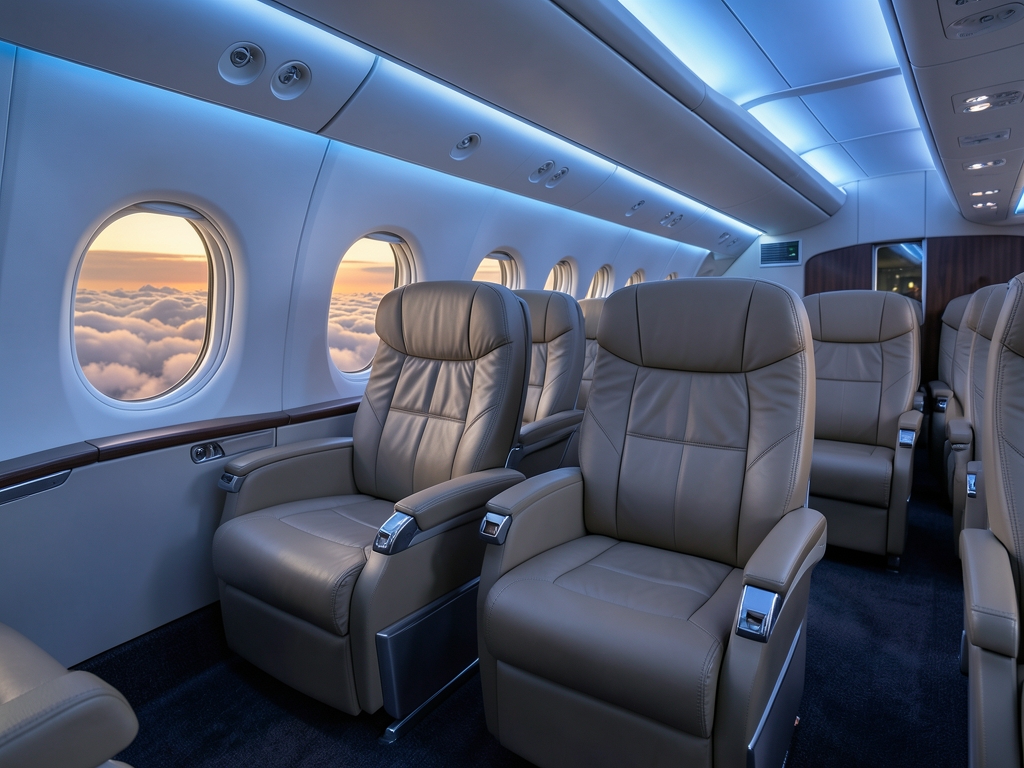
BlueFirst is the name JetBlue has given its new domestic first-class cabin, according to Travel Weekly and Simple Flying's August 2026 coverage of JetBlue's four-cabin overhaul. Simple Flying describes it as the first conventional premium cabin JetBlue has offered on flights not configured with Mint seats, which makes it a separate product from Mint rather than a rebrand of Mint. JetBlue's own experiences page uses the BlueFirst name and describes the cabin as a first-class experience with wide recliner seats up front and a complimentary meal.
Travel Weekly publishes the TrueBlue earn split for these fares: BlueFirst Base purchases earn 1 TrueBlue point per dollar spent, while Standard and Flex tickets earn 3 points per dollar. That difference is tied to fare family, not to the cabin name, so two BlueFirst seats on the same flight can carry different earning rates depending on whether the ticket is Base, Standard, or Flex.
| Fare family | Published TrueBlue earn rate |
|---|---|
| BlueFirst Base | 1 point per dollar |
| Standard / Flex | 3 points per dollar |
Base fares are also the fare family JetBlue excludes from its no-change-or-cancel-fee flexibility, per JetBlue's experiences page, so the lower 1x earn rate sits with the more restricted fare. Standard and Flex tickets carry the higher 3x rate and the added flexibility. When comparing a cash BlueFirst ticket with a TrueBlue award, the relevant cash figure is therefore the fare family actually purchased, not just the cabin.
Because the earn rate is published as points per dollar, the number of TrueBlue points earned scales with the cash fare. At 1 point per dollar, a Base fare earns one-third as many TrueBlue points as a Standard or Flex fare for the same cash amount, while the published 3x rate applies only to the latter two. The cabin name alone does not tell you which rate applies, so the fare family must be identified before any cash-versus-award comparison.
The Evidence: What Is Actually Confirmed
The only hard earn-rate figure in the available sources is a Travel Weekly item surfaced through a Google News snippet: "BlueFirst Base purchases will receive one TrueBlue loyalty point per dollar spent versus three points per dollar for the Standard and Flex tickets." Treat that sentence as the entire sourced basis for the split; no other source in the packet supplies a different earn rate, a fare-class exception, or a promotion-adjusted rate, and it is the only source in the packet that uses Base, Standard, and Flex in an earn-rate context.
Read the quote narrowly. It compares Base purchases with Standard and Flex tickets, but it does not say whether the three-point rate applies to every BlueFirst Standard or Flex fare, whether taxes or fees count toward the dollar base, or whether TrueBlue Mosaic or another promotion changes the rate. It also gives no award price, cash fare, or cents-per-point value, so it cannot by itself decide a cash-versus-award booking.
JetBlue's own experiences page at jetblue.com/flying-with-us/our-experiences presents the cabin lineup as Main, EvenMore®, BlueFirst™, and Mint®. On that page, the BlueFirst blurb reads, "Comfort’s within reach with our fresh take on first class, featuring wide recliner seats up front, a complimentary meal, premi..." The deep read is truncated at that point, so the wording should be quoted only through the visible text rather than completed from memory.
The same page is a product lineup, not a fare rule. It names four cabins and marketing language, and it notes no change or cancel fees except on Base fares, but it does not publish BlueFirst Base, Standard, or Flex fare rules or TrueBlue earn rates. Keep the Travel Weekly earn-rate sentence and the JetBlue cabin list as two separate evidence items; one does not confirm the other.
Before relying on either item, reopen the Travel Weekly item and the JetBlue experiences page on the booking day and save the exact wording used. Web pages can change without notice, and if either page no longer shows the 1x/3x split or the four-cabin list, rebuild the comparison from current sources instead of from a saved summary.

Cash vs. TrueBlue Awards: Options Compared
At the decision point, the same BlueFirst seat can be bought three ways: cash on a Base fare, cash on Standard or Flex, or a TrueBlue award. The comparison turns on cash outlay, points earned, and flexibility, not on cabin differences, because all three buy the same seat.
| Option | Cash outlay | TrueBlue earn | Change/cancel fees | Wins when |
|---|---|---|---|---|
| A: Cash, Base fare | Lowest sticker price | 1 point per dollar | Yes | Lowest price matters most and flexibility is not needed |
| B: Cash, Standard or Flex | Higher sticker price | 3 points per dollar | No | Default unless the award test beats it |
| C: TrueBlue award | No cash fare | None on the ticket | Depends on fare rules | Award price divided by cash fare clears the decision threshold |
Option A has the lowest sticker price, but it earns only 1 TrueBlue point per dollar and, per JetBlue's experiences page, Base fares are the only JetBlue fares that still carry change or cancel fees. That makes it the price-first, flexibility-last choice; it is attractive only when the cash savings are large enough to offset both the lower earn and the fee exposure.
Option B costs more upfront, but it earns 3 TrueBlue points per dollar and carries no change or cancel fees. That combination is why the canonical rule defaults to Standard or Flex cash for BlueFirst; the extra points and flexibility are the return on the higher fare.
Option C requires no cash fare, but it spends TrueBlue points and gives up the 3x earn that a Standard or Flex cash ticket would have produced. It wins only if the TrueBlue award price for the same seat, divided by the cash fare, clears the threshold set in the decision inputs; otherwise the points are worth more kept than spent.
Under the canonical rule, Option B is the winner by default: book BlueFirst with cash on Standard or Flex unless Option C's award-to-cash ratio clears that threshold, in which case the award is the better buy. Option A remains the fallback when the lowest sticker price outweighs points and flexibility.
Costs and Numbers That Matter
The decision input this section adds is a break-even of 1.5 cents per TrueBlue point. It is a method figure, not a JetBlue-published rate: divide the cash fare in cents by the TrueBlue award price in points for the same BlueFirst seat; if the result is greater than 1.5, redeem points, and if it is 1.5 or less, pay cash. The threshold only works when the cash and award prices describe identical inventory, not a different cabin or a different day.
The second input is a 21-day checkpoint before departure. The available sources does not state a JetBlue-published 21-day rule, so treat 21 days as your own planning horizon and decision checkpoint rather than an airline deadline, fare cutoff, or last day to book. That distinction matters because a self-imposed checkpoint can be moved if your plans change, while an airline deadline cannot.
| Input | Value | How to use it |
|---|---|---|
| Break-even | 1.5 cents per TrueBlue point | Redeem if (cash fare in cents) ÷ (award price in points) is greater than 1.5; otherwise pay cash. |
| Checkpoint | 21 days before departure | Your own planning horizon; not a JetBlue-published deadline. |
| Fee exception | Base fares only | JetBlue's page confirms no change or cancel fees except on Base fares. |
The third input is not a price but a fee exception. JetBlue's own experiences page says you still get no change or cancel fees except on Base fares, so a Base-fare cash ticket carries a change or cancellation exposure that Standard and Flex cash tickets do not. If Option A is the Base-fare cash route, that exception is its hidden cost.
Use the inputs in sequence: set the 21-day checkpoint, price the same BlueFirst seat in cash and in points, run the cents-per-point division, and check whether the cash fare is Base, Standard, or Flex before treating the cash price as final. The fee check is especially important when the cash fare is close to the threshold, because a later change can erase the small advantage that made cash look better at 21 days. Do not replace a missing price with an assumed fare or an average from another route.
Because 1.5 cents is a method threshold and 21 days is a self-imposed checkpoint, neither should be read as a JetBlue rule. If either input is unavailable for your itinerary, stop at the mechanism—collect the two prices and the fare type—rather than inventing a number to complete the comparison. The result is a decision rule with three verifiable inputs and no invented prices: threshold, checkpoint, and fare-type exception.

What the Evidence Does NOT Establish
The biggest gap in most BlueFirst coverage is a sourcing gap, and it's worth naming before anyone books. Three things the available sources does not contain: a BlueFirst award chart, a list of BlueFirst perks for TrueBlue Mosaic members, and a confirmed launch date. Yahoo Travel reports that BlueFirst flights "will start flying later this year" — 2026 — but no specific date appears in the available sources. The same article notes that JetBlue is "keeping quiet about the special BlueFirst perks for its TrueBlue Mosaic loyalty program members."
That matters directly at the 21-day mark. With no award chart published, any BlueFirst award price is a live-flow number, generated the moment you search a specific route and date. Treat any figure quoted in an article, forum thread, or video — even one that looks plausible for your city pair — as unverified until you reproduce it yourself. The check: log in to TrueBlue, search your exact travel date and city pair, select the BlueFirst option, switch the display to points, and record the award price and the taxes and fees as separate line items. Do that once and you have a real number to compare against the cash fare; skip it and you're pricing a rumor.
The 21-day figure deserves its own caution. In the available sources it is the planning frame — the point at which to run the comparison — not a deadline JetBlue publishes. No source here ties 21 days to an award-chart cutoff, a booking window, or a fee change. So don't wait for a 21-day trigger or assume something expires when it passes; use it as the date you pull the live award quote. For the cash side, JetBlue's own experiences page states the airline charges no change or cancel fees except on Base fares, which is the term to verify against whatever fare you actually select.
Mosaic is the other blank. Because no BlueFirst perk list exists in the available sources, do not build the decision on an assumed upgrade, an assumed waived fee, or an assumed baggage allowance tied to your status. If JetBlue publishes those terms between now and your booking, the honest move is to reopen the comparison rather than carry an old assumption forward.
What survives all three gaps is a method rather than a number: obtain the live award price and the live cash fare for the identical BlueFirst seat on the identical date, keep both labeled one-way or both labeled round-trip so the units match, and hold the pair only until you've rechecked whether a status benefit, a fee, or availability has moved. Where a figure is missing, the check replaces the number.

21-Day BlueFirst Decision
At 21 days before departure, test the same BlueFirst seat three ways before you pay cash or spend TrueBlue points. First, check fare family: search a BlueFirst-eligible domestic route and note whether the lowest BlueFirst fare is Base (1x) or Standard/Flex (3x). The article's worked example uses a Standard fare of $400 one-way; if only Base is available on your search, the cash path earns one point per dollar instead of three, so the 3x case for paying cash does not apply.
If the BlueFirst cash fare is Standard or Flex and the live award price implies no more than 1.5 cents per point, pay cash: you keep the 3x TrueBlue earn and the no-change/no-cancel flexibility that JetBlue attaches to non-Base fares.
If only Base BlueFirst fares are available, rerun the same comparison at 1x earn; the cash path's advantage shrinks by two-thirds, so the award threshold falls to 0.5 cents per point. Pay cash only if the live award price implies 0.5 cents per point or less.
If only Base BlueFirst fares are available and the live award price implies more than 0.5 cents per point, redeem TrueBlue points, because the lower earn rate leaves less cash-side value to offset the award.
Keep the comparison unit-consistent: same route, date, passenger count, and trip type. If only one side is priced, do not force a cents-per-point figure, and remember that a Base cash fare can carry change or cancel costs, so a flexible Standard or Flex fare may be worth more than the earn rate alone suggests.
Also worth reading American Airlines award calendar Alaska's 4,000-mile economy award Qatar Qsuites award pricing
What to do next
| Step | Action | Why it matters |
|---|---|---|
| 1 | At the 21-day decision point, pull the cash fare and TrueBlue award price for the same BlueFirst seat. | The rule requires comparing both prices for the identical seat before booking. |
| 2 | Divide the TrueBlue award price by the cash fare and compare the result with 1.5 cents per point. | This is the threshold that switches the recommendation from cash to points. |
| 3 | If the value is not above 1.5 cents per point, book BlueFirst with cash on a Standard or Flex fare. | Standard and Flex earn 3 TrueBlue points per dollar, while Base earns 1. |
| 4 | If the value is above 1.5 cents per point, redeem TrueBlue points for that BlueFirst seat. | The award then provides better value than paying cash and earning points. |
| 5 | Confirm the flight is a BlueFirst cabin on a route without Mint seats and in the late-2026 launch window. | BlueFirst is JetBlue's conventional premium cabin on flights without Mint seats. |
| 6 | Recheck the same comparison if the fare or award price changes before ticketing. | The 21-day decision point is only valid for the prices used in the comparison. |
Frequently Asked Questions
How many TrueBlue points does a BlueFirst Base fare earn per dollar?
Base fares earn 1 TrueBlue point per dollar.
What earn rate applies to BlueFirst Standard or Flex fares?
Standard or Flex fares earn 3 TrueBlue points per dollar.
Is BlueFirst just a rebrand of Mint?
Simple Flying describes it as a separate product from Mint rather than a rebrand of Mint.
When is BlueFirst scheduled to launch?
JetBlue's BlueFirst domestic first class launches in late 2026.
When should a traveler compare award and cash prices for BlueFirst?
The decision point is 21 days before departure.
What two prices should be compared at that decision point?
Compare the TrueBlue award price for the same BlueFirst seat with the cash fare.
Quick answers
| What is BlueFirst? | BlueFirst is JetBlue's new domestic first-class cabin and its first conventional premium cabin on flights without Mint seats. |
| When do BlueFirst flights start? | BlueFirst flights start later this year. |
| How many TrueBlue points do Base fares earn? | Base fares earn 1 TrueBlue point per dollar. |
| How many TrueBlue points do Standard or Flex fares earn? | Standard or Flex fares earn 3 TrueBlue points per dollar. |
| What should be compared at the 21-day mark? | At the 21-day mark, the TrueBlue award price should be compared with the cash fare before booking BlueFirst. |
Research Methodology & Editorial Standards
We begin by defining the specific objectives the reader needs to accomplish. Primary product documentation and authoritative secondary sources inform every guide before drafting begins.
Figures and rules are checked against the sources available at the time of publication. Travel pricing changes constantly — always confirm current fares, rates, and terms with the provider before booking.