
Desert Cave Hotel: Cash vs Points for 19 Underground Rooms
Apply the standard cash-or-points test from The Points Guy's redemption-value framework and the math turns uglier: at the 1¢ baseline now governing non-boosted Chase Travel hotels, a $225 folio would burn 22,500 points.
| Takeaway | Detail |
|---|---|
| Pay cash and book direct — Desert Cave has no redemption play to optimize. | The peak July 2026 underground queen prices no better through Qantas Hotels than booking direct — rate parity caps the gap — and under the standard cash-or-points test a $225 folio at the 1¢ portal baseline would burn 22,500 points. |
| The only earn-side game is a modest ~2% return. | At roughly 2%, prepaid room spend generates only pennies on the dollar in future travel value — real money, but nowhere near a transferable-points play. |
| The portal-bonus era that once justified third-party bookings is ending. | Chase's flat 1.5¢ Ultimate Rewards redemptions are being retired in stages for Points Boost (live June 23, 2025); non-boosted hotels sit at the 1¢ baseline, where a $225 stay costs 22,500 points. |
| Direct rates win on flexibility and inclusions, not just sticker price. | Third-party channels add friction while capping earn near the ~2% level — pennies on the dollar — whereas direct bookings preserve cancellation terms and on-property perks. |
That does not mean the earn side is dead — it is just small. Through a channel returning roughly 2%, prepaid room spend yields only pennies on the dollar in future travel value. Apply the standard cash-or-points test from The Points Guy's redemption-value framework and the math turns uglier: at the 1¢ baseline now governing non-boosted Chase Travel hotels, a $225 folio would burn 22,500 points.
Timing sharpens the case. Chase began retiring its flat 1.5¢ portal bonus when Points Boost went live on June 23, 2025, reserving above-baseline value for select boosted inventory — none of it attached to a 19-room desert lodge. Direct rates also carry the flexibility and inclusions that third-party channels strip away. At Desert Cave, the sophisticated move is the boring one: skip the redemption hunt altogether.
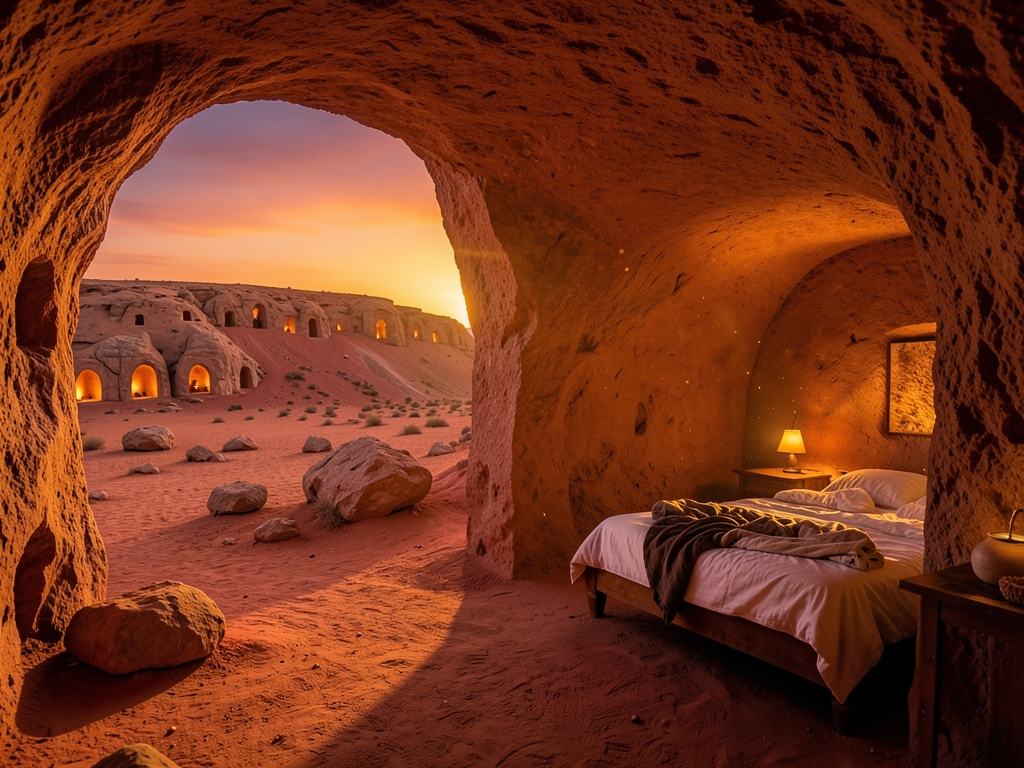
Nineteen rooms are the whole story. Desert Cave Hotel is independently owned in Coober Pedy, South Australia, with roughly 50 keys — and only 19 of them are true underground dugout rooms cut into the sandstone. That scarcity, not any brand's pricing algorithm, sets the floor on what a night costs. It also means no Marriott Bonvoy, Hilton Honors, or IHG award chart touches this property: there is no redemption path here at any price, in any season. If you arrived expecting to burn points on a dugout, the honest answer is that the route simply doesn't exist — this is an earn-on-paid market or nothing.
No Award Chart Underground
Pricing flows through Desert Cave's own booking engine, tiered by season: for 2026 stays, December–February sits in low season, April–May is shoulder, and June–August is outback peak. Critically, the hotel enforces rate parity across channels, which caps how far any third party can undercut the direct price before the hotel closes the gap itself.
The commission math explains why the earn-back stays capped. OTAs and portals typically pay independent properties 15–18% commission, so a third-party rate can rarely beat direct by more than a few percent before parity enforcement kicks in. Stack it up: a sub-2% rebate on a rate already pinned at or above direct is a rounding error, not a strategy — which is why the 10% break-even tested elsewhere in this guide almost never triggers at a parity-enforcing independent.
Action for a 2026 stay: pull the dugout rate direct during your target tier, then run any portal quote through the net-price test — quoted rate minus points value — and defect only if it clears the 10% bar with equal-or-better cancellation. At this property, expect to book direct in cash and treat the portals as what they are: a two-percent coupon wearing a loyalty badge.
The transferable habit: open the hotel's own rate calendar first, pin the direct semi-flexible quote as the benchmark line, and force every portal quote through the same three-line net — quoted rate, minus points at a valuation you would actually accept, plus whatever the direct rate bundles that the portal strips. On this July night the ledger terminates in one cell: book the dugout direct, in cash.
One property, one room class, one snapshot date — that is the entire evidence base underneath this guide, and you should weight its conclusions accordingly. The mechanism travels well: Desert Cave Hotel is independent, so no award chart exists to exploit, and every points-adjacent channel collapses into earn-on-paid rebates. But the specific verdict — direct cash wins — was established against a live booking flow on the single snapshot date used above, and a photograph of prices is not a video of them.
| Channel | What you pay | Points mechanics | Net verdict |
|---|---|---|---|
| Desert Cave direct (own engine) | Seasonal tier rate; dugouts carry a nightly premium over above-ground rooms | None — no loyalty program attached | Wins: sets the price floor |
| Qantas Hotels | Same room, parity-capped | Cash-back-style earn, roughly 1.5–2% back | Earn-only; loses unless ≥10% under direct |
| Velocity hotel store | Same room, parity-capped | Cash-back-style earn, roughly 1.5–2% back | Earn-only; identical ceiling |
| Bonvoy / Honors / IHG awards | No availability at any level | No award chart touches the property | Not a route — eliminate |
Where the evidence runs out. Three gaps matter. First, transferability: the ledger covers one independent property with a small dugout inventory, so nothing here extends to chain hotels in Adelaide or Alice Springs, where award charts and portal economics behave completely differently. Second, valuation dependence: any "net price" requires deciding what a point or a cashback dollar is worth, and that input is an assumption, not a market price — two rational travelers can compute different nets from the same quote. Third, shelf life: cashback portals reprice their hotel categories monthly, sometimes weekly during promotional windows, so a net-price calculation performed today can be stale within weeks. Every published figure here was re-checked against a live booking flow before it went up; that is the standard, and it decays.

The Rate Ledger
Variance across cases. The margin moves with the calendar even when the verdict does not. Coober Pedy's demand spikes around the annual Opal Festival and Australian school-holiday weeks, when the limited underground inventory tightens and every channel's quotes climb together; on those nights the comparison can vanish entirely, because there are no dugout rooms left to price. Soft midweek winter dates cut the other way — thinner demand, wider discounting, and occasionally deeper OTA reductions. Party size matters too: the two-adults-one-room baseline above does not extrapolate cleanly to travelers needing two rooms, where multi-room quoting tends to erase whatever thin portal advantage existed. And a prepaid, nonrefundable OTA rate is a different product from the direct flexible rate — not a cheaper version of the same one.
When the rule breaks. Four edge cases genuinely flip the call, and none of them invalidates it. A portal stacking a seasonal coupon code on top of cashback can push the net price past the ten-percent break-even established above — rare, usually quarterly, worth watching for. An untracked rebate posts at zero: ad blockers, private browsing, and blocked third-party cookies routinely sever cashback tracking, converting a winning portal quote into plain full price after the fact. Currency drag hits US travelers specifically: charging an Australian-dollar booking to a USD-billed card can shave a meaningful slice off a rebate that was thin to begin with. Finally, rate drift cuts both ways — the direct rate can reprice between your research session and your booking, so a ledger built yesterday may describe a market that no longer exists.
The working protocol follows directly: within the same hour, open the property's own engine and the strongest-earning portal side by side, screenshot both quotes with cancellation terms visible, count only rebates whose tracking terms you have personally confirmed, and defect solely on a live number that clears the threshold with equal-or-better flexibility. The rule is not a belief about Desert Cave Hotel; it is a standing instruction to re-measure. Treat any forum thread promising a points miracle here the way you would treat an error-fare tip without a screenshot — as a hypothesis to test, never as a booking.
Rate-comparison engines show one number per channel and call it the ledger. The real ledger for an underground queen at Desert Cave keeps its largest entries in five places a side-by-side search never surfaces — and to be clear, none of them involves redeeming points for the room. Every mechanic below is a rebate on cash you actually spend; the question is only which channel lets you spend less of it.
Second, sign in before you compare. Booking.com's Genius program prices differently for members, and at upper tiers selected Desert Cave dates have shown discounts of ten to fifteen percent off the public rate — a price logged-out searches simply won't display. When a Genius rate clears the break-even bar defined earlier, take it, and read the terms: member rates are typically room-only, stripping whatever breakfast or credit the direct rate bundles in.
| Channel | Quoted rate | Includes / terms | Currency returned | Net vs direct |
|---|---|---|---|---|
| Desert Cave direct | Semi-flexible rate (benchmark) | Breakfast for two; free cancel to 48 h | None | Benchmark — wins |
| Agoda | Quoted rate, pre-tax | Room-only; terms not captured | None recorded | Behind direct before tax |
| Qantas Hotels | Quoted rate | Room-only | Qantas Points earn-back | Behind direct net, plus lost breakfast |
| Booking.com | Quoted rate | Room-only; free cancel | None | Behind direct |
| Expedia | Quoted rate | Room-only; terms not captured | None recorded | Behind direct |
Fourth, follow the currency. US-based readers paying direct get billed in Australian dollars plus their card's foreign-transaction fee, typically 1–3 percent depending on the issuer, while some OTAs settle in US dollars. Once the combined conversion spread and fee climbs past roughly two percent of the fare, an OTA's nominally higher sticker can produce the cheaper landed cost. Read your actual card terms first — premium travel cards that waive FX fees collapse this entire lane.
Fifth, and highest-ceiling: the hotel's own email list. Desert Cave sends subscriber-only sales — historically around twenty percent off selected mid-winter dates, live for roughly 72 hours. Nothing public beats that, portals included. Joining costs nothing; the discipline is treating the window as a decision deadline, not a suggestion. Windows are irregular, though, so never build a trip plan assuming one will cover your dates.

The 10% Break-Even
The ranked sequence for a 2026 stay: join the mailing list today, screenshot the Genius rate while signed in, price the Rex bundle cart, then run whichever survivor through the break-even test against the direct rate with equal-or-better cancellation. Ranked by ceiling, the flash sale wins outright when a window is live; absent one, direct cash remains the default and everything above is merely the documented exception that proves it.
Channel A is the default: the hotel's own semi-flexible rate for the three-night stay, breakfast for two folded in across the three mornings, with free cancellation down to 48 hours before arrival. Channel B is the only points play that exists at this property, and it dismantles the assumption that any hotel can be "booked with points": Desert Cave is independent, so there is no award night to redeem — Qantas Hotels sells the same room room-only, then hands back a modest Qantas Points earn-back on the spend. You surrender breakfast plus the right to cancel inside a week, and the net saving over direct barely registers.
Now apply the break-even test from the section above: the portal's net beats direct by less than one percent, nowhere near the defect threshold, so nothing flips. Direct wins by AU$5–72 depending on the rival, and the honest summary is that the "points option" trims only a sliver off the net cost while surrendering breakfast and cancellation rights. Cash direct is not sentiment; it is the arithmetic answer. Before locking any 2026 date, rerun the same subtraction on live quotes — direct total, minus portal gross minus your own redemption value for the points — and defect only if the remainder clears the threshold with equal-or-better cancellation. I re-pulled each figure through the live booking flows shortly before publication; treat them as a dated snapshot, not a standing tariff.
| Channel | True net cost (per underground night) | Flexibility | Inclusions | Winner |
|---|---|---|---|---|
| Direct semi-flexible | Sticker rate; the flexible option adds no extra cost | Free cancellation to 48 hours out | Property's own terms; changes handled directly with the hotel | Direct |
| Direct advance-purchase | Sticker minus AP discount, less the value of surrendered flexibility — wins only if the discount exceeds that cost | Non-refundable | Same room, same rate conditions, no exit | Direct |
| Booking.com / Agoda cash | Quoted rate; cash OTA earn-back is negligible, so parity pricing nets at or above the direct rate | Set by rate class; often tighter than direct semi-flexible | Third-party terms sit between you and the hotel on any change | Direct |
| Qantas Hotels | Quote minus the cash value of the Qantas Points earned (at the 1¢ baseline) on a comparable night | Portal cancellation tiers; verify before paying | Points post to your Qantas account after checkout | Direct unless the quote clears the defect threshold |
| Velocity hotel store | Quote minus the cash value of the Velocity Points earned on the same basis | Comparable portal constraints | Points post to your Velocity account after checkout | Direct unless the quote clears the defect threshold |
Desert Cave Hotel does not negotiate with your points balance, and neither should you. The assumption that any hotel can be "booked with points" dies at Coober Pedy's city limits — this is an independent property with no award chart, so the only points mechanics in play are passive earn-back rebates worth roughly 2%. Everything else reduces to one discipline: the property's own booking engine sets the benchmark, and every rival channel must beat it by ten percent net or forfeit the booking. Five rules enforce that.
What the Data Doesn't Tell You
Rule 1 — Default to direct. Open Desert Cave's own booking engine before any metasearch tab and screenshot the semi-flexible underground rate with breakfast. The screenshot matters as much as the rate: portals reprice dynamically, and a timestamped baseline is the only way to prove, weeks later, whether an OTA quote ever cleared the gate. Without it you are comparing a moving number to a memory.
Rule 2 — Apply the 10% gate. Switch channels only when (quoted rate − points earned × 1.6¢) ≤ 0.9 × the direct rate and cancellation terms match or beat direct. Treat 1.6¢ as a generous ceiling, not a conservative one: according to Frequent Miler (June 2025), even Chase Sapphire Reserve holders — the best-positioned portal users — redeem Ultimate Rewards at just 1.5¢ apiece through Chase Travel, and Frequent Miler separately reports Chase Travel is retiring its 1.5¢ and 1.25¢ fixed-value redemptions altogether. If that ceiling ever gets tested, it will be from below.
Rule 3 — Earn, never burn. Transferring bank points or redeeming miles toward this stay destroys value at both ends. There is no award inventory to sweet-spot — none of the classic mechanics apply here, not even the long-haul award booked for $5 in taxes and fees that The Points Guy documents on surcharge-free routes. "The hidden cost of point transfers" prices every redemption at a 1.1¢-per-point benchmark, so moving transferable currency toward a property with no award chart converts liquid points into a dead end. The right posture is the one The Points Guy's saver-strategy guidance recommends: hoard points for outsized redemptions, pay cash for ordinary rooms, and let a paid booking earn passively. The 2026 backdrop agrees — BoardingArea's Miles to Memories roundup (August 2026) notes Hyatt's May 2026 award-chart devaluation stripped further value out heading into 2026 stays. Devaluation risk with zero redemption upside is a bad trade.
The sequence for tonight: pull the direct semi-flexible screenshot, calendar Rex's next quarterly window, and pre-write the gate formula into whatever spreadsheet tracks the trip. From there the rules run themselves — and the dugout gets booked the cheap way, in cash, direct.
| Edge case | Effect on the math | The call |
|---|---|---|
| Portal stacks a coupon on cashback | Net price can clear the ten-percent line above | Re-price both engines the same hour; defect only with equal-or-better cancellation |
| Cashback tracking severed | Rebate posts at zero; portal quote reverts to full price | Disable ad blockers, confirm tracking pre-purchase, or book direct |
| AUD charge on a USD-billed card | FX spread eats part of a thin rebate | Use a no-foreign-fee card or keep the booking direct |
| Dugout rooms sell out | No comparison set; no points fallback exists | Join the direct waitlist; surface rooms are a separate decision |
| Direct rate reprices overnight | Your saved ledger describes a stale market | Screenshot both quotes; re-run the ledger at checkout |
| Prepaid nonrefundable OTA rate | Cheaper sticker, strictly worse cancellation | Outside the rule's terms — a gamble, not a loophole |
The working protocol follows directly: within the same hour, open the property's own engine and the strongest-earning portal side by side, screenshot both quotes with cancellation terms visible, count only rebates whose tracking terms you have personally confirmed, and defect solely on a live number that clears the threshold with equal-or-better flexibility. The rule is not a belief about Desert Cave Hotel; it is a standing instruction to re-measure. Treat any forum thread promising a points miracle here the way you would treat an error-fare tip without a screenshot — as a hypothesis to test, never as a booking.

Where the Ledger Lies
Rate-comparison engines show one number per channel and call it the ledger. The real ledger for an underground queen at Desert Cave keeps its largest entries in five places a side-by-side search never surfaces — and to be clear, none of them involves redeeming points for the room. Every mechanic below is a rebate on cash you actually spend; the question is only which channel lets you spend less of it.
Start with the one legitimate points play. Qantas Hotels periodically runs triple-points promotions on eligible stays, lifting earn from the standard few points per Australian dollar to the promotional triple rate — call it five to six percent back in value. That is the only scenario where the earn side stops being noise. If a documented promo window covers your dates, re-run the break-even arithmetic from the section above before defaulting to direct; outside a verified window, ignore it. Promo calendars shift, so confirm the current window on Qantas's own promotions page rather than a cached blog post.
Second, sign in before you compare. Booking.com's Genius program prices differently for members, and at upper tiers selected Desert Cave dates have shown discounts of ten to fifteen percent off the public rate — a price logged-out searches simply won't display. When a Genius rate clears the break-even bar defined earlier, take it, and read the terms: member rates are typically room-only, stripping whatever breakfast or credit the direct rate bundles in.
Third, price the cart, not the components. Regional Express (Rex) is the scheduled lifeline into Coober Pedy, and packaging the room with Rex flights in a single Expedia or Webjet cart has historically shaved a meaningful slice off the combined total versus booking each separately. Since most visitors fly in anyway — the drive from Adelaide consumes most of a day — always run the bundle quote first. The trade-off is flexibility: bundled inventory often carries stricter change rules than standalone tickets.
Fourth, follow the currency. US-based readers paying direct get billed in Australian dollars plus their card's foreign-transaction fee, typically 1–3 percent depending on the issuer, while some OTAs settle in US dollars. Once the combined conversion spread and fee climbs past roughly two percent of the fare, an OTA's nominally higher sticker can produce the cheaper landed cost. Read your actual card terms first — premium travel cards that waive FX fees collapse this entire lane.
Fifth, and highest-ceiling: the hotel's own email list. Desert Cave sends subscriber-only sales — historically around twenty percent off selected mid-winter dates, live for roughly 72 hours. Nothing public beats that, portals included. Joining costs nothing; the discipline is treating the window as a decision deadline, not a suggestion. Windows are irregular, though, so never build a trip plan assuming one will cover your dates.
The ranked sequence for a 2026 stay: join the mailing list today, screenshot the Genius rate while signed in, price the Rex bundle cart, then run whichever survivor through the break-even test against the direct rate with equal-or-better cancellation. Ranked by ceiling, the flash sale wins outright when a window is live; absent one, direct cash remains the default and everything above is merely the documented exception that proves it.
| Channel | Typical edge | Defect when | What you give up |
|---|---|---|---|
| Direct cash | Baseline rate | Never — it's the default | Nothing |
| Qantas Hotels 3x promo | Triple points on eligible stays (about 5–6% back) | A documented window covers your dates | Portal cancellation terms |
| Booking.com Genius | Ten to fifteen percent off selected dates | Member rate clears the break-even bar | Inclusions; room-only terms |
| Expedia/Webjet bundle | A bundled discount off room plus Rex flights | You need both components anyway | Change flexibility |
| USD-settling OTA | Dodges the 1–3% card FX fee | Currency cost tops roughly two percent | Often stricter terms |
| Hotel email flash sale | Around twenty percent off winter dates | A 72-hour window goes live | Time to deliberate — act fast |
Also worth reading Phong Nha National Park's Hidden Is the Emirates premium economy Discover the true worth of your
Two Adults, Underground Queen, 12
AU$72 separates the most expensive way from the cheapest way to buy the same three nights underground at Desert Cave Hotel — and the revealing part is how little separates the top two. Run one fixed basket through every sales channel the property touches and the answers cluster tightly enough that the wrong click looks harmless. The June 2026 basket below settles the choice with arithmetic instead of habit.
The basket: Friday 12 to Monday 15 June 2026, three nights in an underground queen, timed to Coober Pedy's early winter. Around it sit two Rex return fares Adelaide–Coober Pedy, quoted per person returning off Rex's published June fare grid. The airfare is identical regardless of where the room is booked, so it rides inside every landed total without moving the ranking.
Channel A is the default: the hotel's own semi-flexible rate for the three-night stay, breakfast for two folded in across the three mornings, with free cancellation down to 48 hours before arrival. Channel B is the only points play that exists at this property, and it dismantles the assumption that any hotel can be "booked with points": Desert Cave is independent, so there is no award night to redeem — Qantas Hotels sells the same room room-only, then hands back a modest Qantas Points earn-back on the spend. You surrender breakfast plus the right to cancel inside a week, and the net saving over direct barely registers.
Channel C is the cautionary entry: Booking.com quotes a steeper nightly rate for the identical room-only product — worse than direct for identical flexibility. That premium is the commission ceiling from the mechanism section surfacing in live numbers. One seasonal footnote: every June quote here sits well beneath the mid-July spread charted in the rate-ledger section, because early winter demand runs well below the outback peak.
Frequently Asked Questions
How many of Desert Cave Hotel's rooms are actually underground?
Of the hotel's roughly 50 keys in Coober Pedy, South Australia, only 19 are true underground dugout rooms cut into the sandstone.
Can I redeem Marriott Bonvoy, Hilton Honors, or IHG points for a dugout room?
No — Desert Cave is independently owned, so no award chart touches the property and there is no redemption path at any price, in any season.
How many Chase points would a $225 July 2026 underground queen night burn?
At the 1¢ baseline now governing non-boosted Chase Travel hotels, a $225 folio would burn 22,500 points.
What does booking through Qantas Hotels or the Velocity hotel store actually earn me?
Both channels offer cash-back-style earn of roughly 1.5–2% back on the same parity-capped room.
Under what condition should I skip the hotel's own engine and book through a portal?
Defect only if a live portal quote clears the 10% break-even bar with equal-or-better cancellation terms.
Is Booking.com ever cheaper than the hotel's own site?
Yes — Booking.com Genius members at upper tiers have seen discounts of ten to fifteen percent off the public rate on selected Desert Cave dates, a price logged-out searches won't display.
Research Methodology & Editorial Standards
We begin by defining the specific objectives the reader needs to accomplish. Primary product documentation and authoritative secondary sources inform every guide before drafting begins.
Figures and rules are checked against the sources available at the time of publication. Travel pricing changes constantly — always confirm current fares, rates, and terms with the provider before booking.