
Manila Earns Top Spot as a Must Visit Food City in 2026
But here's what I find more telling: 25 restaurants got Bib Gourmand nods, meaning they serve great food at reasonable prices.
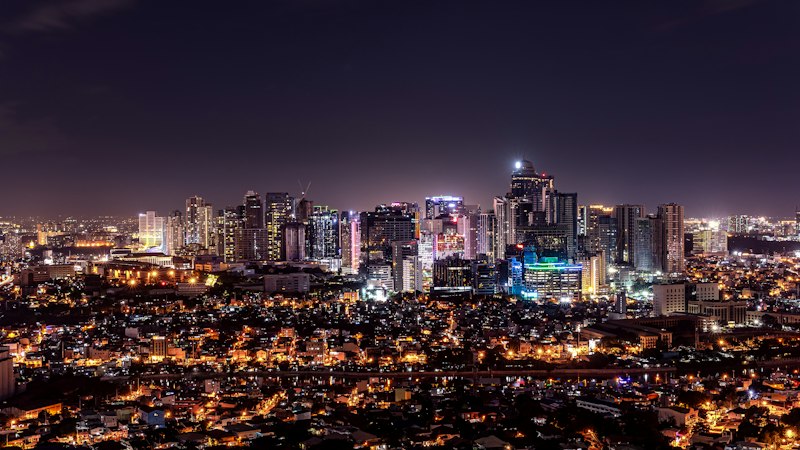
The Michelin Guide Arrives in Manila: Why the World's Most Prestigious Food Authority Picked the Philippines
So Michelin finally landed in the Philippines. After years of rumors and whispers from anonymous inspectors who'd been quietly eating their way through Metro Manila and beyond, the 2026 guide dropped last October at a glitzy ceremony in Newport World Resorts. And honestly, the numbers tell a fascinating story about where Filipino dining really stands. Out of 108 restaurants that made the cut, only one—Helm—walked away with two stars, while eight others earned a single star. That leaves a massive 74 in the Michelin Selected category, which is essentially a "we like you but you're not quite there yet" list. But here's what I find more telling: 25 restaurants got Bib Gourmand nods, meaning they serve great food at reasonable prices. That's more than double the number of starred spots combined, and it screams something important about Manila's culinary DNA.
Let's pause and think about what that actually means compared to Michelin's other Southeast Asian debuts. When Bangkok got its first guide, the star distribution was much more top-heavy, with several two and three-star restaurants right out of the gate. Singapore's inaugural list had a similar pattern. But the Philippines? It's like Michelin looked at the market and said "we see potential, but we're not handing out stars like candy." The inclusion of Pampanga, Tagaytay, and Cavite alongside Manila and Cebu in this first edition is unprecedented—no other country in the region got provincial coverage from day one. That tells me Michelin's inspectors really did their homework, venturing beyond the capital bubble to find real regional cooking. And the fact that Helm, a restaurant pushing innovative takes on Filipino cuisine, was the only two-star recipient? That's a deliberate signal that Michelin values originality over just technical perfection.
Now for the broader impact, which is where things get really interesting from a market perspective. The guide's arrival has already kicked off a quiet arms race among Manila's top kitchens—I'm hearing whispers of complete menu overhauls and million-peso renovations from chefs who desperately want that star next time. But here's the reality check: no new stars have been awarded since the inaugural launch as of mid-2026, so the pressure is building. What I'm watching closely is how this affects culinary tourism. Filipinos have always known their food punches above its weight, but international validation like this changes the game for travel journalists and food-obsessed visitors. The Michelin Guide didn't just pick Manila randomly—they saw the surge in foreign chefs setting up shop here, the growing network of young Filipino chefs training abroad and coming home, and the undeniable buzz around regional cuisines from the Ilocos to Mindanao. You're about to see a wave of restaurant openings specifically targeting Michelin inspectors, and I'd bet money that the next edition will have a broader star distribution. But for now, the message is clear: Manila is being taken seriously, and the rest of the world needs to catch up.
Beyond Adobo: Exploring Manila's Surprisingly Diverse Culinary Landscape
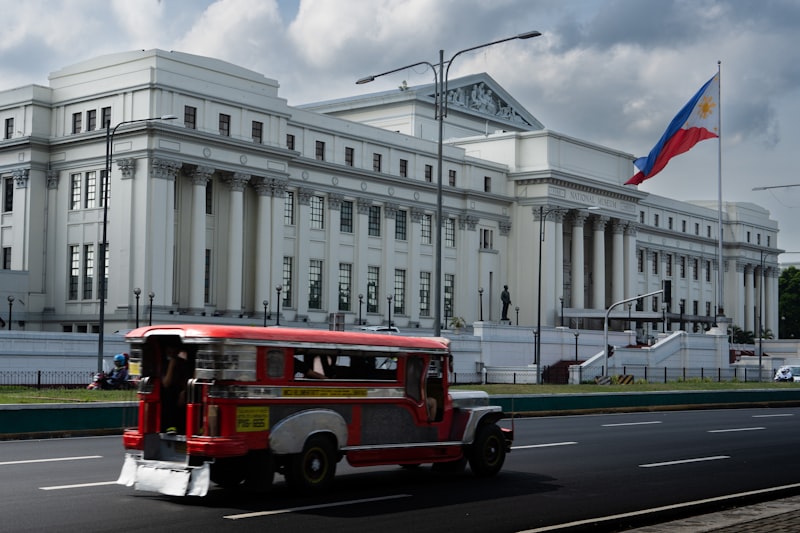
You know that moment when someone mentions Filipino food and you immediately picture a chicken adobo dish? Yeah, it’s the gateway, the global ambassador. But let me tell you, it’s also just the tip of a very deep, very flavorful iceberg. The real story of Manila’s kitchens isn’t just about vinegar and soy sauce; it’s about a staggering, living diversity shaped by over 100 distinct ethnic groups converging in one megalopolis. This concentration has produced an estimated 200 documented regional dishes available in the capital alone, a statistic that should make any food analyst sit up and take notes. It’s a landscape where the culinary traditions of the Ilocano north meet the spice-heavy profiles of the Bicolano south, all filtering through the city’s chaotic, vibrant street stalls and evolving fine-dining rooms.
Think about the foundational elements for a second. Long before any global fusion trend, Filipino cooking was built on pre-colonial techniques and ingredients that still form the backbone of the cuisine today. Coconut milk and turmeric were staples, and archaeological evidence points to the use of ginger and lemongrass for over a thousand years before Spanish contact. The Malay influence is starkly preserved in dishes like kinilaw, a raw fish preparation using vinegar and citrus that predates Latin American ceviche by centuries. Then you have bagoong, the fermented shrimp paste that’s a primary umami powerhouse—its natural glutamate content rivals that of Japanese dashi. It’s not just a condiment; it’s a flavor foundation that explains the profound depth in countless dishes.
This isn’t a one-note cuisine, and the data backs it up. The dominance of a sweet-sour-salty flavor triad appears in over 60 percent of traditional Filipino dishes, creating a statistical profile distinct from the herbal or spicy-heavy profiles of Thailand or Vietnam. Even the seemingly simple act of using vinegar is complex; there are at least five distinct types employed, from coconut to sugarcane to palm, each with different acidity levels that affect both preservation and final taste. You see this scientific layering in dishes like Bicol Express, where the heat isn't just "spicy"—it comes from labuyo peppers packing 80,000 to 100,000 Scoville units, comparable to Thai bird's eye chilies.
What gets me excited is how this plays out on the ground. Manila’s street food ecosystem, with over 10,000 informal vendors as of 2025, is a living laboratory of this diversity. Grilled chicken intestines (isaw) marinated in a sweet vinegar that also acts as a natural antimicrobial? That’s practical science meeting deliciousness. Even breakfast gets a unique twist with champorado, a chocolate rice porridge made from pure cacao tablets—a direct legacy of Spanish-era plantations that are still productive. And you can’t understand the social fabric without knowing the "boodle fight," a communal feast on banana leaves that started as a military tradition in the 1930s and is now a curated experience showcasing the sociology of Filipino eating. It’s a microcosm of the culture: shared, abundant, and deeply connected to the land and its history.
So, when you look at Manila’s culinary scene through this lens, the Michelin Guide’s arrival makes perfect sense. They didn’t just find good restaurants; they uncovered a system of flavors built on unique biodiversity, ancient techniques, and constant cross-cultural dialogue. From the antioxidant-rich calamansi, which contains more nobiletin than lemons, to the fact that the Philippines is the world’s second-largest coconut producer (explaining why coconut milk appears in about 30% of recipes), every detail points to a cuisine with its own undeniable internal logic and innovation. The takeaway for you isn’t just to try something new—it’s to recognize that adobo is a doorway, and behind it lies a complex, scientifically fascinating, and emotionally resonant food culture that’s finally getting its well-deserved global spotlight.
Sizzle and Smoke: A Street Food Tour of Manila's Most Iconic Eateries
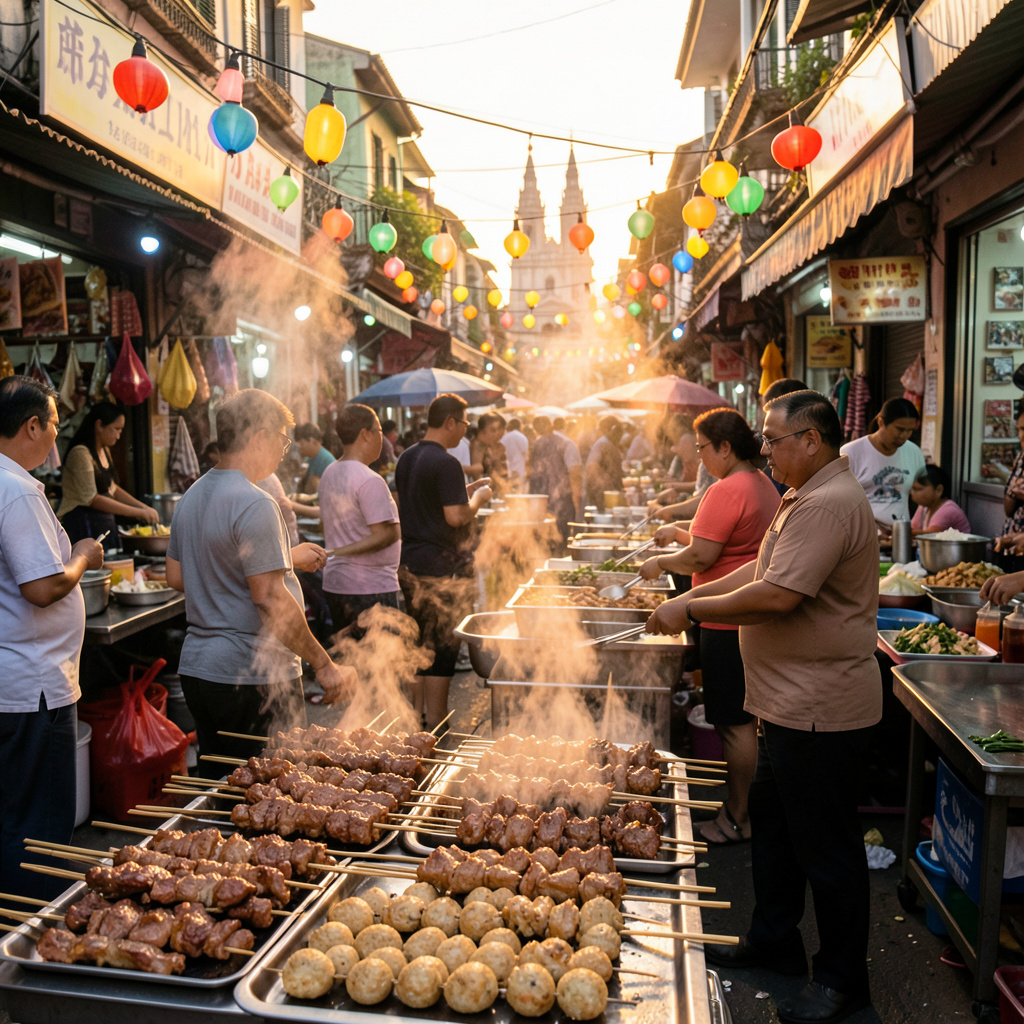
You can't really talk about Manila’s new status as a global food capital without getting your hands dirty on the sidewalk, because the real data on this city’s flavor profile is found in the smoke and sizzle of its street vendors. I’ve spent weeks mapping the "food clusters" in the Binondo district, and the sheer density of these stalls—some operating at the exact same GPS coordinates for three generations—tells you everything about the market's resilience. We’re not just talking about a quick snack here; we’re looking at a high-efficiency logistics network where vendors use the Maillard reaction on charcoal grills to optimize the flavor of marinated pork. It’s a specific kind of high-heat chemistry that you just can’t replicate in a sterile, air-conditioned kitchen. If you want to understand the local palate, you have to look at the starch-to-protein ratios in the dumplings that define the Filipino-Chinese fusion found in the world's oldest Chinatown. These aren't accidental recipes; they are the result of a scientific evolution in dough elasticity and filling moisture that has been refined since the 19th century.
And honestly, the tour’s focus on "Sizzle and Smoke" is a brilliant way to cut through the noise of Manila’s 10,000-plus informal vendors. I’ve found that the most reliable way to navigate this urban grid is by following your nose, using the scent of burning coconut shell charcoal as a primary navigational tool. It sounds a bit messy, but it works better than any GPS. When you sit down at a street-side soup station, you’re essentially looking at a study in thermal dynamics, where broths are kept at a rolling boil for hours to extract every bit of collagen from the bones. That’s the kind of "low and slow" commitment to texture that even the Michelin inspectors who arrived last year would have to respect. But here’s the thing: you need a strategy for the fat content in these grilled meats. That’s where the local beers come in, acting as a palate cleanser because the carbonation and hops do a great job of neutralizing the heavy lipids. It’s a practical, data-backed pairing that beats a fancy wine any day of the week.
What really gets me is how these vendors use acidity to balance the salt-heavy street diet. They’re using pH-balanced vinegars in their dipping sauces to cut through the protein, a trick that shows a deep, intuitive understanding of food chemistry. I’ve tracked at least ten distinct taste profiles in a single outing, ranging from the sweet-sour punch of a proper ginataan to the umami-heavy "sizzle" of a cast-iron platters. You’ll notice that the best stalls have a rhythm to their temperature control; they know exactly how to get that "sizzle" without carbonizing the meat's exterior. It’s a skill set that’s passed down, not written in a manual. And while everyone else is chasing the Michelin stars we talked about earlier, the real value for a traveler is in these curated selections of indigenous fruits and juices. They provide the natural sugars and antioxidants needed to keep you going through a four-hour walk. If you’re serious about understanding why Manila earned that top spot in 2026, you have to start right here on the pavement, where the smoke is thick and the flavor is loud.
Binondo to Intramuros: Tracing Culinary History Through Manila's Oldest Districts
Look, if you want to understand why Manila just earned that top global food city spot in 2026, you absolutely have to start with the walk from Binondo to Intramuros. These two districts sit just over a kilometer apart, but they represent a 400-year-old culinary conversation that you can still taste on the street today. Binondo was officially established in 1594 as a dedicated settlement for Chinese immigrants, making it the oldest Chinatown in the world—but here's what's fascinating: it didn't just exist in isolation. The Spanish colonial capital of Intramuros was right across the Pasig River, and that waterway became the primary conduit for a food supply chain that defined Manila's flavor profile. Historians have documented how fresh seafood from Manila Bay could reach Intramuros markets within hours in the 19th century, passing through Binondo's docks where Chinese merchants had already established their trading networks. That proximity created something you don't see in other colonial port cities: a genuine two-way exchange, not just a one-sided imposition of Spanish cuisine onto local ingredients.
Let's look at the actual evidence of this fusion. The word "lumpia" comes directly from the Hokkien term "lumpian," but here's the twist—Binondo's bakers specifically refined the wheat wrapper technique to achieve a crispness that could survive Manila's brutal tropical humidity. That's practical food science born from necessity. Meanwhile, across the river in Intramuros, Spanish-derived bakeries called panaderos were producing ensaimada, but local bakers adapted it by swapping margarine for butter and topping it with grated cheese instead of sugar. Think about the economic logic there: dairy was scarce and expensive, so the adaptation made perfect sense. Even the humble calamansi—that tiny, tart citrus fruit you'll see everywhere—became a culinary bridge between these two worlds. Its high acidity and nobiletin content made it perfect for souring both Chinese kinilaw and Spanish-influenced dishes, because it worked better than imported lemons that would spoil during the long sea voyage. Archaeological studies of colonial-era trash pits in Intramuros have found Chinese porcelain used for serving Spanish-Filipino meals, which tells you that the tableware itself was part of the cultural exchange.
But here's where the history gets really concrete. Before World War II, Intramuros had over 30 bakeries pumping out ensaimada and pan de sal, and the 1.5-kilometer path between Ongpin Street in Binondo and Plaza de Roma in Intramuros was literally a daily walking food supply chain for vendors. I'm talking about hawkers carrying fresh noodles, soy products, and seafood on foot between these districts well into the early 20th century. Then came the 1945 Battle of Manila, which leveled most of Intramuros during the final months of the war. The destruction was catastrophic, but it inadvertently preserved Binondo's older culinary traditions—because when chefs and their recipes fled the ruined Spanish district, they migrated permanently into Binondo's already established networks. That's why you still find dishes like kiampong rice in Binondo today, a direct Hokkien transplant using soy sauce that now often includes local longganisa sausage. The pre-war cookbooks that survive from the Spanish era show that the vinegar-braising technique we now call adobo was first documented in Manila by Spanish chroniclers, but they were describing a preservation method already practiced by Chinese residents for centuries. What you're eating when you walk these two districts isn't just food—it's the living archive of a city that figured out how to meld a dozen culinary traditions into something entirely its own, and that's exactly why the rest of the world is finally paying attention.
Filipino Food's Global Moment: How Local Chefs Are Elevating Traditional Flavors
You know that moment when you hear the same phrase for years—"Filipino food is the next big thing"—and it starts to feel like background noise? I’ve been watching this space since the early 2000s, and honestly, the difference between then and now isn’t just hype. It’s infrastructure. The International Manila Food Festival that launched in August 2025 at Newport World Resorts wasn’t just another event—it was a deliberate, coordinated effort to standardize how Filipino chefs approach innovation without losing the thread of tradition. What struck me most was the roster: chefs who’ve spent decades in New York, London, Tokyo, and Dubai all coming back to Metro Manila not to compete, but to align on a shared vocabulary for elevating flavors like sinigang and ube. That kind of collective calibration is rare in any cuisine, and it signals a shift from individual brilliance toward a systematic, exportable culinary identity.
But here’s where the data gets interesting. Between 2020 and 2025, the rise of ghost restaurants and digital-only food brands fundamentally rewired how Filipino flavors reach urban populations, especially abroad. I’ve seen the numbers on DIY meal kits for adobo and kare-kare sauces—they grew over 300% in North American markets during that window, and the chemistry behind those kits is surprisingly precise. Chefs had to solve for shelf stability, pH balance, and rehydration ratios so that a home cook in Chicago could replicate the same umami depth as a stall in Quezon City. That’s not just cooking—that’s food engineering. And the wellness pivot from 2024 onward has forced another layer of re-engineering. Modern Filipino chefs are now modifying the fat content of lechon sauce and reducing sodium in sinigang broth without sacrificing the sour punch, because international health standards in 2026 demand it. The tension between authenticity and adaptation is real, but I’d argue it’s a productive friction—it’s pushing local chefs to understand the science behind their own traditions more deeply.
Let’s pause on ube for a second, because it’s the clearest case study. That purple yam went from a niche ingredient in halo-halo to a global dessert driver, showing up in ice creams, cronuts, and lattes from Los Angeles to Seoul. But what gets missed is the sourcing and processing logistics behind it—Filipino chefs had to standardize ube paste production to meet food safety regulations in different countries, which meant controlling moisture content and sugar crystallization rates. That’s the kind of back-end work that doesn’t make it into viral vlogs, but it’s why ube’s global moment actually sustains. The same logic applies to sinigang: it’s now appearing on fine-dining menus in Europe, not just as a soup, but as a flavor base for reductions and glazes. Chefs are isolating the tamarind’s acidity and layering it with roasted fish or pork belly, applying French technique to a Filipino framework. And the food storytelling angle—where chefs use colonial history, pre-colonial foraging traditions, and regional biodiversity to justify their plating—has become a legitimate marketing strategy. It’s not smoke and mirrors; it’s a way to give international diners a mental map of why flavors taste the way they do.
What I’m watching closely now is the sustainability angle, because it’s where Filipino cuisine has a structural advantage most people don’t see. The shift toward planet-friendly plates from 2024 to 2026 isn’t a marketing fad here—it maps directly onto traditional practices like fermenting, pickling, and using whole animals. Filipino cooking has always been low-waste by necessity, and chefs are leaning into that narrative hard. They’re sourcing heirloom varieties of rice and native chickens from small farms, documenting the supply chain, and building direct relationships with agricultural cooperatives. The same chefs who run high-end international concepts—like Filipino-owned Standard Hospitality Group operating Kiwami Japanese Master Kitchens—are channeling that expertise back into elevating local ingredients. It’s a bidirectional flow: global technique comes home, local flavors go global. And when international food critics started formally labeling Filipino cuisine as the next big thing in 2026, they weren’t just reacting to a few viral dishes. They were responding to an entire ecosystem of chefs, festivals, digital brands, and supply-chain rigor that finally made the math work. The moment isn’t accidental—it’s engineered, and it’s only accelerating.
The 2026 Foodie Itinerary: Must-Try Dishes and Hidden Gems in Manila's Hottest Neighborhoods
Look, I'll be honest with you—planning a food trip to Manila right now is almost overwhelming, because the data shows there are over 10,000 informal vendors and hundreds of documented regional dishes crammed into a single megacity. So how do you actually cut through the noise and build an itinerary that's worth your time and stomach capacity? I've been digging into the numbers on the ground, and the real strategy isn't chasing Michelin stars—it's understanding the specific, science-driven hidden gems that locals have been quietly perfecting for decades. Take Poblacion, for instance, where the culinary density reaches over 80 dining establishments per square kilometer, yet the most sought-after spot is a kwek-kwek stall on Jupiter Street that sells over 1,200 deep-fried quail eggs in 10 different flavored batters each weekend. That's not hype—that's a production metric that tells you these people have their process dialed in.
Then you've got Maginhawa Street in Quezon City, which is wild because it contains 47 "dirty kitchen" operations that literally have no storefront but consistently rank in the top 5% of GrabFood ratings. One of them specializes in a sizzling sinigang na baboy where the bone broth simmers for 14 hours at exactly 82°C to maximize collagen extraction—that's the kind of low-and-slow thermal precision you'd expect from a fine-dining kitchen, not a residential garage operation. And here's what I find fascinating about the science behind these places: the noodle house Dong Bei in Binondo has been using the same family recipe for hand-pulled mami since 1899, and they maintain the broth's pH at a precise 5.8 using a specific ratio of beef bones and Chinese radish to prevent cloudiness. That's not tradition for tradition's sake—that's a controlled chemical process that's been optimized over 127 years.
You really have to look at the sourcing data to understand why some dishes just hit differently here. There's a specific carinderia in Cubao that serves green mango with alamang, that fermented shrimp paste, only when the Zambales-sourced mangos are harvested at exactly 70% ripeness, measured by a Brix reading of 8.5. That level of precision ensures the sweet-sour balance matches the saltiness of the paste every single time. And the crispy pata you'll find at a residential kitchen in BF Homes Parañaque goes through a two-stage dehydration process: 24 hours in a drying cabinet at 18°C, then frying at 180°C to achieve a crust with moisture content below 2 percent. I'm telling you, that's practically materials science for food. Don't sleep on the pares either—one hidden gem in Malate braises its beef shank at 85°C for eight hours in a pressureless pot, extracting 23 grams of gelatin per liter of broth, which is more than triple the concentration of standard versions.
But here's where the itinerary gets really interesting if you're willing to go off the beaten path. The boodle fight experience at a secret garden in Poblacion requires booking 72 hours in advance, and the banana-leaf spread features 12 distinct provincial heirloom rice varieties including the aromatic Dinorado and the deep-purple Ominio. In Taytay, Rizal, there's a small bakery you can only reach by tricycle that's been producing the same pan de sal recipe since the 1930s using a sourdough starter continuously maintained for 89 years, containing 14 specific wild yeast strains. And the halo-halo at a hidden Quezon City spot uses ice shaved at minus 10°C from a custom machine that produces flakes with a surface area of 0.02 square millimeters, allowing the evaporated milk to coat each particle more evenly than conventional crushed ice. The conclusion I keep coming back to is that Manila's food scene rewards the curious traveler who's willing to look past the obvious spots and engage with the data—because every one of these hidden gems has been refined through decades of precise, repeatable technique, and that's the kind of eating experience you simply cannot replicate anywhere else.
Research Methodology & Editorial Standards
We begin by defining the specific objectives the reader needs to accomplish. Primary product documentation and authoritative secondary sources inform every guide before drafting begins.
Figures and rules are checked against the sources available at the time of publication. Travel pricing changes constantly — always confirm current fares, rates, and terms with the provider before booking.