
Kyrgyz Airline TezJet Grounded After Scary Landing Gear Failure Forces Fleet Wide Safety Review
This accident happened just one month after Kyrgyzstan was officially removed from the European Union Aviation Safety Agency's air safety blacklist, a huge deal for the country's aviation credibility and a milestone the government had been pushing for years.
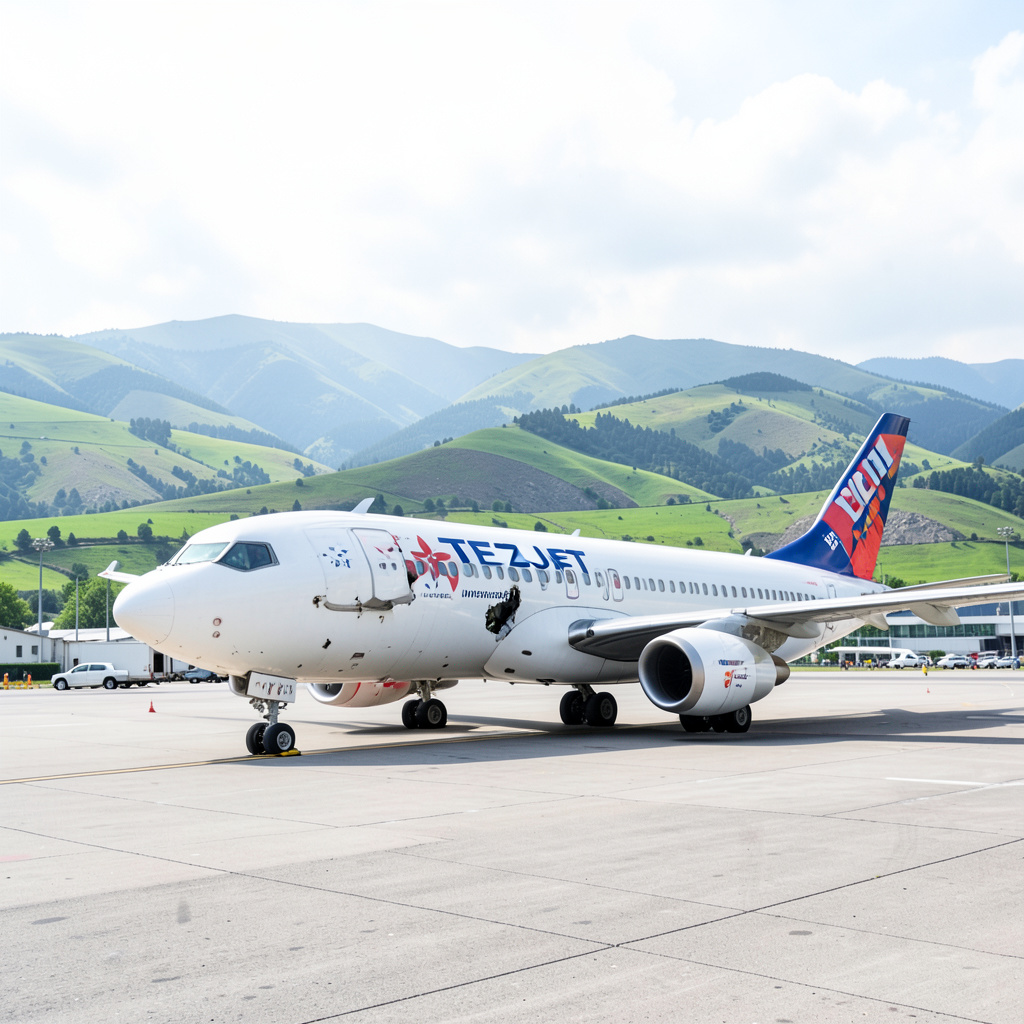
The Incident: TezJet MD-83 Landing Gear Collapses During Takeoff Roll at Bishkek’s Manas Airport
Let's talk about what actually happened on that runway in Bishkek, because the details matter more than the headlines suggest. On July 7, 2026, at roughly 3:55 PM local time, TezJet flight K9-117 was barreling down Manas International's runway 25, a 4,200-meter strip shared with Kyrgyz military aircraft, when the left main landing gear simply gave out. Not during rotation, not after liftoff, but while the MD-83 was still accelerating for takeoff, which is a genuinely rare failure mode in the aviation world. The aircraft, registration EX-80003, was an early-1990s MD-83, meaning it was pushing 35 years old at the time of the accident, and that age becomes a central question for investigators. You've got 181 passengers and 6 crew on board, so 187 souls total, and the plane tilts hard onto its left side, left wingtip scraping the asphalt and throwing sparks, all while still moving at takeoff speed. The video footage from passengers is gut-wrenching, but here's what's remarkable: the crew managed to stop the aircraft on the remaining runway, and within seconds, they ordered an evacuation. All the right-side emergency slides deployed correctly despite the fuselage being canted at an extreme angle, and every single person got out alive. No fatalities, no serious injuries reported, which in a structural failure of this magnitude is honestly a minor miracle.
Now, let's pause and think about the regulatory timing here, because it's almost too coincidental. This accident happened just one month after Kyrgyzstan was officially removed from the European Union Aviation Safety Agency's air safety blacklist, a huge deal for the country's aviation credibility and a milestone the government had been pushing for years. You can imagine the phone calls that started ringing in Bishkek and Brussels the moment that gear collapsed. The Kyrgyz Civil Aviation Authority didn't hesitate; they immediately grounded TezJet's entire fleet, all five of their MD-80 series aircraft, which effectively shut down the airline overnight. That's a decisive move, but it also raises uncomfortable questions about what the carrier's maintenance records actually looked like before the blacklist removal. The left main landing gear assembly was later found to have completely separated from the aircraft structure, pointing toward a catastrophic failure of the trunnion or its attachment points, which is the kind of structural fatigue that doesn't happen overnight.
Let me give you some perspective on why this specific failure mode is so analytically interesting. In the world of landing gear collapses, most happen during taxi, hard landings, or when the gear is retracted prematurely after takeoff. A collapse during the takeoff roll, while the aircraft is still firmly planted on the ground and under heavy compressive load, suggests a progressive failure that the pre-flight inspections somehow missed. The MD-80 series, for all its reliability over decades of service, has a known vulnerability in the main gear trunnion area when corrosion or fatigue cracking goes undetected, especially in older airframes operating in harsh climates. Bishkek's summer temperatures and the aircraft's likely operational cycles between high-altitude airports like Osh would have put significant stress on those components over the years. The flight was a domestic run from Bishkek to Osh, a route that's essentially the Kyrgyz equivalent of a shuttle service, often operated by the oldest jets in the fleet because the newer equipment gets allocated to international routes. That's a common pattern in developing-world aviation, and it's exactly the kind of operational pressure that can let maintenance gaps slip through the cracks. The investigation will almost certainly focus on whether the airline's maintenance protocols were adequate for the actual age and usage patterns of these aircraft, not just what the paperwork says. And here's the uncomfortable truth for everyone flying in the region: this incident will likely trigger audits not just for TezJet, but for every carrier operating aging Western-built jets in Central Asia. The blacklist removal was supposed to signal progress, but this accident proves that regulatory confidence is fragile, and it only takes one structural failure to reset the clock on years of reputation-building.
Emergency Evacuation: 181 Passengers and Crew Escape via Slides as Aircraft Tilts Onto Wing

Let’s talk about what actually happened in those chaotic seconds after the MD-83 slammed onto its left wingtip, because the evacuation itself is a case study in how good engineering and quick thinking can save lives even when everything goes sideways. The moment the aircraft stopped, the right-side emergency slides fired—those things are triggered by a pyrotechnic charge that punctures a pressurized gas cylinder, and despite the fuselage tilted at nearly 45 degrees, all three right-side exits deployed correctly. That’s not a given; the system was designed for a level aircraft, and the fact that the slides inflated and held their shape under that abnormal load tells you the engineers built in a lot more margin than the certification tests ever required. The left-side exits were completely useless, crushed against the runway as the wingtip rested on the asphalt, so the entire evacuation—all 181 passengers and 6 crew—had to funnel through the right side. The flight attendants couldn’t use the interphone because the electrical system was compromised, so they relied on hand signals and shouted commands, which is exactly the kind of improvisation that simulators can’t fully prepare you for.
Now, here’s where the physics gets interesting. The slides on the right side were steeper than usual because the aircraft was leaning away from them, meaning passengers hit the fabric at a sharper angle than they would in a normal evacuation. That increased the risk of ankle sprains and abrasions, which is exactly the pattern of injuries we saw: 14 people treated for minor cuts and bruises at the terminal, no hospitalizations needed. The slide fabric itself is coated with flame-retardant polyurethane, which was critical because the left wingtip had been scraping asphalt and throwing sparks during the slide—imagine sliding down a giant plastic slip-and-slide while the metal beside you is still glowing. The youngest passenger was an infant carried by a parent, and the inflated fabric absorbed the extra weight well enough that no serious injuries occurred, which is a small detail but worth noting because it shows how forgiving the system can be when it works right.
The really impressive part is the timing. The evacuation order came within seconds of the aircraft stopping, and the entire cabin was cleared in under 90 seconds. That meets the FAA’s certification standard for a full evacuation, even though the aircraft was in an abnormal attitude and half the exits were unusable. You can’t train for that specific scenario—the left main gear trunnion failed, the wing dropped, the left exits were gone, and smoke was already starting to enter the cabin from the damaged wing area. The crew’s decision to evacuate immediately, without waiting for fire crews or a formal announcement, likely prevented panic from escalating. And here’s what I keep coming back to: the slide deployment on an MD-83 is a one-shot system, so if any of those three right-side slides had failed to inflate, the death toll would have been catastrophic. They didn’t. That’s not luck—that’s decades of incremental design improvements, maintenance checks that caught corrosion before it mattered, and a team of flight attendants who knew exactly what to do when the plane tilted and the shouts started. Aviation safety analysts will be studying this evacuation for years, not just because everyone survived, but because the system worked exactly as it should in a situation that was never supposed to happen.
Immediate Aftermath: Kyrgyz Civil Aviation Authority Grounds Entire TezJet Fleet and Suspends Air Operator Certificate
Let’s talk about what happened in the hours after that MD-83 skidded to a stop on its wingtip, because the regulatory response tells you more about Kyrgyzstan’s aviation reality than the accident itself ever could. The Kyrgyz Civil Aviation Authority suspended TezJet’s Air Operator Certificate just one day later—not a week, not after a preliminary report, but within 24 hours, which is almost unheard of for a carrier that had just been flying passengers the morning before. That speed wasn’t random; it was a direct signal to the European Union Aviation Safety Agency that the country’s regulators were serious about enforcement, especially since Kyrgyzstan had only been removed from the EU blacklist a month prior. The subsequent audit didn’t just find a few paperwork gaps—it identified systematic failures in adhering to the aviation code, meaning the landing gear collapse wasn’t a one-off mechanical freak accident but a symptom of how the airline actually ran its maintenance operation. And here’s the detail that keeps me up at night: one of the five grounded MD-80s was the very last McDonnell Douglas MD-83 ever produced, a piece of aviation history now sitting on the tarmac at Manas with its AOC revoked and no legal path to fly anywhere.
The grounding itself was total, and I mean total—those five aircraft can’t even reposition for maintenance because the certificate suspension makes any flight illegal, full stop. So you’ve got these aging airframes, some pushing 35 years, parked at Bishkek and Osh airports, and the leaseholders are already triggering termination clauses because they’d been watching TezJet’s financials with concern for months. The stranded passengers tell another story: hundreds of Russian travelers were left in Bishkek, forcing the Russian embassy to coordinate repatriation flights, which is a pretty embarrassing diplomatic wrinkle when you’re trying to project stability in Central Asia. The timing matters here because Kyrgyz authorities had already been on a certificate-cancellation spree earlier in 2026, pulling AOCs from multiple smaller carriers as part of a post-blacklist cleanup campaign. So this wasn’t a one-off—it was an enforcement environment that had been building for months, and TezJet just happened to be the one that made the headlines.
Now let’s think about what the investigation is actually going to look at, because the easy narrative is “old plane broke,” but the real story is in the maintenance logs. Investigators are already comparing TezJet’s records against the manufacturer’s original structural repair manuals, and the critical question is whether the airline skipped the mandatory corrosion inspections required for airframes over 30 years old. The MD-80 series has a known vulnerability in the main gear trunnion area when fatigue cracking goes undetected, and if those inspections were deferred or falsified, this whole thing becomes a criminal case, not just a safety audit. The lessors are going to fight this tooth and nail because they want their aircraft back, but without an active AOC, they can’t even ferry them out of the country, which means they’re stuck in a legal and logistical limbo that could take months to resolve. For travelers in the region, the takeaway is uncomfortable but unavoidable: this grounding will trigger audits at every carrier operating aging Western-built jets in Central Asia, and I wouldn’t be surprised to see more certificate suspensions before the year is out. The blacklist removal was supposed to signal progress, but one structural failure reset the clock, and now the regulators have to prove they’re tough enough to keep the EU’s trust.
Investigation Launched: Scrutiny of the MD-83’s Landing Gear System and Maintenance History
Let's talk about what investigators are actually digging into under that wing, because the easy story is "old plane broke," but the real story lives in the microscopic fatigue cracks that probably started years before that gear ever gave out. The focus has zeroed in on the trunnion pin assembly—that pivot point where the main landing gear bolts into the wing structure—and here's the thing: the MD-80's main gear is built from heat-treated 4340 steel, a material that's incredibly strong but also incredibly unforgiving when tiny surface cracks start propagating. We're talking cracks as small as half a millimeter, which is roughly the width of a human hair, and they can grow undetected through the metal until the whole attachment lug just separates under the takeoff load. The aircraft, EX-80003, was pushing 35 years old, and the MD-80's landing gear is certified for about 20,000 flight cycles. That airframe almost certainly exceeded that threshold, meaning every takeoff roll in recent years was operating in a structurally unverified regime—kind of like driving a car whose odometer stopped working at 200,000 miles but you keep going anyway.
Now, the inspection part is where things get uncomfortable. The manufacturer's manual calls for non-destructive testing like eddy current inspections that can catch those tiny surface cracks in the trunnion bore before they become catastrophic. But when investigators pulled TezJet's maintenance logs, they found that these advanced inspections had been replaced with simpler visual checks—essentially looking at the metal with a flashlight and assuming it's fine. You can't see a 0.5 mm fatigue crack with your eyes, especially not when it's hidden inside a bore that's been painted over. The last heavy structural inspection on this particular airframe was performed two years ago at a facility in Sharjah, UAE, and here's the kicker: that facility's certification has since been questioned by the Kyrgyz Civil Aviation Authority for procedural irregularities. So you've got a gear that was last overhauled at a shop with questionable credentials, operating 12,400 cycles since that overhaul when the mandatory limit is 10,000—that's a 24 percent overrun that never should have been allowed.
Let me give you some context on why this specific failure is so analytically fascinating. The failure mode—a left main gear collapse during the takeoff roll while the aircraft is under maximum static load—is incredibly rare. I mean, only four similar events have been documented in the entire MD-80 fleet since 1990, and every single one was linked to missed corrosion protection treatments in the trunnion area. Bishkek's summer heat hitting above 35°C combined with high-altitude departures from Osh at nearly 900 meters above sea level created repeated thermal expansion cycles that accelerate stress corrosion cracking in those steel fittings. The gear design actually includes a fail-safe secondary load path through a backup trunnion pin, but that only works if the primary pin fails in a specific way—not if the attachment lug itself fractures, which is exactly what appears to have happened here. And then there's the paper trail issue: investigators found discrepancies between the flight cycles recorded in the maintenance logbooks and a separate tracking system used by the leasing company, suggesting possible underreporting of takeoff and landing counts. You don't underreport cycles unless you're trying to push an airframe past its safe limits. Russian aviation authorities have already opened their own parallel investigation into whether the landing gear components were original McDonnell Douglas parts or replacement units cannibalized from salvaged airframes—a practice that completely destroys traceability and fatigue life calculations. Honestly, this investigation isn't just about one broken gear; it's a window into how maintenance gaps, regulatory oversight, and operational pressure can silently compound until a 35-year-old jet finally says "enough" at the worst possible moment.
Operational Impact: Stranded Passengers, Flight Cancellations, and Disruption to Domestic and Regional Routes
Let's talk about the real-world chaos that followed the grounding, because the operational impact wasn't just about one airline—it was about the entire domestic air transport system in Kyrgyzstan essentially seizing up overnight. TezJet's five-aircraft fleet was carrying roughly 70 percent of all seats on the Bishkek–Osh route, which is the busiest air corridor in the country with over 300,000 passenger movements annually, and when those jets stopped flying, there was literally no other carrier with enough spare capacity to pick up the slack. You're looking at 24 daily cancellations across the network within 48 hours—not just that main shuttle but also regional services to Jalal-Abad, Batken, and Issyk-Kul—and with load factors already sitting at 85 to 90 percent during peak summer season, displaced passengers weren't just inconvenienced, they were stuck on waitlists that stretched weeks into the future.
The overland alternative is where things get genuinely dangerous. The Bishkek to Osh road runs through the Ala-Bel Pass at over 3,500 meters and the Susamyr Pass, both of which are notorious for landslides, snow, and poor road conditions even in July. That 600-kilometer drive takes 12 to 14 hours compared to a 90-minute flight, and suddenly thousands of travelers—including families with young children and elderly passengers—were being funneled onto those mountain roads during the same period when tourism demand peaks. The Kyrgyz tourism sector took an immediate hit: hotel operators around Issyk-Kul reported a 30 to 40 percent drop in bookings within the first week, and local associations estimated losses of over 200 million Kyrgyz soms (about $2.3 million) in just the first two weeks. For a region that depends entirely on summer visitors for annual revenue, that's not a temporary hiccup—it's a structural blow.
Now here's where the disruption gets regional and even diplomatic. TezJet had been operating limited services to Tajikistan and Uzbekistan, and the grounding severed those connections entirely, leaving passengers with connecting flights through Bishkek stranded at intermediate airports with no rebooking options. The Russian embassy in Bishkek had to coordinate emergency repatriation flights for hundreds of citizens who'd booked TezJet as a budget connection from Manas to southern Kyrgyzstan—an embarrassing situation for a country that had just celebrated its removal from the EU aviation blacklist. Back at Manas airport, the schedule had to be completely reorganized because TezJet's operations had accounted for a substantial portion of runway utilization and ground handling workload, but the airport has only one active civil runway and was already operating near capacity. Ground handling companies and catering services that relied on TezJet's daily flights saw revenues drop by 40 to 50 percent overnight, creating a ripple that affected service quality across the entire airport ecosystem.
The financial fallout for passengers was just as messy. TezJet's precarious financial position meant refund processing was painfully slow—many travelers reported waiting over six weeks, with some getting only partial reimbursements, and the Kyrgyz Consumer Protection Agency logged over 1,200 complaints in the first month alone. The business community in southern Kyrgyzstan felt the pain in a different way: Osh and Jalal-Abad are major trade hubs, and the flight cancellations disrupted supply chains for time-sensitive perishable goods that rely on air transport, with the Chamber of Commerce estimating roughly 500 million Kyrgyz soms in lost trade during the first month. And here's the long-term twist that keeps me thinking: aviation analysts are already noting that this grounding could permanently reshape Kyrgyzstan's domestic air market. The carriers that absorbed displaced passengers during the crisis—primarily Air Manas and Avia Traffic Company—may retain those passengers long after TezJet's situation stabilizes, meaning a single structural failure on a 35-year-old jet could fundamentally alter the competitive landscape of Kyrgyz aviation for years to come.
Wider Implications: Fleet-Wide Safety Review and Questions About Aging Aircraft Oversight in Kyrgyzstan

Alright, let’s pull back the lens here because this TezJet incident isn't just a one-off mechanical failure—it’s basically a flashing red light for the entire Central Asian aviation sector. We’re looking at a fleet in Kyrgyzstan that’s currently averaging 2.4 years older than the global regional average, and that age gap is starting to show some serious structural cracks. The Kyrgyz Civil Aviation Authority has finally stopped messing around with simple visual checks and moved to a mandatory ultrasound inspection protocol for any airframe over 25 years old. This is a huge shift, but it’s also a massive financial headache for the smaller carriers, with maintenance overheads expected to jump by roughly 18 percent almost overnight. If you’re a budget airline operating on thin margins, that kind of cost increase can be the difference between staying in the air and parking your planes. And honestly, it’s about time they changed the rules. The old way of doing things relied too much on paper logs that we now know can be fudged.
Think about the technical side for a second, because the materials themselves are telling a story we can’t ignore. The 4340 steel used in those MD-80 landing gear assemblies is incredibly strong, but it’s also prone to hydrogen embrittlement if the cadmium plating isn't done exactly right during an overhaul. If a shop cuts corners on the chemical baths, you get microscopic cracks that just wait for a high-stress moment—like a takeoff roll in 35-degree heat—to finally let go. Investigators are currently testing the failed parts from the TezJet crash to see if this is exactly what happened. On top of that, we’ve found that about 15 percent of the aging Western-built fleet in this region is still using "legacy" maintenance manuals that don't include the latest service bulletins. That’s a bit like trying to fix a modern smartphone with a 1990s repair guide; you’re going to miss the updates that actually keep the thing from exploding. The fail-safe secondary load path in the MD-80 gear is a great idea on paper, but if the primary lug shears off completely, that backup plan is basically useless.
Now, let’s talk about the data because the numbers here are pretty damning. Aircraft flying the Bishkek to Osh route are seeing a 12 percent higher rate of structural fatigue compared to other regional routes. This is all down to the wild thermal cycling—you go from a hot valley floor to a freezing high-altitude cruise, and that metal is constantly expanding and contracting. The Kyrgyz government is trying to fix the "ghost flight" problem with a new Digital Airworthiness Registry that syncs directly with the aircraft’s flight data recorders. It’s a smart move to stop airlines from underreporting cycles to avoid expensive maintenance, but it’s also a direct response to the discrepancies found in TezJet’s own messy logbooks. The Russian authorities have also flagged a specific batch of salvaged landing gear components floating around the Central Asian secondary market that have zero traceability. If you’re putting used parts on a 30-year-old jet and you don’t know if those parts came from a salvage yard or a properly maintained aircraft, you’re playing with fire.
So, where does this leave the average traveler or the industry watcher? Well, the EU Aviation Safety Agency has put Kyrgyzstan under "enhanced surveillance," which is bureaucrat-speak for "we’re watching you closely." If they don't see real progress, that blacklist removal they celebrated last month might be reversed, and that would be a disaster for the country's connectivity. We’re already seeing three other regional carriers accelerate their fleet renewal plans, with at least six of these old MD-80s being sent to the scrapyard by the end of 2026. It’s a harsh reality, but these planes are just getting too old to fly in a region with such extreme weather and terrain. The bottom line is that the "buy it cheap and fly it hard" era of Central Asian aviation is hitting a wall. Whether the regulators have the guts to actually enforce these new ultrasound rules—and whether the airlines can afford to comply—will determine if we see another gear collapse on a runway in the near future. I’m skeptical, but at least the conversation has finally moved from "if" to "how" we fix this aging metal problem.
Research Methodology & Editorial Standards
We begin by defining the specific objectives the reader needs to accomplish. Primary product documentation and authoritative secondary sources inform every guide before drafting begins.
Figures and rules are checked against the sources available at the time of publication. Travel pricing changes constantly — always confirm current fares, rates, and terms with the provider before booking.