
How the Gloster Meteor Changed British Aviation History Forever
Keeping his research under strict secrecy for years meant the public—and even much of the aviation industry—had no clue what he’d pulled off.
The Vision of Frank Whittle: Pioneering the Jet Age
To really understand how we got to the modern jet age, we have to talk about Frank Whittle. It’s wild to think that in 1928, his initial thesis on jet propulsion was actually laughed out of the room by the Air Ministry’s advisors, who insisted his math was flawed and the whole idea was just impossible. He was essentially proposing a radical shift from the piston-and-propeller status quo to a gas turbine design, and it’s fair to say the establishment just wasn't ready for that kind of pivot. The guy even had to let his 1930 patent lapse because he couldn't scrape together the five-pound renewal fee, which shows you how little support he had at the start.
But Whittle didn't stop. He was an absolute tinkerer who realized that existing metals couldn't handle the heat of jet combustion, so he basically had to invent his own heat-resistant alloys from scratch. His WU prototype, which finally ran in 1937, used a centrifugal flow compressor—a design choice that was much more rugged and easier to build than the complex axial flow engines the Germans were pursuing later on. He even integrated a clever reverse-flow combustion chamber to keep the engine compact, showing a level of practical engineering intuition that we don't always associate with "visionaries."
When you look back at it, the irony is thick because the government essentially ignored his work until it was too late to fully weaponize it early in the war. Keeping his research under strict secrecy for years meant the public—and even much of the aviation industry—had no clue what he’d pulled off. He paid a massive personal price for that, suffering a total nervous breakdown under the crushing weight of the project, which is a side of the story we don't hear often enough. Yet, looking at the commercial and military fleets flying today, the fundamental principles he championed are still holding everything together. He didn't just build an engine; he effectively changed the math of altitude and speed, making the supersonic era possible.
From Drawing Board to Scramble: The Development of the Meteor
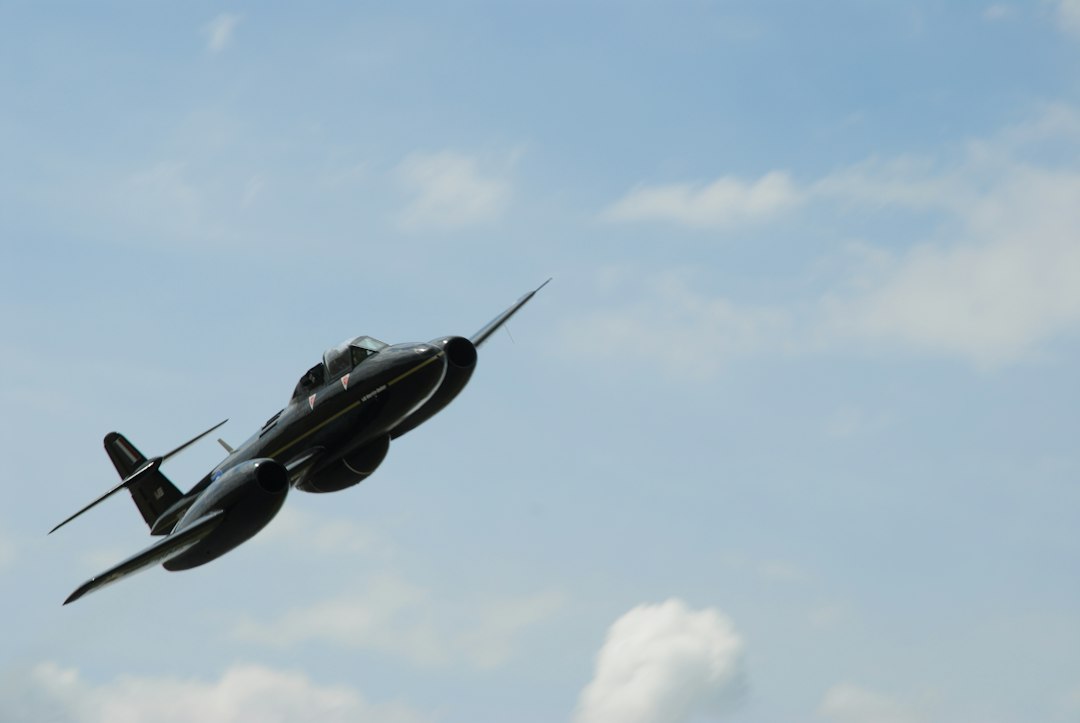
When we look at the transition from the drawing board to the actual flight line, it is fascinating to see how the Gloster Meteor, originally designated as the F.9/40, had to navigate such a tightrope of engineering constraints. The Air Ministry specifically demanded a twin-engine layout in 1940, not necessarily for raw power, but as a practical insurance policy against the notorious unreliability of early jet technology. To keep the project under wraps from enemy intelligence, the team even used the codename Rampage, a far cry from the final name that would eventually define the era. One of the most interesting choices they made was opting for a tricycle undercarriage, a total departure from the tail-dragger standard, which was really just a clever way to stop the hot exhaust from chewing up airfield runways.
The design team relied on a straight-wing configuration with a thick airfoil, which was a necessary trade-off at the time but ultimately capped the aircraft at a Mach number of about 0.82. You also have to consider the sheer pragmatism involved in the engine placement; they chose a mid-wing layout so the engines could be integrated directly into the wing spar, which made field maintenance and engine swaps a lot faster for the ground crews. Speaking of the engines, those early Rolls-Royce Wellands were temperamental machines that suffered from heat soak, meaning crews had to develop a specific routine of motoring the engines with an external starter just to cool them down after shutdown. Even the cockpit was a bit of a work in progress, as they tried to introduce a pressurized system that was so unreliable it often stayed disabled during actual squadron service.
It is also worth noting how they balanced cutting-edge tech with what pilots were comfortable with, like using fabric-covered ailerons and elevators to keep control forces manageable for guys transitioning from piston fighters. When the F.9/40 finally made its debut at Cranwell in March 1943, it was kept on a literal leash during taxi trials to stop it from taking off before the engineers really understood how it handled. And honestly, the early models were surprisingly limited, with a fuel capacity that gave them an operational radius of less than 100 miles, forcing the team to rush the development of drop tanks just to make the plane viable. They tucked the four 20mm Hispano cannons right into the nose, specifically to keep the recoil from messing with the airflow into the engine nacelles. It really puts into perspective how much of this plane was a series of quick, logical patches designed to keep the program moving toward the front lines.
Britain’s First Jet Fighter: Breaking the Propeller Paradigm
When you think about the shift from piston engines to jets, it’s easy to focus on the raw speed, but the real story is how the Gloster Meteor fundamentally shattered the conventions of mid-1940s aviation. We were moving away from the era where a spinning propeller did all the heavy lifting, and suddenly, engineers were grappling with a completely different set of physical laws. Take the Meteor’s fuselage, for instance; it was optimized for sheer speed rather than just hanging heavy armor plates everywhere, resulting in a low wing loading that actually let it out-turn the best piston fighters of the day at altitude. It wasn't just a faster plane—it was a machine that required a total rethink of how we managed weight, heat, and control.
But this new power came with a steep learning curve that the pilots of the time had to navigate in real-time. Because of those early, temperamental engines, the thrust-to-weight ratio was so delicate that pilots were strictly ordered to never attempt a takeoff on just one engine to avoid an uncontrollable yaw. If an engine did flame out, they couldn't just rely on automated systems to save them; they had to manually crank a mechanical trim tab on the rudder just to keep the plane flying straight. Even the basic act of bailing out was a nightmare, as the lack of an ejection seat meant manually climbing over the side at high speeds, which is a detail that really puts the bravery of those early test pilots into perspective.
We also have to look at how the design team had to invent solutions for problems that had never existed before. Without a propeller slipstream to cool the rear of the aircraft, the underside of the fuselage was essentially being cooked by the jet exhaust, forcing them to reinforce the airframe with heavy-gauge stainless steel just to keep it from warping during ground runs. They even had to deal with high-speed buffeting caused by the engine nacelles, which eventually required extending them rearwards to smooth out the airflow. Yet, when you look at the 606 miles-per-hour speed record it set in 1945, you realize that all these messy, manual, and slightly dangerous workarounds were actually the birth pains of the modern flight deck. It’s wild to think that this aircraft, with its complex cross-feeding fuel systems and cutting-edge 24-volt electrical grid, was effectively teaching us how to survive in the jet age long before the technology had really caught up.
Operational Impact: The Meteor’s Role in World War II
When we reflect on the Meteor’s combat debut, it is honestly incredible how much the British government feared the prospect of their cutting-edge jet technology falling into enemy hands. Because of this, the operational mandate was strictly limited to friendly territory, effectively keeping the aircraft out of the skies over Germany where its impact might have been most immediate. Think about the pressure on those early pilots; they weren't just flying a new machine, but were tasked with defending the homeland from V-1 flying bombs, often forced to use the wingtip vortex maneuver to physically flip the pulsejet projectiles out of the sky when their own cannons proved too difficult to aim at such high speeds. It is a stark reminder that this wasn't just a technological showcase, but a desperate, hands-on solution to a very real and immediate threat.
The logistical reality of maintaining the Meteor was just as intense as the flying itself, forcing the Royal Air Force to fundamentally rethink their ground operations. You can imagine the scene on the tarmac, where the early Welland engines were so temperamental that a crew member had to stand by with a foam extinguisher for every single start. The sheer heat from the jet exhaust even required the rapid construction of specialized concrete aprons, as the engines were literally melting the standard asphalt runways. It was a complete overhaul of the airfield ecosystem, showing that adopting a new propulsion paradigm requires far more than just replacing an engine in an existing frame.
But even with these shifts, the pilot’s experience remained a high-wire act of managing design quirks and physical limitations. The lack of dive brakes meant pilots constantly risked hitting compressibility limits, while the optical distortion from that curved canopy made landing on those new concrete strips a nerve-wracking chore. With such a short fuel range and zero radar, every mission felt like an exercise in precision timing, leaving little room for error when returning to base. It’s easy to look back and see the Meteor as a polished piece of history, but when you zoom in on these daily, messy hurdles, you start to see it for what it really was: a volatile, experimental, and essential bridge into the future of flight.
Setting the Standard: How the Meteor Influenced Future Jet Design
When you look at the DNA of every modern jet fighter, you start to see the Gloster Meteor’s fingerprints everywhere, even if we don't always give it the credit it deserves. It wasn't just a plane; it was essentially a testbed for the entire industry, forcing engineers to solve problems they hadn't even named yet. Take the cockpit, for instance—before the Meteor, pilots were lugging around heavy, inefficient heaters, but the design team pioneered an air-bleed system that pulled warmth directly from the engine compressor, a massive shift that saved precious weight. They also had to figure out how to manage thermal expansion, as the intense heat from those early Derwent engines literally made the airframe grow while in flight. By incorporating slotted bolt holes in the wing attachments, they kept the structure from fatiguing, a clever workaround that became a standard lesson in high-speed design.
And let’s talk about the flight deck, because that’s where the real evolution happened. The Meteor introduced a manual fuel cross-feed mechanism that let pilots balance the aircraft's weight on the fly, a feature that feels like a no-brainer today but was a total game-changer for multi-engine safety. To keep those engines running in perfect harmony, they built an automatic throttle synchronization device, which effectively killed the dangerous, unpredictable yaw that plagued other early twin-engine jets. Even something as small as the navigation lights had to be re-engineered, as the plane was moving so fast that standard bulbs were literally shattering under the aerodynamic pressure—leading to those flush-mounted lenses we see on jets today. It’s wild to realize that they were essentially learning how to survive at high speeds through trial and error, one broken lightbulb at a time.
But the most impressive part might be the maintenance logic they established, which honestly set the bar for everything that followed. Those ground crews developed a modular engine-change procedure that could swap out a power plant in under six hours, a benchmark that defined the logistical heartbeat of NATO fleets for decades. They also got creative with the nose-mounted cannons, developing flame suppressors that doubled as airflow stabilizers—a brilliant dual-purpose design that other manufacturers quickly adopted to fix their own intake turbulence. Plus, by raising the tailplane into that high-set T-configuration on later models, they figured out how to cut through interference drag and keep the plane stable near the sound barrier. It’s easy to look back at the sleek jets of today and think they were always that refined, but the Meteor was the messy, brilliant prototype that actually wrote the manual on how to keep these things flying.
Beyond the Battlefield: The Lasting Legacy of the Gloster Meteor
When you step back and look at the big picture, the Meteor wasn't just a fighter; it was a massive, high-speed laboratory that essentially force-fed the aviation industry into the jet age. Think about the fact that it served as the literal platform for the first live ejection seat tests by Martin-Baker, a terrifying but necessary leap that changed pilot survival forever. It also became our first real testbed for radar integration, forcing designers to extend the nose and rethink weight distribution in ways that influenced every night-fighter that followed. Honestly, it’s wild to see how those early, messy modifications to handle high-altitude performance and salt-corrosion in tropical climates eventually became the standard operating procedures we take for granted today.
The ripple effect of the Meteor on global aviation standards is even more staggering when you dig into the data. Because it was the first British jet exported in large numbers, the operational logs from those different countries became the baseline for global jet engine overhaul intervals, effectively writing the rulebook for maintenance we still use. We also owe the current layout of military trainers to the Meteor, as the introduction of its tandem-seat cockpit established the ergonomics that have defined pilot training for decades. And let’s not forget the rudder-boost systems or the density-compensating fuel controllers they had to invent just to keep the thing stable; these weren't just tweaks, but foundational engineering solutions for the problems of high-speed flight.
But the most fascinating part of its legacy is how it quietly laid the groundwork for today’s drone technology. By proving that a jet airframe could be adapted into a successful target drone, the Meteor essentially paved the way for the unmanned aerial systems that now dominate our skies. It’s also worth noting how its advanced cooling system—which cleverly repurposed waste heat for cockpit pressurization—eliminated the need for heavy, auxiliary heating hardware, showing a level of efficiency that was years ahead of its time. When you combine those innovations with the early anti-skid braking systems required for its high-speed landings, you realize the Meteor was doing the heavy lifting to solve the physics problems of the future. It’s not just a museum piece; it’s the quiet, mechanical ancestor of every jet currently cruising at forty thousand feet.
Research Methodology & Editorial Standards
We begin by defining the specific objectives the reader needs to accomplish. Primary product documentation and authoritative secondary sources inform every guide before drafting begins.
Figures and rules are checked against the sources available at the time of publication. Travel pricing changes constantly — always confirm current fares, rates, and terms with the provider before booking.