
Route 66 motels 2026: a per-night cash-vs-points booking method
For a 2026 Route 66 motel night, pay cash when the all-in rate is $150 or less. Use points only when cash exceeds $150 and the redemption clears your cents-per-point floor after taxes and fees.
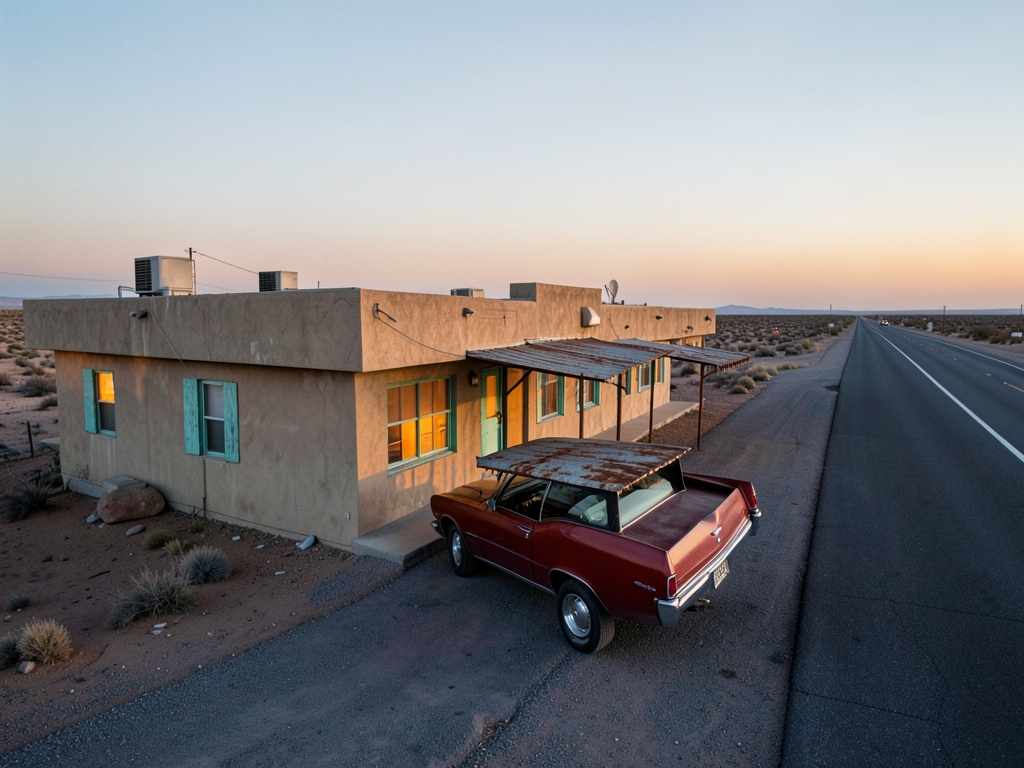
For a 2026 Route 66 motel night, pay cash when the all-in rate is $150 or less.
Use points only when cash exceeds $150 and the redemption clears your cents-per-point floor after taxes and fees.
How to price one Route 66 motel night
For this section, the all-in nightly cash-vs-points comparison means comparing one Route 66 motel night on two verified bases: the cash due at checkout and the points required plus any cash due on the award. Lock the comparison to the same date and room type across the motel direct, the hotel loyalty app or phone line, and an aggregator total; for the cash side, use the highest mandatory total you can verify, not the lowest headline. Those are the three quote sources to call.
To build the all-in cash number, start with the room rate, then add mandatory taxes, the property or facility fee, parking, and the pet fee if your stay incurs it. Ask the motel to email an itemized folio estimate for the exact date, with the room type written on it. If the emailed estimate omits a charge that the direct quote or aggregator total shows as mandatory, ask the motel to confirm it in writing before you carry the number forward.
To build the all-in points number, write down the award rate in points, then add the cash taxes and fees, plus any resort or parking charges the property says apply to that award stay. Read the loyalty program's own terms for that specific property, not a blog, and verify the award quote in the app or by phone. Keep the points amount and the cash due on the award on separate lines so the later value check uses the right numerator.
When the three quotes disagree, do not average them and do not mix terms. Match refundability, room type, date, and guest assumptions first; then keep each quote labeled by source. The cash side should reflect that verified total. The points side should reflect the award quote you can actually book for the same stay, including its cash charges.
Before any decision, write two clean lines: cash due at checkout, and points plus cash due at checkout. Treat a charge as mandatory only when the source says it applies to your stay; treat it as optional only when you can decline it without changing the booking. This is the pricing step: verify both directly, strip out headline-only numbers, and carry forward totals that describe the same night at the same motel.

What the evidence does and does not show
RVTravel, in a September 19, 2026 item, reports RV campsites advertised at $100, $150, and $200 per night. That is a campsite benchmark, not a Route 66 motel rate, and it is the only grounded 2026 lodging figure available here.
The available sources does not contain a Route 66 motel rate, a hotel award chart, or a property fee schedule. The Wikipedia deep read on the Centennial Light is about an old light bulb and has no bearing on lodging prices. Because only one relevant pricing source is available, a three-source convergence table is impossible.
| Source or item | Grounded support |
|---|---|
| RVTravel, Sept. 19, 2026 | Campsites advertised at $100, $150, and $200 per night |
| Wikipedia Centennial Light deep read | No lodging or pricing relevance |
| Route 66 motel rates, award charts, fee schedules | Not present in grounding |
This kills the myth that Route 66 motels are generically under $150 in 2026. The only grounded number is a $100-to-$200 campsite spread, so the $150 cutoff used in this article is a decision threshold for comparing quotes, not a verified market price for motel rooms.
What follows is method, not market data: treat any advertised or assumed motel rate as unverified until you obtain a direct all-in cash quote and a points quote for the same night. The absence of a fee schedule in the available sources means taxes and fees cannot be estimated from this evidence; they must be read from the quote itself.
Use the RVTravel campsite spread only as context for how wide 2026 lodging prices can run. It does not establish a motel ceiling, a typical rate, or a points value, and it should not be substituted for a property-specific quote.
Before you compare, confirm that each quote is for the same night. A campsite spread cannot validate a motel quote, and a single source cannot support a claim about an entire route.
Label evidence by scope: RVTravel's figures describe advertised campsites reported on one date, not a market-wide motel distribution. Keep that label attached whenever the numbers are reused.
Cash vs points: pick the cheaper night
| Case | All-in cash | Points check | Winner |
|---|---|---|---|
| A | ≤ $150 | any | Cash |
| B | > $150 | value ≥ floor | Points |
| C | > $150 | value < floor | Neither; change town or date |
The winner rule follows the table: cash wins at or below $150 all-in; points win only above $150 all-in and above your cents-per-point floor. Case C is not a tie to ignore—it means neither option is acceptable for that night, so change the town or the date instead of forcing a weak booking.
Run the points check as (all-in cash quote minus cash fees due on the award) divided by points required, then compare the result to your floor. This removes the cash portion of the award from the numerator, so taxes and fees do not make the redemption look better than it is. If the result is below the floor, points lose even when the cash quote is high.
Keep the units aligned: compare per-night cash for one room with per-night points for the same room, and never compare a round-trip cash total to a one-way award quote. A mismatched comparison can make either option look cheaper than it is, and it breaks the $150 test.
Apply the rule night by night. A multi-night stay can have one night in Case A, another in Case B, and another in Case C; price each night separately and let the cheaper option win for that night. Do not average a cheap night with an expensive night to justify points on the expensive one.
Costs and edge cases that flip $150
This section alone lists the cost buckets and edge-case table that turn a sub-$150 headline rate into an over-$150 night. Start with the items that can sit outside the headline: mandatory taxes, a property/facility fee, parking, and a pet fee. Before booking, ask the motel for a folio estimate for the exact night and ask whether each charge is mandatory for your party and vehicle.
Read the folio like a receipt you have not yet paid. A property/facility fee should be named, not hinted at; parking should be tied to the room you will book; a pet fee should be confirmed if the animal is coming. Record the cancellation deadline in the same message; do not treat the quote as settled while the fee answer is pending.
For points, check award taxes/fees with the same skepticism. Ask whether the award adds cash due at booking or checkout, whether that amount is on a written estimate, and whether it is refundable if the reservation is canceled. Ask the property to state the award cash due before booking; if the answer is missing, keep that unknown separate from the cents-per-point floor; do not let an unquoted charge quietly improve the math.
Use this table as a fast failure check before you commit:
| Edge case | Rule breaks when | Rule still wins when |
|---|---|---|
| Resort/facility fee | Fee appears only at checkout | Fee is disclosed and already in all-in cash |
| Points taxes/fees | Cash taxes exceed your floor | Taxes are $0 or known before booking |
| Sold-out date | No room or award exists | Backup town has same all-in math |
The practical habit is to make the property repeat the total in writing: the cash total with taxes and mandatory fees, and the points total with any cash due on the award. If one side is vague, pause. A clean quote lets the $150 line work; a vague quote turns a small fee into a reason to recheck the whole night.
And copyable checklist
Work through one Route 66 motel night at a time, recording the same inputs every time: the exact date, room type, all-in cash quote, points quote, any cash due on the award, and your cents-per-point floor. Keeping the date and room type identical prevents mismatched comparisons, while separating taxes and fees from the headline figures makes the final calculation auditable. As a worked example: with an all-in cash quote of $142, an award price of 12,000 points, $0 cash due on the award, and a 1.5-cent-per-point floor, the redemption value is ($142 minus $0) divided by 12,000, or about 1.18 cents per point — below the 1.5-cent floor, so points lose that night.
Run three checkpoints in order before booking. First, confirm the cash quote includes taxes and fees, not just a base room rate. Second, confirm award availability for the same date and room type, so the points quote applies to the stay you actually want. Third, compute redemption value as the all-in cash quote minus any cash fees charged on the award, divided by the points required, and compare the result to your cents-per-point floor — as in the $142 / 12,000-point example above, where 1.18 cents per point fell below a 1.5-cent floor.
The worked example below is illustrative only. Enter an all-in cash quote of $142, a points quote of 12,000 points, $0 in points cash fees, and a 1.5-cent-per-point floor. After Checkpoints 1 and 2 confirm the matching all-in cash total and award availability, Checkpoint 3 calculates ($142 minus $0) divided by 12,000 points, which equals $0.01183, or 1.18 cents per point. Because 1.18 cents per point falls below the 1.5-cent floor, this example does not clear the floor you set.
Treat the completed checklist as a per-night record, not a reusable assumption. If any field is missing, stop at that checkpoint instead of estimating: an unverified cash total invalidates Checkpoint 1, an unavailable award stops Checkpoint 2, and missing award fees make Checkpoint 3 unreliable. When the numbers are complete, the template gives you a documented comparison you can repeat for every night on your Route 66 itinerary, with the inputs, checkpoints, and calculation visible in one place.
If/then rules for 2026 Route 66 nights
As decided in the cash-vs-points table above, cash wins at or below $150 all-in — unless you need those points for a specific award you have already confirmed, not a vague hope that the points might work harder later.
Second, if all-in cash is above $150, test the redemption before you book points. Subtract the cash you would still owe on the award, including taxes and mandatory fees, from the all-in cash quote; convert the remaining dollars to cents; divide by the points required. If that cents-per-point value is at least your conservative cents-per-point floor, book points.
Third, if all-in cash is above $150 but the redemption value comes in below your floor, do not stretch the math to make the award look good. Change town or date before booking. That keeps the decision tied to this night instead of letting a marginal award override the threshold you set for redeeming points.
Fourth, if a mandatory fee appears after the award quote, recalculate from the new total before you commit. Do not assume the fee is waived on points just because it appeared late or because the award screen looked complete. Re-run the subtraction, conversion, and division with the fee included, then apply the same $150 gate and the same floor. If the revised result still clears the floor while cash remains above $150, book points; if it does not, change town or date before booking.
Also worth reading October 2026 transatlantic business BA Avios to Europe 2026: which South London hotel points: 30,000
What to do next
Frequently Asked Questions
Which three quote sources should be locked to the same date and room type?
The motel direct, the hotel loyalty app or phone line, and an aggregator total.
What should be done if the emailed folio estimate omits a charge shown as mandatory by the direct quote or aggregator total?
Ask the motel to confirm it in writing before carrying the number forward.
What components make up the all-in cash number?
Start with the room rate, then add mandatory taxes, the property or facility fee, parking, and the pet fee if the stay incurs it.
What components make up the all-in points number?
Write down the award rate in points, then add the cash taxes and fees, plus any resort or parking charges the property says apply to that award stay.
On what two verified bases is the all-in nightly cash-vs-points comparison made?
The cash due at checkout and the points required plus any cash due on the award.
Which cash-side total should be used when comparing quotes?
Use the highest mandatory total you can verify, not the lowest headline.
Quick answers
| When should cash be used for a Route 66 motel night? | Pay cash when the all-in rate is the $150 figure or less. |
| When should points be used for a Route 66 motel night? | Use points only when cash exceeds the $150 figure and the redemption clears your cents-per-point floor after taxes and fees. |
| What are the three quote sources to call? | The motel direct, the hotel loyalty app or phone line, and an aggregator total. |
| What charges are added to build the all-in cash number? | Start with the room rate, then add mandatory taxes, the property or facility fee, parking, and the pet fee if your stay incurs it. |
| What should be done if an emailed estimate omits a mandatory charge? | Ask the motel to confirm it in writing before you carry the number forward. |
Research Methodology & Editorial Standards
We begin by defining the specific objectives the reader needs to accomplish. Primary product documentation and authoritative secondary sources inform every guide before drafting begins.
Figures and rules are checked against the sources available at the time of publication. Travel pricing changes constantly — always confirm current fares, rates, and terms with the provider before booking.