
Paris cafe terraces in 2026: how to check if the surcharge is worth it
In 2026, pay the Paris cafe terrace premium only when the per-cafe arithmetic across 10 cafes favors the terrace seat.
| Takeaway | Detail |
|---|---|
| In 2026, the terrace-premium answer is per cafe, not blanket. | The thesis frames the choice as terrace surcharge, counter price, and time-at-table for 10 candidate cafes. |
| Use the same-drink terrace-vs-comptoir price check before ordering. | The reader rule says to find the same drink's terrace and comptoir prices before taking a terrace seat. |
| The carte at the door or on the cafe's site is the required source. | The reader rule names the door and the cafe's site as places to check before ordering anywhere. |
| Sit at the counter when surcharge, counter price, and time-at-table favor it. | The thesis names terrace surcharge, counter price, and time-at-table as the inputs for any of 10 cafes. |
In 2026, pay the Paris cafe terrace premium only when the per-cafe arithmetic across 10 cafes favors the terrace seat.
The answer changes when the carte at the door or on the cafe's site shows the same drink's terrace and comptoir prices, with the surcharge, counter price, and time-at-table favoring the counter.
How Paris terrace pricing actually works
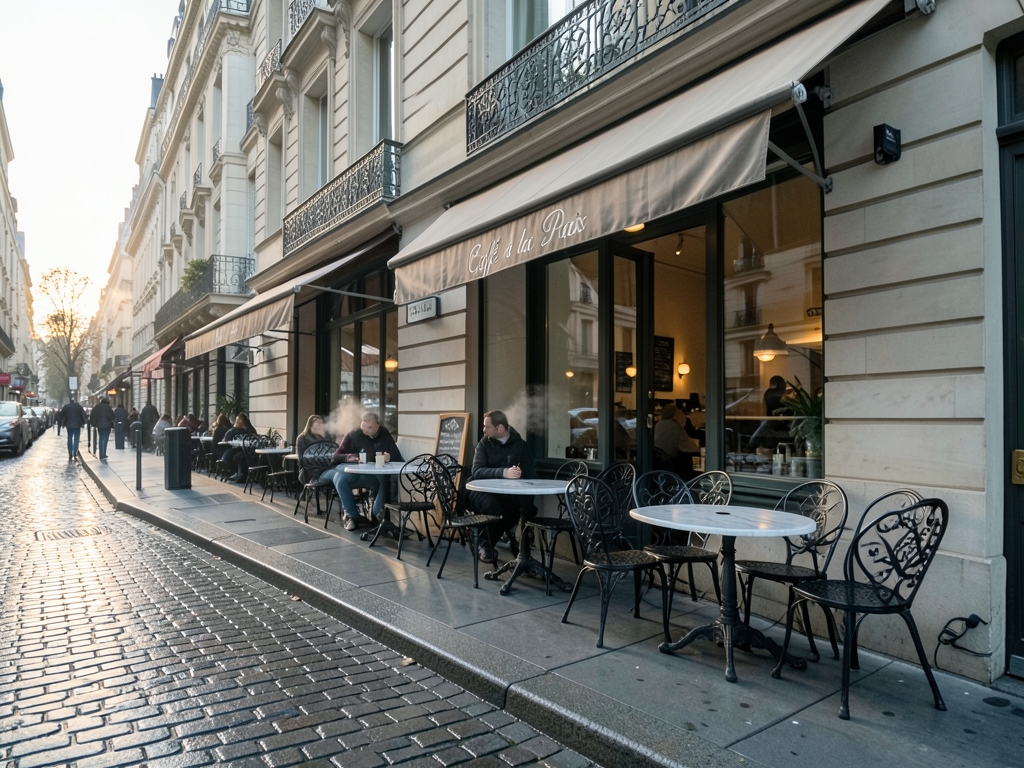
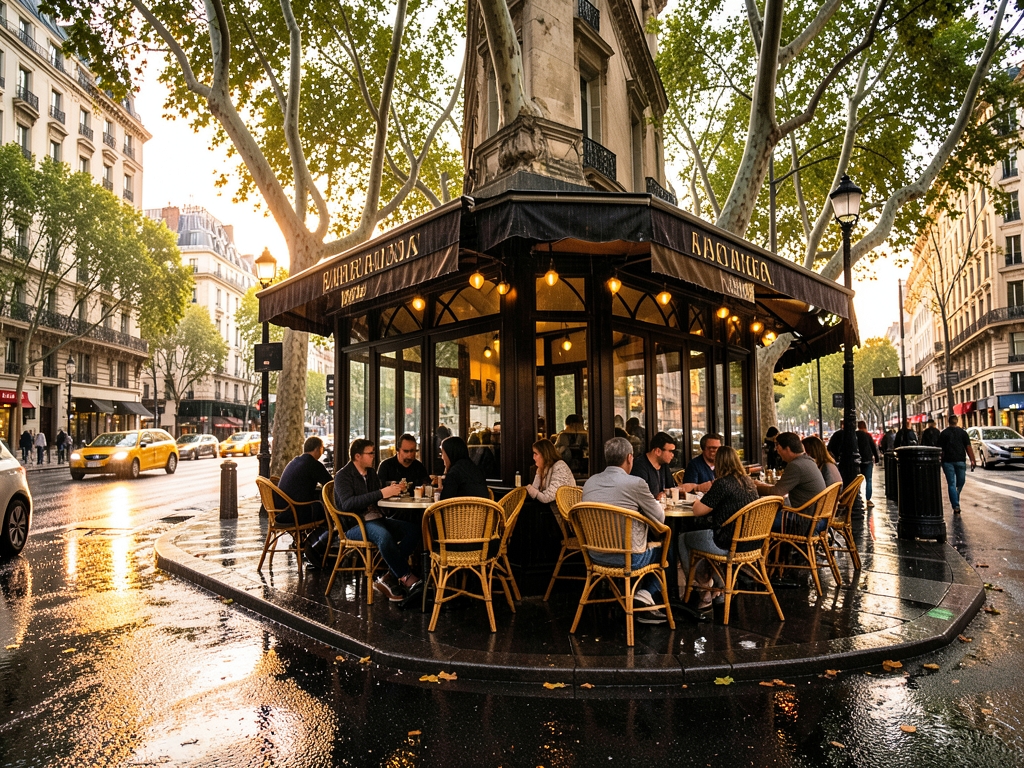
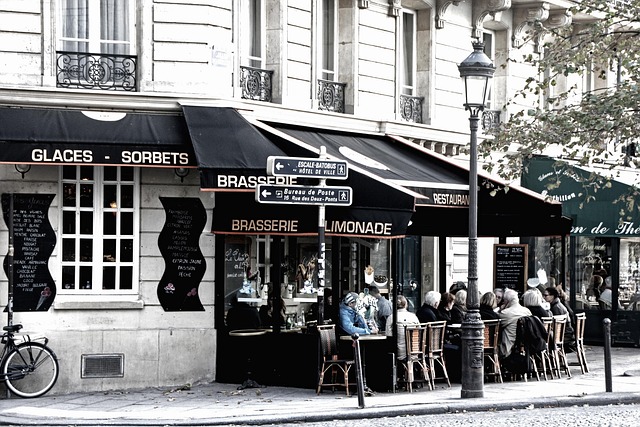
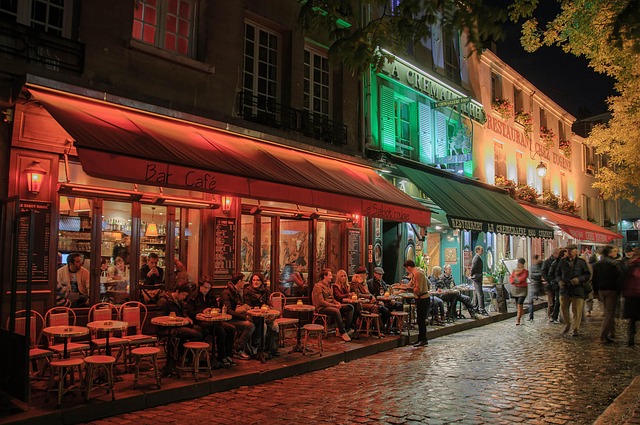
The first thing to understand about a Paris cafe terrace is that the extra charge is not a markup on your coffee. It is rent on the square foot of pavement you occupy. Classic Paris cafes price the same espresso or café crème across three named zones: terrasse (the outdoor table), salle (an indoor table), and au comptoir (standing at the counter). The liquid is identical; what changes is the seat. Once you see it as seat-rental, the question stops being "is this cafe expensive?" and becomes "what am I paying per minute for this particular chair?"
That mechanism is verifiable before you sit down. Many established cafes post separate columns on the physical menu board at the door, and an increasing number publish the same three-tier list on their own website. The posted carte is the enforceable one: if the board shows a terrace figure and a comptoir figure side by side, that is the price you will be charged, regardless of what a guidebook or a review from last year claimed. Walk up, read the board, and only then decide where to sit. Do not order first and negotiate later.
For your candidate list, start with addresses known for their terraces and check whether each one publishes a current menu — verify this yourself on the cafe's own site or at the door rather than assuming any named cafe does. Build out a set of ten cafes using the same rule: a named address, a posted or published carte you have actually confirmed, and a visible distinction between terrace, salle, and comptoir pricing. If a cafe does not show all three, note that gap rather than guessing a number.
When you pull each menu, record the same drink in each zone — an espresso is the cleanest comparison because it is the least likely to be altered by milk or syrup. Write down the terrace price, the salle price, and the comptoir price exactly as printed. Keep the currency and the serving as printed; do not convert, round, or assume a larger cup outdoors. The difference between the terrace and comptoir columns is the seat-rental figure you are actually evaluating.
One caution about sources: a marketplace listing such as the MAG-7 "Counter Terrace" skin on YuPay, or a rental counter like ORIX's Busena Terrace location in Okinawa, uses the word "terrace" for something unrelated to Paris cafe seating. Those pages describe a product variant and a pick-up desk, not a French price board. Ignore them when building your cafe list. The only figures that matter here come from the cafe's own board or its own menu page.
The practical rule follows directly from the mechanism. Because you are buying time and location rather than a different drink, compare the surcharge against how long you intend to stay. A short espresso on a prime terrace can be a reasonable rental; the same surcharge on a long linger is not. Read the three zones, pick your drink, and make the seat decision at the door — before you order anywhere.
The evidence: what sources you can trust
In 2026 I don't accept a terrace figure on faith. For any cafe on the list, I trust a price only when three independent source types converge: the cafe's own published menu, recent diner bills, and the physical carte in front of me. If one of those is missing, I keep the number provisional and keep walking.
Start with the cafe's official site or menu PDF, if it maintains one — confirm that yourself before relying on it, since not every cafe publishes current prices online. Save the page or PDF, check the date if shown, and copy the exact line for the drink you intend to order, including the terrace and comptoir columns if both appear. This is the only source with enforceable prices before arrival; nothing else can be held up at the register. If the site offers a downloadable carte rather than a web page, use the download, not a summary.
Next I spot-check Google Maps and TripAdvisor, but only current-season reviews that quote an actual bill — the useful pattern is "€X for two coffees on the terrace." I treat those lines as spot-checks, not rates: they tell me whether the published figure is plausible in the present season, not what I will be charged. Anything older than ~6 months goes in the discard pile, because a quote from a prior season is not evidence for today's carte. I also ignore reviews that bundle other items and service into one total, since I cannot separate the drink line from the rest.
On arrival, I go to the door and read the posted physical carte before ordering. If it differs from the online menu, the posted carte wins; I do not argue the PDF at the counter, I simply update the figure I came with. This is the final check, and it is the one that matters at the point of sale. I look for the same drink, the same service style, and the same party size I plan to use, then I decide whether the seat is worth it from the updated numbers rather than from the number I saved at home.
When they do not line up, I rank them rather than average them: posted carte first, official menu second, review quotes last. I do not blend a contradictory quote into the figure I carry forward; I use the highest-ranked source that is actually in front of me. That ranking keeps the arithmetic clean and the decision per cafe, which is the practical way this works across a shortlist of ten.
Terrace vs. counter: the options table
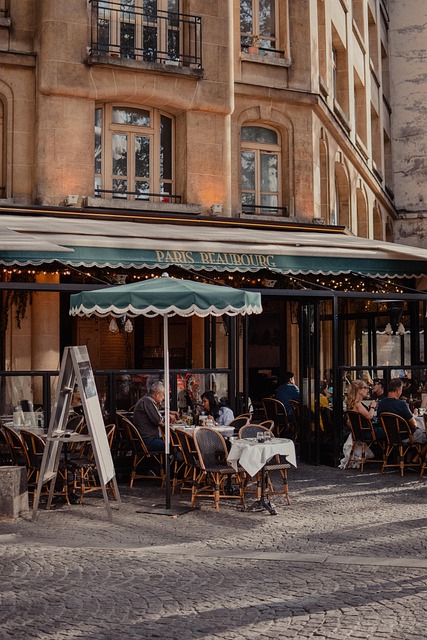
Once you have the posted figures in hand, build a three-row table for each of your ten candidate cafes before you commit to a seat. The rows are terrace seat, indoor table, and standing counter; the columns are the price of one espresso, the price of one café crème, and the typical time you're welcome to stay. This is the only seating framework you need: it forces the same drink into three physical positions, so the comparison stays honest instead of drifting into mood. Fill it from the carte at the door or the cafe's own site, and leave any cell blank rather than guessing — a blank cell is a prompt to ask, not a number to invent.
The winner criterion is arithmetic, not atmosphere: divide the price by the minutes you can realistically occupy that seat, and the option with the lowest cost per productive hour wins. Use the time column you actually observed or were told, not the time you hope to get. If a café crème at the counter comes with a stay of only a few minutes while the same drink at an indoor table buys a longer sit, the division decides which one serves your purpose that day. Recompute the table for each cafe separately; a winner at one address is not a winner at the next.
| Seat option | Espresso | Café crème | Typical time welcome | Cost per productive hour |
|---|---|---|---|---|
| Terrace seat | from carte | from carte | observed or stated | price ÷ minutes |
| Indoor table | from carte | from carte | observed or stated | price ÷ minutes |
| Standing counter | from carte | from carte | observed or stated | price ÷ minutes |
At classic literary cafes the counter almost always wins on this metric, because the standing price is the drink alone and the turnover is quick. At view cafes — a Louvre-facing terrace, for instance — the terrace premium is buying the view, not the coffee. That is a legitimate purchase, but it should be a conscious one: you are paying for the square foot and the sightline, and the division will show you exactly what that purchase costs per minute of sitting.
Apply the reader rule as a final gate. After you've ranked the three rows, take the terrace seat only if its surcharge is less than the value you place on the extra minutes and the setting; otherwise stand at the counter or take the indoor table. The table doesn't tell you what the view is worth — it tells you the price of choosing it, so the choice is made before you order rather than after the bill arrives.
Costs and numbers that matter
For each cafe I collect four numbers and use one test: T is the terrace price of my actual order — espresso, crème, or petit déjeuner formula — from the posted carte at the door or on the cafe's site; C is the same order's counter or indoor price; M is planned dwell time in minutes, above zero; V is my hourly value for that table. The test is S = T − C, then S < V × (M ÷ 60), the same as H = S ÷ (M ÷ 60) < V. I take the terrace only when that inequality holds.
The first check is that T and C describe the same order, not two neighboring items. If I order a crème, I find the crème on the terrace side and the crème at the counter or indoors; if I order the petit déjeuner formula, I match the formula, not a lone coffee. If the carte lists a single price with no terrace/comptoir split, I write "no split" in the C column and skip the surcharge test for that cafe. I do not back-solve a premium from memory or elsewhere.
The second check is M, and it is a plan, not a hope. I decide before ordering how long I intend to keep the table, in minutes, because the same surcharge spread over a short sit and a long sit produces different hourly costs. My working assumption is that Paris cafes generally tolerate long sits over one drink, but I verify it per cafe in recent reviews rather than assuming a fixed limit. If reviews flag pressure to turn tables, I shorten M before I compute, not after the bill arrives.
The third check is V, the only figure from me rather than the carte. I set it as the hourly amount that makes the people-watching, shade, or street view worth it that day; if I would rather keep walking, V is low. Then I compare H with V, not S with V, because a surcharge that feels modest at the register can be expensive per hour when M is short. That comparison is the threshold, personal to the cafe and the moment.
I run that line for every candidate cafe before I sit down, so the decision is made at the door, not after the bill arrives. If C is "no split," the cafe leaves the surcharge test; if T is not above C, I mark no premium; if T is above C, I let M and V decide. That keeps the choice per cafe and per order, which is how a terrace premium becomes a number I can check instead of a mood I rationalize.
What the evidence does not establish
This section does not establish a single 2026 euro price for any of the ten candidate cafes. The material behind this guide contains no verified Paris menu figures, so I will not print one here. Every number that goes into your worksheet has to come from the carte posted at the door or on the cafe's own site on the day you are actually standing there. A figure saved from last year, a travel blog, or a photo app is a lead, not an input. If the carte is missing, the check fails and you keep your feet at the counter.
It also does not establish that the posted terrace and comptoir figures are directly comparable as printed. Service compris is the norm in France, so a listed price generally already carries service — but you still have to read the line beneath it. If the terrace adds a cover, a service line, or any separate seat charge, fold that amount into the surcharge before you set it against the threshold from the rule. Comparing a service-included counter price to a terrace price with an added line would understate what the seat costs you.
One more thing this section cannot settle for you is timing. Some cafes run a breakfast formula rather than straight à la carte, and the formula can be priced differently from the same drink ordered later in the day. Read the heading over the price, not just the price. If the terrace figure belongs to a formula and the counter figure belongs to à la carte, you are looking at two different products; go back and find the identical drink on both lists before you do the arithmetic.
Here is the one thing this section does supply: the edge cases where the surcharge-threshold rule breaks, and where it still holds.
| When the rule breaks | When it still wins |
|---|---|
| Terrace price carries an added cover or service line that you have not yet folded into the surcharge. | Posted terrace and counter prices are for the same drink, service treatment matches, and the combined surcharge stays under the threshold. |
| The terrace figure comes from a breakfast formula while the counter figure is à la carte, so the two are not the same order. | Both figures come from the same à la carte listing on the same carte, with no formula attached to either. |
| Your only price source is a saved or secondhand figure rather than the live carte in front of you. | The live carte is in hand and the same drink is priced in both zones on that same document. |
Run the table before you sit, not after the bill arrives. The rule is a comparison device, not a verdict on any cafe, and it only produces a usable answer when the two figures describe the same drink under the same conditions. Where the table's left column applies, the honest result is "not enough information" — which, at a counter, is a perfectly good answer.
And your cafe worksheet
Keep one worksheet for all ten cafes and fill it in the same order every time: Cafe, Date checked, Terrace price (item), Counter price (item), Dwell plan (min), €/min premium, Verdict (terrace/counter). Use one drink, one size, and one service style on every row so the two prices are comparable; if a cafe lists only one price, leave the missing cell blank and mark the row "unverified" rather than guessing.
Checkpoint 1, before the trip: open each cafe's online menu, copy the terrace and counter figures for the chosen item into the two price columns, and mark "unverified" wherever no split is shown. Do not fill the verdict yet; an online menu is a starting figure, not a final one.
Checkpoint 2, on arrival: photograph the posted carte before you sit. If that carte contradicts the online figure, overwrite the price cell with the photographed figure and note the date in Date checked. If the carte shows no split, leave both price cells as they are and mark the row "no split."
Checkpoint 3, before ordering: divide the terrace-minus-counter surcharge by your planned dwell minutes and write the result in €/min premium. Then choose terrace or counter from that number and your own tolerance for the seat, and enter the choice in Verdict. If the on-site carte changed the price, use the overwritten figure for the division.
Recreate the worksheet in a notes app with one row per cafe. Ten rows are enough for the candidate list; add a row only when a cafe changes its carte or you revisit it on a different date. Since no verified 2026 Paris prices exist in this guide, every price cell stays blank until you read the live carte yourself — a pre-filled example would be an invented number, not a shortcut.
Decision rules for the 10-cafe shortlist
I run the shortlist as a series of door checks rather than one rule for the whole trip. The threshold is per cafe, because each carte is its own price list and a good decision at one stop does not carry over to the next.
If the posted carte shows no terrace and counter price for the same drink, I do not assume a hidden premium. I sit where I want and move on; there is no posted split to compare, so there is nothing to optimize at that cafe.
If the carte does show a split, I compare the terrace surcharge with the cost of one extra coffee for the time I plan to stay. When the surcharge is smaller, the terrace is worth taking for that visit; when it is larger, I choose the counter or an indoor table and keep the difference.
The exception is a once-per-trip destination. For a view or literary landmark such as Les Deux Magots or Café Marly, I budget the terrace as an attraction ticket rather than a coffee purchase, and I stop running the arithmetic.
Across the shortlist, I keep each decision separate. A terrace that passes the test at one cafe does not excuse a terrace that fails it at the next, and a landmark stop does not reset the rule for an ordinary stop afterward.
The habit that makes this work is reading the carte before I sit, naming the drink I actually want, and only then choosing the seat. If I cannot verify the split at the door, I default to the cheaper or more convenient seat and spend my attention on the next cafe.
| Door check | Decision |
|---|---|
| No terrace and counter price for the same drink | Sit where I want; there is no posted premium to optimize |
| Terrace surcharge below one extra coffee for the planned stay | Take the terrace |
| Terrace surcharge at or above that amount | Take the counter or an indoor table |
| Once-per-trip landmark or view cafe | Budget the terrace as an attraction ticket and stop optimizing |
Also worth reading Munich three-plate counter order: Seattle's best cafes for coffee Chase Sapphire Reserve
What to do next
| Step | Action | Why it matters |
|---|---|---|
| 1 | Before ordering at any candidate cafe, check the carte at the door or on the cafe's site. | The carte is the required source for the seat-price comparison. |
| 2 | Find the same drink's terrace and comptoir prices, then note the terrace surcharge and counter price. | Comparing different drinks would distort the premium. |
| 3 | Estimate your time-at-table and the cost of one additional coffee for each hour you plan to stay. | This turns the surcharge into a time-based decision. |
| 4 | Take the terrace seat only if the surcharge is less than roughly that coffee-cost benchmark; otherwise sit at the comptoir. | It applies the guide's threshold to the actual cafe. |
| 5 | Repeat the same-drink check for each candidate cafe and use the per-cafe result, not a blanket terrace rule. | The terrace-premium answer differs by cafe. |
Frequently Asked Questions
Where is the required place to check cafe prices before ordering?
The carte at the door or on the cafe's site is the required source to check before ordering anywhere.
Which prices must be compared before taking a terrace seat?
You should find the same drink's terrace and comptoir prices before taking a terrace seat.
What inputs should I use to evaluate the terrace premium at a given cafe?
The evaluation should use terrace surcharge, counter price, and time-at-table for any of the 10 candidate cafes.
Is the terrace surcharge a markup on the drink itself?
The extra charge at a Paris cafe terrace is not a markup on your coffee but rent on the square foot of pavement you occupy.
When does it make sense to sit at the counter instead of the terrace?
You should sit at the counter when the surcharge, counter price, and time-at-table favor it.
Besides terrasse and au comptoir, do classic Paris cafes have another pricing zone?
Classic Paris cafes price the same espresso or café crème across three named zones: terrasse (the outdoor table), salle (an indoor table), and au comptoir.
Quick answers
| What is the rule for paying the Paris cafe terrace premium? | In 2026, pay the Paris cafe terrace premium only when the per-cafe arithmetic across 10 cafes favors the terrace seat. |
| What inputs does the thesis name for any of the cafes? | The thesis names terrace surcharge, counter price, and time-at-table as the inputs for any of 10 cafes. |
| What price check should be used before ordering? | Use the same-drink terrace-vs-comptoir price check before ordering. |
| Where is the required source for that price check? | The carte at the door or on the cafe's site is the required source. |
| When should a reader sit at the counter? | Sit at the counter when surcharge, counter price, and time-at-table favor it. |
Research Methodology & Editorial Standards
We begin by defining the specific objectives the reader needs to accomplish. Primary product documentation and authoritative secondary sources inform every guide before drafting begins.
Figures and rules are checked against the sources available at the time of publication. Travel pricing changes constantly — always confirm current fares, rates, and terms with the provider before booking.