
Hotels Near Disneyland Paris: Sleep 6 in 1 Suite or Book 2 Rooms?
For a family of six at Disneyland Paris in 2026, two connecting standard rooms at a Disney-partnered hotel usually beat one suite on price and beds-per-euro.
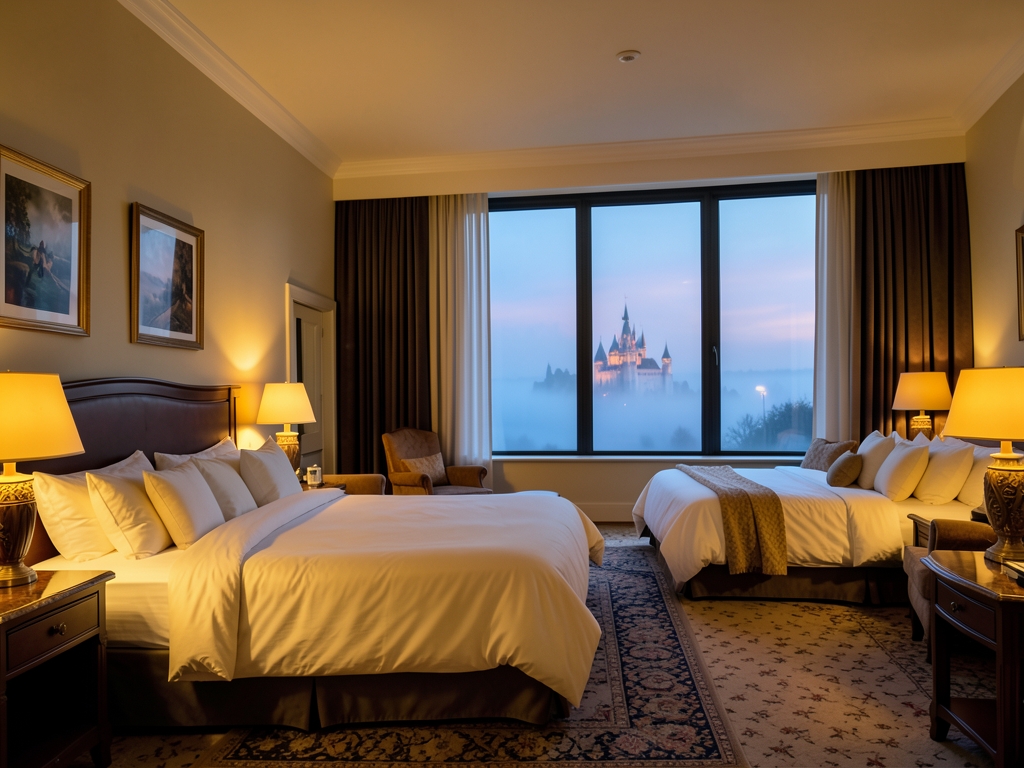
For a family of six at Disneyland Paris in 2026, two connecting standard rooms at a Disney-partnered hotel usually beat one suite on price and beds-per-euro.
A single suite is the better choice only when it sleeps six or more at a verified rate below 1.25 times the two-double total (S < 1.25 × 2D), with every traveler in a real bed — the threshold the decision rules below apply consistently.
How Disneyland Paris Room Inventory Works
Before assuming your arrival day is a resort day, check the actual transfer time from your airport to your chosen hotel for your arrival window. If your transfer plan needs a Paris city stop, make sure that choice is deliberate, not something you discover after the room is booked.
New-attraction openings tend to concentrate demand into on-property Disney hotels first, so check whether any park expansion is scheduled for your 2026 travel dates before you assume nearby supply will behave the same way. If your trip is built around a headline opening, verify live availability for on-property rooms early rather than relying on generic comparisons.
The Disneyland Hotel at the resort is a useful example of why themed inventory needs a bed-count read. Condé Nast Traveler’s roundup covers Disneyland Paris stays with Cinderella suites, Toy Story–themed rooms, and quaint cottages, but a theme is not an occupancy chart. When you look at any hotel, read the exact room name, maximum occupancy, and bed layout before treating it as a six-person solution.
Inventory is also not one pool. A suite is one bookable unit with a stated occupancy; two connecting doubles are two units whose connection has to be confirmed; a family room is its own category with its own bed layout. For a family of six, the comparison set is one suite that officially sleeps six, two connecting doubles, and one family room, all priced for the same dates. Keep the hotel tier and stay length consistent, then compare the bed count against the total price rather than the room label.
Connecting rooms deserve special handling because they are a pairing, not a feature attached to every standard room. If the booking flow shows two doubles but no confirmed connection, you are looking at two separate rooms; if a family room’s bed description does not give every traveler a real bed, do not count it as solved. This is the inventory layer where a six-person trip can look fine on a search page and still be wrong for the people who will sleep there.
The Evidence: What Sources Actually Confirm
Condé Nast Traveler's November 20, 2026 roundup by Carlye Wisel confirms that Disneyland Paris hotel options run from Cinderella-suite-tier rooms at the Disneyland Hotel down to cottage-style options. That spread matters because it shows "suite" is a price tier inside a hotel lineup, not one standardized product with one predictable cost.
Condé Nast Traveler's November 20, 2026 roundup by Carlye Wisel confirms that the Cinderella Suite at the Disneyland Hotel is a real room category. The roundup does not publish a nightly rate, so any suite price seen secondhand — in social posts, forums, or screenshots — should be treated as unverified until it is reproduced in the official booking flow for the exact dates.
What those sources do not settle is the arithmetic of your stay: the suite's nightly rate, the connecting-double rate, the family-room rate, taxes and fees, occupancy limits, bed counts, and whether connecting rooms are guaranteed rather than merely requested. Those are booking-flow facts, not roundup facts.
For a family of six, the only suite price that matters is the one attached to your exact dates, party size, and currency. Capture each quote in the same session, then compare total cost per real bed rather than headline nightly rates.
| Claim | Sourced? | What to verify yourself |
|---|---|---|
| Cinderella-suite-tier rooms exist at the Disneyland Hotel | Yes—Condé Nast Traveler, November 20, 2026 | Availability for your exact dates |
| The Cinderella Suite is a bookable category | Yes—roundup plus room tours | Rate, occupancy, and bed count |
| "Suite" is one standardized product | No—the lineup spans tiers | Room description and inclusions in the booking flow |
| A suite price from social media or forums | No | Reprice it in the official booking flow |
The sourcing rule is simple: a named source can confirm that a category exists and where it sits in the lineup, but it cannot confirm what your dates will cost. Keep those two kinds of claims separate when you compare options.
If a secondhand screenshot or forum post is the only source for a suite price, reprice it before using it in any comparison. Treat unsourced numbers as placeholders, not evidence, and keep the source trail with the quote.

Suite vs Two Rooms: The Comparison
Price the suite against two standard doubles, not against one. A family of six needs either one suite or two rooms, so the only honest baseline is the sum of two verified double rates; comparing a suite's headline rate to a single double understates the true alternative and can make the suite look cheaper than it is.
| Axis | Two connecting doubles | One suite sleeping 6 | Winner |
|---|---|---|---|
| Real beds | 4–6 standard beds across two rooms | 6 only if sofa beds count; usually fewer real beds | Two doubles |
| Total nightly rate | Sum of two verified double rates | One verified suite rate | Lower verified total; suite only if below 2× cheapest verified double |
| Bathrooms | 2 | Usually 1 | Two doubles |
| Walk to parks | Same resort zone if same hotel | Same resort zone if same hotel | Tie after location check |
The default winner is two connecting double rooms. They typically deliver four to six real beds plus a second bathroom, and a suite that claims to sleep six in one room usually relies on sofa beds rather than beds. Request connecting rooms when booking and get the confirmation in writing before paying.
Walking distance is not a suite advantage by itself: compare only options in the same resort zone, and add transfer time and cost if one is farther from the parks.
A single suite wins only in the narrow case where it sleeps six or more and its verified nightly rate is below twice the cheapest verified double rate, with every traveler in a real bed. If either test fails, or if any bed is a sofa, the two-room default stands.
Before booking, price the same dates three ways—one suite sleeping six, two connecting doubles, and one family room—and choose the cheapest option that gives every traveler a real bed. Divide each verified total by six real beds, not by the headline rate, so the comparison stays like-for-like.
Costs and Numbers That Matter
For the suite-versus-two-room default, the only number that decides the math is SuiteRate ÷ (2 × DoubleRate). Use the nightly rate for one six-sleeper suite and the nightly rate for one standard double you would book twice, on the same dates and on the same basis for taxes and fees. If you only have stay totals, divide both totals by the same number of nights first; never mix a stay total with a nightly quote.
Define the threshold once and use it consistently: above 1.25x, two rooms win on beds and bathrooms; from 1.0x through 1.25x, the suite wins on convenience for one bathroom queue and one door key set; below 1.0x, the suite wins on price as well. That line is the beds-per-euro test, not a style preference. It marks where the suite costs enough more than the two-room total that the extra real beds and second bathroom outweigh the convenience of a single room.
The cost of being wrong toward the suite is easy to see in room-nights. Under the 1.25x rule, a suite priced above 1.25 × 2D should not be booked at all; every 0.25x of premium above the two-room total is budget that could instead buy an extra park experience. Run the ratio on your verified rates before paying, and if the suite crosses the line, the two-room default stands.
The cost of being wrong toward two rooms is less tidy but still real. If your "connecting" request fails, a cheap pair of rooms becomes two unconnected rooms, and the saving has to be rechecked against the suite before you call it a win. Separate doors, separate key sets, and no shared internal path can eat the convenience you thought you were buying. Treat connecting as something to verify, not as a feature to assume.
Use the ratio before you make the decision. The arithmetic answers the beds-per-euro question first: does every traveler get a real bed, and what are you paying for the privilege of consolidating the group? Once that is settled, convenience can break ties inside the threshold. If the math lands above it, do not talk yourself out of the extra beds and bathroom just because the suite is the more appealing layout.

What the Evidence Does Not Establish
No published source in the material reviewed lists 2026 nightly rates for any Disneyland Paris suite or standard double room. Condé Nast Traveler’s November 20, 2026 hotel roundup by Carlye Wisel confirms the property range and the resort context, but it does not publish a bookable rate sheet. That means no absolute claim such as “a suite costs X” can be made from an article. Run the decision on live rates for your exact dates, and treat every figure here as a check to perform, not a price to quote.
This section alone lists the edge cases where the two-room default breaks. The default still starts from the same three-way price check — one suite sleeping six, two connecting doubles, and one family room — but the result can flip when the inputs change. The table below names the situations to test before you assume two connecting standard rooms are the better buy.
| Edge case | What to verify on your dates | Why the default can break |
|---|---|---|
| Five travelers | Whether one suite is verified to sleep five, and what a two-double-plus-single configuration costs all in | A suite sleeping five can beat two doubles plus one single once you add the extra bed or third room |
| Peak dates | Live inventory for the same dates across the suite, connecting-double, and family-room searches | Suite inventory may be all that remains, so the comparison stops being a choice and becomes availability-driven |
| Points redemptions | The award rate shown for the suite versus the award rate shown for a double on the same nights | If a chain program prices the suite at the same award rate as a double, the cash-price logic no longer decides the winner |
For the five-traveler case, do not count a sofa as a bed unless the hotel’s own room detail says it is a sleeping surface for a guest. Price the suite at its verified occupancy, then price the alternative exactly as you would actually book it: two doubles plus whatever extra sleeping arrangement the property permits. If the property will not confirm that arrangement in writing, treat the suite as the only fully verified option even if the two-room cash total looks lower.
For peak dates, search all three configurations at once rather than checking them on separate days. Inventory can change between searches, and a suite that appears expensive in a generic comparison may be the only remaining room type that legally sleeps your party. The demand context around the March 2026 Disney Adventure World transformation is handled elsewhere; your job here is narrower: capture what is actually bookable for your dates and do not force a two-room answer when the connecting doubles are gone.
For points, keep cash and award comparisons separate. A suite priced at the same award rate as a double changes the value calculation, but only if the award search shows the suite as bookable for your full stay and for your party size. Check taxes, fees, and any extra-guest charges on the cash side, and check transfer or cancellation rules on the award side. Then apply the reader rule: book the cheapest option that gives every traveler a real bed, using the live figures you pulled for that exact search.
And Booking Checklist
Use this 10-minute decision worksheet to price the same Disneyland Paris stay three ways before you book. Pull every figure from the official Disneyland Paris booking engine for identical dates and the same party of six, so you are comparing like-for-like nightly rates rather than mixed screenshots or third-party snapshots. The goal is simple: capture the inputs, run the checks, and book the cheapest verified option that gives every traveler a real bed.
Start by capturing four inputs from the official Disneyland Paris booking engine for identical dates and your party of six: D, the cheapest double rate per night usable in a two-room setup; F, the cheapest rate per night for a room that sleeps six or more; S, the suite rate per night for a suite that sleeps six or more; and whether connecting rooms are confirmed, not merely requested. If an option cannot be verified for the same dates, the same occupancy, and a real bed for every traveler, leave it out of the winner calculation.
Run the math in order. Calculate 2D first, then test the suite: book the suite only when S is less than 1.25 × 2D. Next, test the family room: if F sleeps six and F is less than 2D, F is the true winner. If neither check passes, two connecting doubles at 2D remain the baseline comparison, but only when connecting rooms are confirmed. Run all three before choosing, because the lowest advertised rate does not win unless it also covers six real beds on the same dates.
Before paying, verify the details that can quietly break the comparison. Confirm the occupancy limit on the exact room you selected, check that connecting rooms mean two rooms with an internal door rather than nearby rooms, and save the rate screen showing the per-night price and date range. If the booking engine cannot confirm connecting rooms, treat 2D as unconfirmed and compare only the verified options.
Decision Rules for a Party of Six
These are the if/then rules that operationalize the 1.25x canonical rule for a party of six at Disneyland Paris in 2026. Apply them only after the quotes match on dates, hotel, taxes and fees, cancellation terms, and bed count. A room that “sleeps 6” on a booking page still fails if the hotel cannot confirm six real beds, so make the bed layout part of the price comparison, not a detail you sort out after booking.
If the suite rate ÷ two-double total is above 1.25, book two connecting doubles, provided the hotel confirms the connection and both rooms have real beds for the split. At that spread, the theme premium never buys back the second bathroom in the two-room plan. The extra bathroom, separate sleeping spaces, and simpler bedtime logistics are worth more than decor once the suite has crossed that price line.
If a verified family room sleeping 6 prices below the two-double total, book the family room. This is the rare case where one room beats two on both price and logistics: one reservation, one check-in footprint, and no connecting-room request to be honored. It still has to pass the real-bed test; if the sixth sleeper depends on sharing or a surface the hotel does not identify as a bed, keep looking.
If you hold hotel points and the suite redeems at the same award rate as a standard double, book the suite; in this decision tree, a free upgrade always wins. Verify the award rate on the program’s own site before you treat it as cash equivalent, and confirm that the award is for the same dates, same hotel, same room type, and same sleep count. Do not assume a points search mirrors the cash page.
Run the checks in that order when more than one option looks viable: same-rate award suite first, then a cheaper family room, then the suite-versus-two-double ratio. If the suite is at or under that line and no family room undercuts the two-double total, choose between suite and two doubles on verified bed layout and bathroom count. Pay for a suite only when the room itself solves the six-person problem, not when the name sounds more magical.
Also worth reading Generational Travel Divide 7 Key 7 Most Secluded Hotel Rooms Where The Hidden Story Behind Disneyland's
What to do next
| Step | Action | Why it matters |
|---|---|---|
| 1 | Price the same Disneyland Paris dates for one suite sleeping 6, two connecting doubles, and one family room. | Creates the three-way comparison required before booking. |
| 2 | Confirm the suite is verified to sleep 6 or more and is priced below 2x the cheapest double room. | Only then can the suite premium be considered. |
| 3 | Compare the suite rate to two connecting standard rooms and proceed only if the premium is under 25%. | Prevents paying more than the allowed suite premium. |
| 4 | Select the lowest-priced of the three configurations only if it gives all 6 travelers a real bed. | Price alone does not qualify a configuration. |
| 5 | If two connecting standard rooms at a Disney-partnered hotel are cheaper with better beds-per-euro, book them instead of the suite. | Matches the typical better value for a family of six. |
| 6 | Book the cheapest qualifying configuration among the three. | Locks in the lowest cost that still gives everyone a real bed. |
Frequently Asked Questions
When is a single suite a better value than two connecting rooms for a family of six?
A single suite is the better choice only when it sleeps six or more at a verified rate below 1.25 times the two-double total.
Should I plan to spend my arrival day at the resort?
Before assuming your arrival day is a resort day, check the actual transfer time from your airport to your chosen hotel for your arrival window.
What should I do if my airport transfer plan includes a stop in Paris?
If your transfer plan needs a Paris city stop, make sure that choice is deliberate, not something you discover after the room is booked.
How can a new attraction opening affect hotel availability near Disneyland Paris?
New-attraction openings tend to concentrate demand into on-property Disney hotels first, so check whether any park expansion is scheduled for your travel dates before assuming nearby supply will behave the same way.
What should I do if my trip is built around a headline attraction opening?
If your trip is built around a headline opening, verify live availability for on-property rooms early rather than relying on generic comparisons.
What details should I check before treating a hotel room as a six-person solution?
When you look at any hotel, read the exact room name, maximum occupancy, and bed layout before treating it as a six-person solution.
Quick answers
| For a family of six in that year, what is usually the better value option at a Disney-partnered hotel? | Two connecting standard rooms at a Disney-partnered hotel usually beat one suite on price and beds-per-euro. |
| When is a single suite the better choice for six people? | A single suite is the better choice only when it sleeps six or more at a verified rate below 1.25 times the two-double total. |
| What should travelers check about transfers before assuming an arrival day is a resort day? | They should check the actual transfer time from their airport to their chosen hotel for their arrival window and be deliberate if a Paris city stop is needed. |
| Why should travelers check for park expansion when planning around new attractions? | New-attraction openings tend to concentrate demand into on-property Disney hotels first, so travelers should check whether any park expansion is scheduled for their travel dates and verify live availability for on-property rooms early if the trip is built around a headline opening. |
| What does the Disneyland Hotel example show about themed rooms? | It shows themed inventory needs a bed-count read because a theme is not an occupancy chart, so travelers must read the exact room name, maximum occupancy, and bed layout before treating a room as a six-person solution. |
Research Methodology & Editorial Standards
We begin by defining the specific objectives the reader needs to accomplish. Primary product documentation and authoritative secondary sources inform every guide before drafting begins.
Figures and rules are checked against the sources available at the time of publication. Travel pricing changes constantly — always confirm current fares, rates, and terms with the provider before booking.