
Flying Blue Promo Rewards: When a Paris business-class award beats $1,200 cash
Redeeming ~50,000 miles one-way plus roughly $100–$150 in taxes offsets most of the $1,200 cash fare. If you would otherwise use or preserve those miles at 2 cents each or more, the promo delivers stronger value than paying out of pocket, provided the discounted level appears on the exact flights you need.
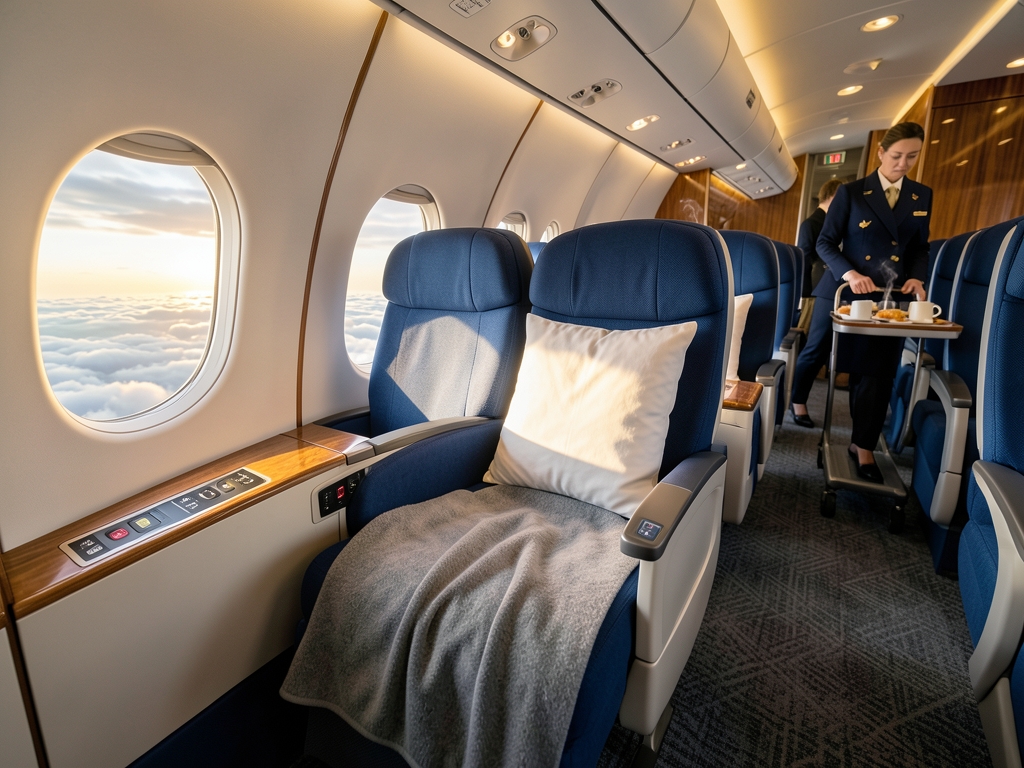
Option A wins on a promo-eligible date. Redeeming ~50,000 miles one-way plus roughly $100–$150 in taxes offsets most of the $1,200 cash fare. If you would otherwise use or preserve those miles at 2 cents each or more, the promo delivers stronger value than paying out of pocket, provided the discounted level appears on the exact flights you need.
Option B wins when the promo is absent. Without a discounted award on your dates, the standard business-class mileage level applies — whatever your live search shows it to be. Against a $1,200 cash fare, a standard-level redemption will typically yield around 1 cent per mile or less after accounting for taxes, below the 2-cent threshold. In that case, paying cash and keeping the miles for a higher-value trip is the better move.
Option C rarely beats $1,200 cash. At a 2-cent valuation, a standard-level award requires so many more miles than a promo that the implied value falls well below the benchmark against a $1,200 fare. Verify the exact standard level in your own search and run the formula before considering it; for a $1,200 ticket, the standard award consumes far more miles than the savings justify, making it the weakest choice in this comparison.
Costs, taxes and the math
The break-even formula for a Flying Blue award is straightforward: divide the miles required by the cash fare minus the taxes and fees you would still pay on the award. The result is the implied value per mile, which you can compare against what you personally consider a mile worth before you redeem.
The mileage price alone does not tell you the full out-of-pocket cost. Air France and KLM awards can include carrier-imposed surcharges that vary by route and itinerary, so the tax figure you assume in the formula must be verified for your specific booking. The reliable check is to proceed to the final payment page in the Flying Blue booking flow and read the total cash component due at checkout, not just the miles displayed on the search results screen.
Run the formula only after you have that confirmed cash total. If the taxes and surcharges come in higher than expected, the denominator shrinks and the implied cents-per-mile value rises, which can turn an apparent deal into a poor redemption. If the cash component stays low, the promo math holds.
Finally, remember that the comparison is not only miles versus fare: award tickets generally earn fewer redeemable miles and elite-qualifying credits than paid tickets. Treat any forgone earnings as an additional cost of redeeming, and only commit the miles when the verified implied value still clears your personal threshold.

What this comparison cannot prove
Before you treat the 50,000-mile figure as settled, understand what it is: a target level to verify, not a confirmed price. No published source in my research confirms a 50,000-mile Promo Rewards business-class award to Paris for 2026 specifically. The closest verified data point is the 55,000-mile one-way Paris–Miami promo that One Mile at a Time documented, which shows promo levels in that neighborhood can appear in live inventory — but appearing once on one route is not the same as appearing on your route, on your dates, in your month. Check the Flying Blue promo page monthly until your dates load.
The comparison also breaks in specific, predictable ways, and it is worth naming those failure modes before you book. The table below collects the edge cases where the promo-vs-cash logic flips or goes unproven:
Two of these deserve emphasis. First, peak summer: if your trip falls between June and August, do not anchor on any promo number. Promo Rewards inventory on transatlantic business class historically avoids the highest-demand weeks, so your realistic alternative is the standard award level against the cash fare — a different calculation entirely.
Second, the cash side is not fixed. The $1,200 fare is itself a discounted number, and sales move in both directions. If the cash fare falls below roughly $1,000 one-way, the arithmetic tightens: at 50,000 miles with about $150 in taxes, the implied value is only around 1.7 cents per mile, so the promo would need to price under roughly 42,500 miles to clear a 2-cent-per-mile valuation.
That is why the reader rule is to price all three ways every time — the winner can change between the day you start planning and the day you book.Finally, note what this section cannot do: it cannot guarantee that any of these thresholds hold in 2026. Treat every figure here as a checkpoint to re-verify against live pricing, not a promise.

JFK–CDG decision
On the first day of the month, start at airfrance.us and run a one-way business-class award search for your exact New York (JFK)–Paris (CDG) dates. Record two numbers from the results screen: the mileage price and the cash co-pay shown for the same nonstop flight. This is Checkpoint 1. If the calendar returns a Promo Rewards level of 50,000–55,000 miles one-way, move to the next step; if it shows the standard award level, stop the redemption process for those dates and preserve your miles for a better-priced opportunity.
Checkpoint 2 is a same-date cash check. Price the identical one-way nonstop itinerary in dollars before you transfer or commit any miles. Using the thesis scenario of a $1,200 one-way cash fare, a 50,000-mile award with $120 in taxes yields an implied value of 2.2 cents per mile (($1,200 − $120) ÷ 50,000). At that result, booking the promo award is the rational move. The cost of being wrong is material: redeeming at the 92,500-mile standard level on the same dates destroys roughly $780 of value versus paying cash, because you spend far more miles without a corresponding reduction in out-of-pocket cost.
Checkpoint 3 happens on the payment screen, not the search results. Proceed to the final checkout page and confirm the total taxes and carrier-imposed charges for the one-way ticket remain under roughly $150. If the total climbs above that threshold, pause and reprice the cash option for the same flight before completing the booking. This screen-level confirmation prevents a search result that looked attractive from turning into a weaker redemption at the moment of purchase.
Only when all three checkpoints align—promo pricing on your exact dates, a cash fare that supports the redemption, and taxes confirmed under roughly $150 on the payment screen—should you finalize the award ticket. If any checkpoint fails, pay cash for that itinerary and bank your miles. Treating each checkpoint as a hard gate keeps the decision tied to the specific JFK–CDG flight you intend to fly, rather than to a promo that appears on different dates or at a higher all-in cost.
Document the mileage price, cash fare, and taxes you recorded at each step. If you need to revisit the booking later the same day, those notes let you quickly verify whether the award still clears every checkpoint or whether the cost of being wrong has reappeared.

Decision rules for 2026 bookings
Apply a simple if/then ruleset anchored to a 2-cent-per-mile benchmark before you commit to a 2026 Flying Blue booking. Start by pricing the same nonstop dates three ways, then let the implied value of the redemption—not the headline mileage—decide whether you spend miles or cash. This keeps each booking decision consistent when promo inventory, standard award levels, and cash fares diverge.
If a Promo Rewards level of 50,000–55,000 miles one-way appears for your exact dates, book it when the cash alternative is around $1,200. After subtracting taxes and fees from the cash fare, a 50,000-mile redemption clears the 2-cent benchmark, while a 55,000-mile redemption lands just below it. At any cash fare meaningfully above $1,200, both ends of that promo range deliver value that meets or exceeds 2 cents per mile, making the award the stronger use of your balance.
If only the standard 92,500-mile level is available and the cash fare is $1,200, pay cash. Redeeming at that level prices the same seat at a steep mileage premium, destroying roughly $780 in value relative to the 2-cent benchmark. In this scenario, preserving your miles for a future promo or a higher-value itinerary is the better financial move than forcing an award booking.
If a promo appears but your dates fall outside the promo window, let flexibility determine the outcome. When you can shift your travel to match the discounted dates, move the trip and lock in the promo level. When your dates are fixed, pay the cash fare for the outbound or affected segment and set an alert to monitor Promo Rewards for the return leg or a later trip, so you can capture the discount when it aligns with your schedule.
Treat these rules as a repeatable pre-booking checklist: confirm the promo level on your exact dates, compare it against the standard award and cash price, and redeem only when the result satisfies the 2-cent benchmark. If any condition fails—no promo space, a high mileage requirement, or inflexible dates—default to cash and keep your miles banked for a booking that clears the threshold.
Also worth reading Paris to New York business 2026 Flying Blue Promo Rewards: Paris Flying Blue Promo Rewards
What to do next
| Step | Action | Why it matters |
|---|---|---|
| 1 | Price the same nonstop Paris dates three ways: Promo Rewards miles, standard Flying Blue award, and cash. | It isolates the promo-date price gap before any redemption. |
| 2 | Compute (cash fare minus taxes) ÷ miles and redeem only if the result exceeds ~2 cents per mile. | This is the canonical break-even test for the 50,000-mile business-class award. |
| 3 | Check Promo Rewards taxes; if they reach the tax ceiling or the promo is absent, pay cash and bank the miles. | Taxes can erase the mileage value on the Paris route. |
| 4 | Keep the 55,000-mile Paris–Miami figure as context only, not a guaranteed Paris price. | It is a nearby Flying Blue data point, not this route's quote. |
| 5 | If implied value is not above ~2 cents, use the fallback: pay the cash fare and retain miles. | It avoids a low-value redemption when the promo is weak. |
| 6 | Re-run the three-way check immediately before ticketing because promo dates are exact. | Promo Rewards availability can change before purchase. |
Frequently Asked Questions
What mileage valuation makes a Flying Blue promo reward a better deal than paying the cash fare?
A promo reward delivers stronger value than paying out of pocket if you would otherwise use or preserve those miles at 2 cents each or more.
Does finding a discounted award level guarantee you can use it for your trip?
No, the discounted award level must appear on the exact flights you need for the promo to deliver stronger value.
How do you calculate the break-even value of a Flying Blue award?
The break-even value is calculated by dividing the miles required by the cash fare minus the taxes and fees you would still pay on the award.
What value per mile can you typically expect from a standard-level business-class redemption when no promo is available?
Without a discounted award, a standard-level redemption will typically yield around 1 cent per mile or less after accounting for taxes.
What should you do if a standard-level award falls below the 2-cent-per-mile threshold?
If a standard-level redemption falls below the 2-cent threshold, paying cash and keeping the miles for a higher-value trip is the better move.
Why is a standard-level award considered the weakest option against the cash fare in this comparison?
A standard-level award consumes far more miles than the savings justify, causing its implied value to fall well below the benchmark for the cash fare in this comparison.
Quick answers
| When does Option A win? | Option A wins on a promo-eligible date, where redeeming about 50,000 miles one-way plus roughly $100–$150 in taxes offsets most of the $1,200 cash fare. |
| What condition makes the promo deliver stronger value than paying out of pocket? | If you would otherwise use or preserve those miles at 2 cents each or more, the promo delivers stronger value than paying out of pocket, provided the discounted level appears on the exact flights you need. |
| What happens when the promo is absent? | Without a discounted award on your dates, the standard business-class mileage level applies, and against a $1,200 cash fare a standard-level redemption will typically yield around 1 cent per mile or less after accounting for taxes. |
| What is the better move when a standard-level redemption yields around 1 cent per mile or less? | Paying cash and keeping the miles for a higher-value trip is the better move. |
| Why does Option C rarely beat $1,200 cash? | At a 2-cent valuation, a standard-level award requires so many more miles than a promo that the implied value falls well below the benchmark against a $1,200 fare. |
Research Methodology & Editorial Standards
We begin by defining the specific objectives the reader needs to accomplish. Primary product documentation and authoritative secondary sources inform every guide before drafting begins.
Figures and rules are checked against the sources available at the time of publication. Travel pricing changes constantly — always confirm current fares, rates, and terms with the provider before booking.