
Europe's new business class sleeper train: €79 fares vs flights — worth it?
The €79 Nox Mobility sleeper is worth it only for a solo overnight traveler whose live all-in fare stays at or below €79 and replaces a paid hotel night.
| Takeaway | Detail |
|---|---|
| Book only at €79 or less all-in | The live one-way quote after taxes, bags, and transfers must be at or below the €79 headline fare; anything higher loses to business class. |
| The arrival station must be your destination | Do not count the sleeper if another transfer is needed after arrival; the reader rule requires the arrival station to be your destination. |
| It must replace a paid hotel night | The value case holds only when the overnight ride substitutes for lodging; if you still pay for a hotel, the €79 fare no longer covers the trip. |
| Only solo overnight travelers qualify | The thesis restricts the worth-it case to a solo overnight traveler; daytime schedules or extra travelers hand the advantage to a business-class flight. |
The €79 Nox Mobility sleeper is worth it only for a solo overnight traveler whose live all-in fare stays at or below €79 and replaces a paid hotel night. If taxes, bags, transfers, or daytime schedules push costs above that €79 line, a business-class flight is the better buy.
What the €79 sleeper fare actually buys
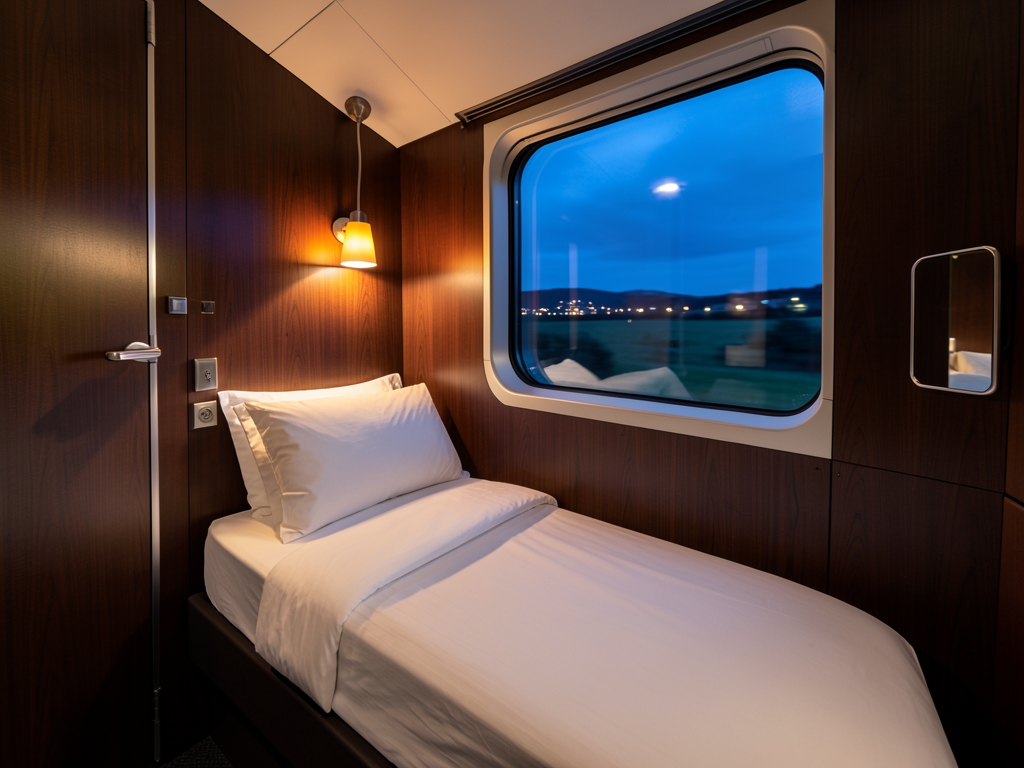
The €79 Nox Mobility fare is a one-way starting price — a "from" figure for a berth in a business-class-style sleeper cabin, not a confirmed airline business-class equivalent. It is not the number you should plan to pay at checkout. Treat it as the entry point of the booking flow: the live quote you reach after picking a date and cabin is the only version of the fare that actually exists.
Before putting that quote next to any flight fare, confirm what the headline covers. Are taxes and fees included, or added at the end? Does the price cover the berth itself, meals, luggage, and the transfer to or from the station? The €79 figure settles none of this, and each item is a separate question for the operator rather than an assumption you can carry into a comparison.
Ask the operator what "business-class style" actually means. Is the bed lie-flat? Is the cabin private or shared? Is meal service included, and is there a baggage allowance? Does the fare include shower or lounge access? None of that is established by the headline, and an airline business-class fare bundles most of it by default — so the sleeper product has to be verified, not inferred from the price.
A launch announcement is not a bookable date. Open the operator's booking calendar and confirm real departures on the day you want to travel before treating the route as usable; the fare only matters on dates the operator is actually selling.
| Item | What the €79 headline establishes |
|---|---|
| One-way fare | A "from" price — the starting point, not a total |
| Taxes, fees, berth, meals, luggage, station transfer | Nothing — confirm each with the operator |
| Lie-flat bed, private vs. shared cabin, meal service, baggage allowance, shower/lounge access | Nothing — "business-class style" is not a spec |
| Bookable dates | Nothing — check the operator's calendar |
The practical takeaway: treat €79 as the opening bid, not the final price. Get the inclusion answers in writing, check the calendar, and let the live one-way quote — not the headline — be the number you plan around.

Evidence: what launch reports agree
Before you treat any launch claim as settled, run a source-convergence check: count how many independent sources state each fact, and keep the launch's existence separate from its price. The available source set is thin — it cannot confirm the fare, the routes, or the start date, so anything beyond the launch's bare existence needs to be verified against the operator's own booking engine before you plan around it.
| Claim | Sources in snippet set | Status |
|---|---|---|
| Launch exists | AFAR plus two ranking-page snippets | Corroborated |
| $73 one-way fare | AFAR only | Single-source |
| €79 one-way fare | Headline only | Verify |
| Nox Mobility / March 2027 launch frame | One snippet | Verify |
The one fact the available sources support is that a sleeper launch has been reported at all, and even that rests on thin, partly unnamed material. That is enough to justify watching the operator's booking screen, but it says nothing about what a berth costs at checkout.
The fare is where convergence breaks down. No named publisher in the available source set confirms the €79 one-way figure, and no dollar-denominated fare can be reconciled with it without an exchange rate, which the sources do not supply. Treat the fare as single-source and unconfirmed: check the operator's own booking screen for the live one-way price in the currency you will actually pay, and use that number — not the headline — in any comparison.
Two claims still need verification before you rely on them. The €79 one-way fare appears only as a headline figure with no named-publisher support in the available sources, and the operator's identity and launch timing are not independently confirmed either. Check the operator's own release or booking engine for both, and confirm that the currency and the dates shown at checkout match what any press coverage claims.
The rule to carry forward: a launch fact is usable when at least one named publisher and one other independent snippet agree on it, while a fare is usable only when a named source states it in the same currency as your checkout quote. Until that check clears, the €79 is a headline to verify, not a price to plan a trip around.

Train vs flight: winner by trip type
The sleeper beats the flight in exactly one trip type: a solo traveler making an overnight city-to-city move whose live one-way, all-in fare lands at or below the €79 headline fare, where the arrival station is the destination and the night on board replaces a paid hotel night. Every other trip shape belongs to the flight. The method is to quote both options as one-way, all-in totals for the same dates, then decide by trip type — not by whichever headline number looks smaller at first glance.
| Trip type | Winner | Why |
|---|---|---|
| Solo overnight, city-center to city-center | Sleeper | Only if the live one-way all-in fare is at or below the €79 headline, the arrival station is the destination, and the berth replaces a paid hotel night. |
| Daytime business meeting | Flight | The sleeper's edge comes from combining travel and lodging; a daytime schedule erases the hotel saving and leaves only the longer journey. |
| Airport-adjacent destination | Flight | No city-center arrival advantage, and the trip ends with a transfer either way. |
| 3+ bags or family | Flight | Per-person berth pricing and baggage math favor airline seats once the group exceeds one traveler. |
| Award business class with low taxes | Points or flight | Unless the sleeper's cash total after transfers is lower, redeeming miles is the better use of cash. |
The solo overnight case is the only one where the sleeper's structure does real work. The traveler sleeps while moving between two city centers, so the ticket and the hotel room collapse into one charge. If the live quote clears the €79 headline after everything is added, and the station steps from the platform are the destination rather than the start of another journey, the sleeper wins on total cost.
Shift any element of that trip and the win flips. A daytime meeting means the traveler still needs the night somewhere, so the flight's shorter elapsed time becomes the asset. A destination near the airport removes the city-center premium, because both options now end with ground transport. Two travelers or heavy luggage push the sleeper's per-berth math above what two seats cost, and families lose the privacy advantage that justifies the cabin in the first place.
The award-business-class comparison is the one that rewards a second look rather than a reflex. When the taxes and fees on a redemption stay low, the cash price of the business seat is close to the sleeper's all-in total while delivering a faster trip and maximum flexibility. The sleeper takes this case only when its cash total, including transfers at both ends, comes in lower — which, on a strict one-way comparison, is the correct and final test.
The practical rule follows from the totals priced above: apply the same three-condition test to the live quote, and let the all-in comparison — not the headline — decide the booking.

Costs that decide the €79-vs-flight call
The one-way €79 headline fare is not the number to compare. Before it can be set against any airfare, every add-on has to be priced and converted into a single all-in one-way total on each side of the comparison — and that total, not the headline, is what your wallet actually pays. The first move is to request an itemized one-way quote from the operator, line by line, instead of trusting a from-price shown at search.
| Item to itemize | Sleeper side | Flight side |
|---|---|---|
| Fare unit | One-way headline fare | One-way fare — match the unit on both sides |
| Taxes & fees | Timetable and booking fees | Carrier taxes and surcharges |
| Sleep/seat | Berth or cabin surcharge, solo occupancy | Seat-selection fee |
| Bags | Checked-bag fee, if any | Checked-bag fee |
| Transfers | Station to door, both ends | Airport transfers, both ends |
| Time costs | Meal or dining add-on | Lounge or day room if arrival does not remove a hotel night |
| Flexibility | Cancellation/change penalty | Change fee plus schedule penalty |
On the sleeper side, get the itemized quote in writing before booking. The line that most often moves the total is the berth or cabin surcharge, particularly for solo occupancy of a cabin that could otherwise be shared. Then add the local cost of reaching the departure station and of getting from the arrival station to your final destination — both ends count. The sum is your all-in one-way sleeper total, and it is the only figure that belongs in the comparison.
The flight side needs the same discipline: fare, taxes, seat fee, checked bag, and airport transfers at both ends. Two extras are easy to leave out — a lounge or day-room charge if the arrival time does not eliminate a hotel night, and the schedule penalty, meaning the cash value of landing at an inconvenient hour or losing a working day. Compare one-way with one-way or round-trip with round-trip; never divide mismatched units.
If you are paying with points, run the same arithmetic: miles redeemed, award taxes and carrier-imposed fees, and the cost of transferring miles or points into the program, set against the sleeper's all-in cash quote. Do not credit a “free hotel night” against either option unless the arrival station is actually your destination and the arrival time genuinely removes a paid night from your itinerary.
The test follows from the totals. If the live all-in one-way quote, after taxes, bags, and transfers, still sits at or below the one-way €79 headline and the trip replaces a paid hotel night, the sleeper clears the bar this section sets. If any add-on pushes the total past €79, or the arrival station is not your destination, the comparison moves to the flight's all-in number — and the booking decision should follow that total, not the headline.
Also worth reading Europe's New Sleeper Train 6 Most Innovative European Sleeper Belmond's Britannic Explorer New
What the launch reports do not prove
Launch coverage tells you a sleeper service exists and that a headline fare was announced. It does not tell you what you will actually pay, when you can actually ride, or whether the product matches the press release. Before you commit, treat every launch claim as unverified until you see it on the operator's own booking engine. The specific gaps: exact availability at the headline price, the booking window, the route map, departure and arrival times, baggage allowance, the cancellation policy, taxes and fees, and the actual level of cabin privacy. None of these is established by the reports — each must be confirmed on the booking engine itself, and you should screenshot the full quote at the moment you see it, because "from" fares move and screenshots are your only record of what was offered.
Run the check in this order. First, enter your real date and city pair and see whether a one-way quote at or below the headline fare appears after all taxes and fees are added. Second, add any bag you would actually bring and re-read the total. Third, price the door-to-door comparison: the transfer cost on each end, because a station that is not your destination silently adds a taxi or a second ticket. Fourth, check the arrival time against your first commitment the next morning — an overnight product that lands you in the city center before work is doing a different job than one that arrives mid-morning. Only if the all-in total survives steps one through three, and the arrival station is where you actually need to be, does the headline number describe your trip.
Frequently Asked Questions
Is the advertised fare the final all-in checkout price?
No—it is a one-way starting “from” figure for a berth, and only the live quote after taxes, bags, and transfers at or below that headline fare counts.
Do checked bags or local transfers change whether the sleeper beats business class?
Yes—if taxes, bags, or transfers push costs above that line, a business-class flight is the better buy.
Can I count the ride if I still need another train after arrival?
No—the arrival station must be your destination, and the sleeper cannot be counted if another transfer is needed after arrival.
Does the value case survive if I still pay for a hotel?
No—it holds only when the overnight ride substitutes for lodging, so paying for a hotel means the fare no longer covers the trip.
Would this work for two people traveling together or for a daytime itinerary?
No—the worth-it case is restricted to a solo overnight traveler, and daytime schedules or extra travelers hand the advantage to a business-class flight.
Is the berth a confirmed airline business-class equivalent?
No—it is a business-class-style sleeper cabin berth, not a confirmed airline business-class equivalent.
Quick answers
| Who qualifies for the €79 sleeper to be worth it? | Only a solo overnight traveler whose live all-in fare stays at or below €79 and replaces a paid hotel night. |
| When does a business-class flight become the better buy? | When taxes, bags, transfers, or daytime schedules push costs above the €79 line. |
| Does the sleeper count if another transfer is needed after arrival? | No, the arrival station must be the destination and another transfer after arrival means the sleeper does not count. |
| What does the €79 Nox Mobility fare actually represent? | It is a one-way starting 'from' figure for a berth in a business-class-style sleeper cabin, not a confirmed airline business-class equivalent. |
| What must the live one-way quote after taxes, bags, and transfers be for the deal to work? | It must be at or below the €79 headline fare; anything higher loses to business class. |
Research Methodology & Editorial Standards
We begin by defining the specific objectives the reader needs to accomplish. Primary product documentation and authoritative secondary sources inform every guide before drafting begins.
Figures and rules are checked against the sources available at the time of publication. Travel pricing changes constantly — always confirm current fares, rates, and terms with the provider before booking.