
Chengdu street food crawl: a $15, 10-dish evening plan, cashless-first with cash backup
Carry 50–100 RMB in cash as a backup, since a minority of vendors may not accept QR-code wallet payments.
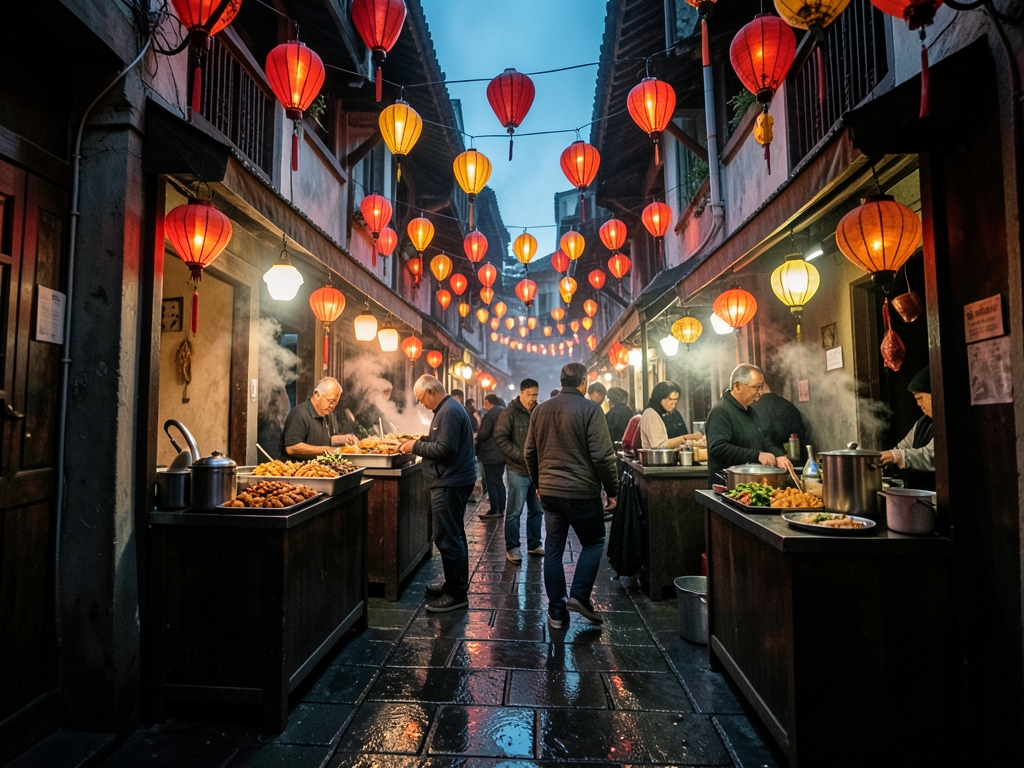
In 2026 Chengdu, you can sample 10 street-food dishes for $15 in one evening, with Alipay and WeChat Pay covering most stalls.
Carry 50–100 RMB in cash as a backup, since a minority of vendors may not accept QR-code wallet payments.
How Chengdu street payment works in 2026
At a Chengdu street stall, payment is usually a QR-code transaction inside a wallet app rather than a separate street-food payment system: the vendor displays a personal or merchant code, you scan it in Alipay or WeChat Pay, enter the RMB amount, and your linked foreign card is charged.
| Step | What you do |
|---|---|
| 1 | Scan the vendor's displayed QR code in Alipay or WeChat Pay. |
| 2 | Enter the RMB amount yourself. |
| 3 | Confirm the charge posts to your linked foreign card. |
| 4 | Show the payment-success screen before taking food. |
The two apps that matter are Alipay and WeChat Pay. Both accept linking international Visa or Mastercard cards, but support, verification steps, and any fee are controlled by each app and can change; verify the current card-support and fee terms on each app's card-linking screen before departure, because that screen—not this guide—states the current rule.
Cash still circulates alongside QR codes. Some vendors may not display a code or may ask for cash, so a small backup float—roughly 50-100 RMB—covers the minority of cases without making cash the crawl's main payment plan. That float is a backup, not the plan.
Before departure, run three checks inside the apps: confirm your foreign card is linked, confirm the app can scan a standard merchant code, and locate the amount-entry field. Keep the app open until the success screen appears, because a pending screen is not proof of payment.
At the stall, treat the code as the payment instruction, not the price tag: scan it, enter the amount yourself, and wait for the success screen before taking food. If the code is printed on a card, sign, or phone screen, check that it matches the vendor's stall before you confirm.
The evidence: what sources actually show
This section is an evidence inventory, not a payment tutorial: the mechanism of QR-code payment at stalls, the comparison between cashless and cash, the $15 budget method, the crawl itinerary, and the payment decision rules are handled in their own sections. Here, the only claims presented as grounded neighborhood or hotel facts are three items, each tied to a named source.
Nomado Travel's Wuhou District guide describes the Yulin residential area as blocks of independent cafés, local restaurants, and everyday Chengdu street life. That description is the sole basis for using Yulin as the crawl's anchor neighborhood; no other neighborhood characterization in this guide is presented as sourced.
The same Nomado Travel guide notes Sichuan Opera performances at several venues near the shrine district, with evening shows that include face-changing. That is the only grounded basis for treating an opera venue as a fixed end-point for an evening crawl; it does not extend to prices, availability, or schedules.
Travelated's Chengdu hotel listings explicitly flag "cashless payment available" as a listed amenity. In this guide, that fact is used narrowly: it documents that cashless payment is an advertised, normal condition in Chengdu lodging. It does not establish that any particular street stall, market vendor, or food cart accepts a wallet payment.
| Source | Grounded fact used | Use in this guide |
|---|---|---|
| Nomado Travel, Wuhou District guide | Yulin residential area: independent cafés, local restaurants, everyday street life | Anchor neighborhood |
| Nomado Travel, Wuhou District guide | Sichuan Opera venues near the shrine district; evening face-changing shows | Fixed evening end-point |
| Travelated, Chengdu hotel listings | "Cashless payment available" listed as an amenity | Evidence that cashless is a documented default in lodging |
The practical consequence is that the crawl's geography is sourced while its execution remains a reader-side check: verify current venue locations, hotel amenities, and stall-level payment acceptance on the ground, because the named sources do not provide addresses, prices, hours, or payment guarantees.
Everything else in the guide is framed as a check, a method, or a reader decision rather than as a sourced fact. If a stall, venue, or hotel cannot be matched to one of these three named-source facts, the guide does not present its details as verified.
Cashless vs cash: options compared
For a single evening street-food crawl in Chengdu, the winning payment setup is cashless-first with a 100 RMB cash float. Linking a foreign card to Alipay or WeChat Pay aligns with how most stalls expect to be paid, while a small reserve of cash caps your downside if a transaction fails or a vendor cannot process a mobile payment. This combination keeps the crawl moving without forcing you to reorganize your route around payment logistics.
Alipay and WeChat Pay with a linked foreign card are the default way QR-accepting stalls expect to be paid, and they leave a digital receipt trail you can review after the crawl. The primary risk is technical rather than acceptance-related: card linking, identity verification, or a transaction limit can break at the moment you need to pay. Treat setup as a pre-departure task—complete verification, add your card, and confirm the wallet is ready to transact in-app before you fly so you are not troubleshooting on the sidewalk. Cash in small RMB notes is the fallback where QR payment is not taken; carry small notes because vendors may be short on change for large denominations.
Cash in small RMB notes remains universally accepted and carries no app dependency, making it a reliable fallback. The trade-offs are practical: you must obtain yuan through a bank or ATM exchange step, and vendors may be short on change if you present large denominations. Keeping your backup in small notes reduces friction and prevents a minor purchase from stalling because a stall cannot break your bill.
| Method | Strengths | Failure points | Role in this crawl |
|---|---|---|---|
| Alipay/WeChat Pay (linked foreign card) | Accepted at nearly all QR stalls; digital receipt trail | Linking, verification, or transaction issues | Default payment method |
| Cash (small RMB notes) | Universally accepted; no app dependency | Requires exchange; vendors may lack change for large notes | Backup only (100 RMB float) |
Use your wallet by default and deploy the 100 RMB float only when a payment fails or a stall cannot accept a mobile transfer. If a vendor cannot take either your wallet or your cash, skip that stall and move on. This rule keeps payment a solved detail, preserves the cashless-first approach reflected in local cashless availability noted by sources such as Travelated, and ensures no single stall dictates the pace or shape of your evening.
Costs: the $15 crawl budget
Treat the $15 as a planning envelope, not a receipt total. Convert it on the day you go—roughly 100-110 RMB at prevailing rates, but check the live rate in your wallet app—and divide that RMB amount across ten dishes at about 8-11 RMB each. That band is a menu-checking tolerance, not a sourced price list: if a posted menu shows 12 RMB, the method works only if another dish is 7 RMB, because the ten-dish total must stay inside the envelope.
| Line | If wallet shows 100 RMB | If wallet shows 110 RMB |
|---|---|---|
| Total envelope | 100 | 110 |
| Buffer, unspent | 10-15 | 10-15 |
| Ten dishes | 85-90 | 95-100 |
| Per dish | 8.5-9.0 | 9.5-10.0 |
Name the buffer before you start: keep 10-15 RMB unspent as your "second helping of the best dish" reserve. Do not turn it into an eleventh stall; the reserve exists to buy more of the one item you would actually repeat. If you spend it early, the crawl is no longer a $15 crawl—it is a $15-plus crawl with no correction point.
The method assumes you can pay at the stall. If you arrive without a working wallet, the budget stops being a plan and becomes a ceiling: you are choosing which stalls to skip, and any cash you carry is a backup for exceptions rather than the funding source. The opposite error is quieter—setting up the wallet but never checking the live rate—because planning ten dishes at 11 RMB on a 100 RMB day spends the buffer in the math before you order.
Before ordering, check three numbers in this order: the live RMB value of $15 in your wallet app, the posted price on the stall menu, and your running total after each dish. If the running total passes 90 RMB on a 100 RMB day, stop adding stalls and spend the remaining 10 RMB on the reserve dish. The method is self-correcting only if you do the arithmetic in RMB, not dollars, because exchange-rate drift and rounding can hide a 1-2 RMB overrun until the end.
What the evidence does not establish
The only new boundary to establish for this section is an explicit list of unverifiable claims, including per-dish prices and card fees. None of the sources in the available sources provide 2026 per-dish prices in Chengdu, so there is no basis for publishing a fixed price list for a street-food crawl. Rather than estimating one, every RMB figure used elsewhere in this guide is a budgeting method to verify against posted stall menus on the day. Without a grounded figure to cite, precision is not a matter of rounding, but of checking at the point of sale.
That evidentiary gap extends to the wallets themselves. No source in the available sources states current Alipay or WeChat Pay foreign-card fees, linking rules, or per-transaction limits for 2026. These are volatile details that can change without notice, and older references offer no substitute for up-to-date terms. The only defensible approach is a procedural one: check each app’s official card-linking page before travel, noting its stated terms at that time rather than relying on a published rate or cap from a third-party guide.
At the vendor level, uncertainty remains just as concrete. While Wuhou District, Chengdu: Neighborhood Guide (Nomado Travel) identifies Yulin as a residential area with everyday Chengdu street life, it offers no confirmation of which individual Yulin stalls accept cash versus QR only. No other item in the available sources fills that gap. As a result, vendor-level payment acceptance must be treated as unknown until you are standing at the counter, with no grounded way to pre-sort stalls by payment method for a 2026 evening crawl.
Taken together, these are not missing details to approximate, but boundaries of the available evidence. Without grounded data for per-dish prices, foreign-card fees and limits, or stall-by-stall acceptance in Yulin, any attempt to fix those items to numbers would be an invention. The task for the reader, then, is not to memorize figures, but to run three checks on the day or before departure: a menu check for price, an app check for current card terms, and a counter check for acceptance if a stall cannot take a QR payment. Those checks are the evidence-based response to a list of claims that the available sources simply does not establish.
Also worth reading Why Malaysian hospitality and street Discover the most vibrant culture Discover the best food and culture
A Yulin evening crawl
This Yulin evening crawl runs on three checkpoints that keep payment decisions simple: prepare before you leave, start with your wallet app on arrival, and close the night with whatever budget remains. The rule is fixed throughout—set up your wallet before the crawl, carry 100 RMB in cash as backup only, and skip any stall that cannot take either option rather than rerouting the evening around it.
Checkpoint 1 — Before departure: Link your foreign card in Alipay, send a 1 RMB test transfer to confirm the connection works, and verify that the app shows your card as active. If the test fails or the card does not appear as active, resolve the issue at home. Do not wait until you are on the street to troubleshoot payment setup.
Checkpoint 2 — Arrival in Yulin: Head to the Yulin residential area, described by Nomado Travel as neighborhood blocks with independent cafés, local restaurants, and everyday Chengdu street life. Before ordering, withdraw or set aside 100 RMB in cash and note the live RMB-per-dollar rate displayed in your wallet app so you can track spending in real time. Pay for your first dish with the app and keep the cash untouched unless a vendor cannot accept a wallet payment.
Frequently Asked Questions
How many street-food dishes are included in the evening plan?
The plan lets you sample 10 street-food dishes in one evening.
How much cash should I carry as a backup?
Carry roughly 50–100 RMB as a backup float.
Which wallet apps are used for stall payments?
The two apps that matter are Alipay and WeChat Pay.
Which international cards can be linked to those apps?
Both accept linking international Visa or Mastercard cards.
What final step should I take before receiving food?
Show the payment-success screen before taking food.
Where can I check the current card-support and fee terms?
Verify the current card-support and fee terms on each app's card-linking screen before departure.
Quick answers
| How many street-food dishes can you sample in one evening on the Chengdu street food crawl? | You can sample 10 street-food dishes in one evening for the stated budget in the specified year. |
| Which payment apps cover most stalls during the crawl? | Alipay and WeChat Pay cover most stalls. |
| How much cash should you carry as a backup? | You should carry roughly 50–100 RMB in cash as a backup. |
| What steps do you follow to pay at a Chengdu street stall? | You scan the vendor's displayed QR code in Alipay or WeChat Pay, enter the RMB amount yourself, confirm the charge posts to your linked foreign card, and show the payment-success screen before taking food. |
| Why is it recommended to carry a small cash float? | A small cash float is recommended because some vendors may not display a code or may ask for cash. |
Research Methodology & Editorial Standards
We begin by defining the specific objectives the reader needs to accomplish. Primary product documentation and authoritative secondary sources inform every guide before drafting begins.
Figures and rules are checked against the sources available at the time of publication. Travel pricing changes constantly — always confirm current fares, rates, and terms with the provider before booking.