
Airport security at JFK in 2026: 12 Trips to Pick Clear Plus Over PreCheck
At JFK in 2026, CLEAR Plus at $209 per year beats TSA PreCheck only for travelers making 12 or more annual departures.
| Takeaway | Detail |
|---|---|
| CLEAR Plus breaks even at 12 or more annual departures | At $209 per year, CLEAR Plus carries a $17.42-per-trip premium over TSA PreCheck when spread across 12 trips. |
| CLEAR Plus requires an airport with CLEAR lanes | CLEAR skips the ID check line but not physical screening, so it provides no benefit where CLEAR lanes are unavailable. |
| CLEAR Plus must be paired with TSA PreCheck | Buy CLEAR Plus only if you already hold or will also hold TSA PreCheck, because CLEAR expedites identity verification, not screening. |
| TSA PreCheck costs roughly $16 per year | The standard TSA PreCheck enrollment fee is about $80 for five years, making it the lower-cost option below the 12-trip threshold. |
At JFK in 2026, CLEAR Plus at $209 per year beats TSA PreCheck only for travelers making 12 or more annual departures.
That advantage disappears if your airport lacks CLEAR lanes, PreCheck waits are short, or you do not also hold TSA PreCheck at roughly $16 per year.
How CLEAR and PreCheck differ at JFK
The useful distinction is mechanical: CLEAR is used to verify identity before physical screening, while TSA PreCheck affects the screening lane itself. Check the current CLEAR and TSA guidance for your terminal to confirm the sequence, because CLEAR is not a substitute for the X-ray or body scanner.
TSA PreCheck, as Wikipedia describes it, is a trusted traveler program that allows some travelers expedited security screening in the United States. TSA.gov describes the practical benefit in dedicated PreCheck lanes: travelers leave electronics such as laptops and 3-1-1 liquids in bags, and keep belts, light jackets, and shoes on. That is the part of the process where PreCheck changes what you do at the checkpoint.
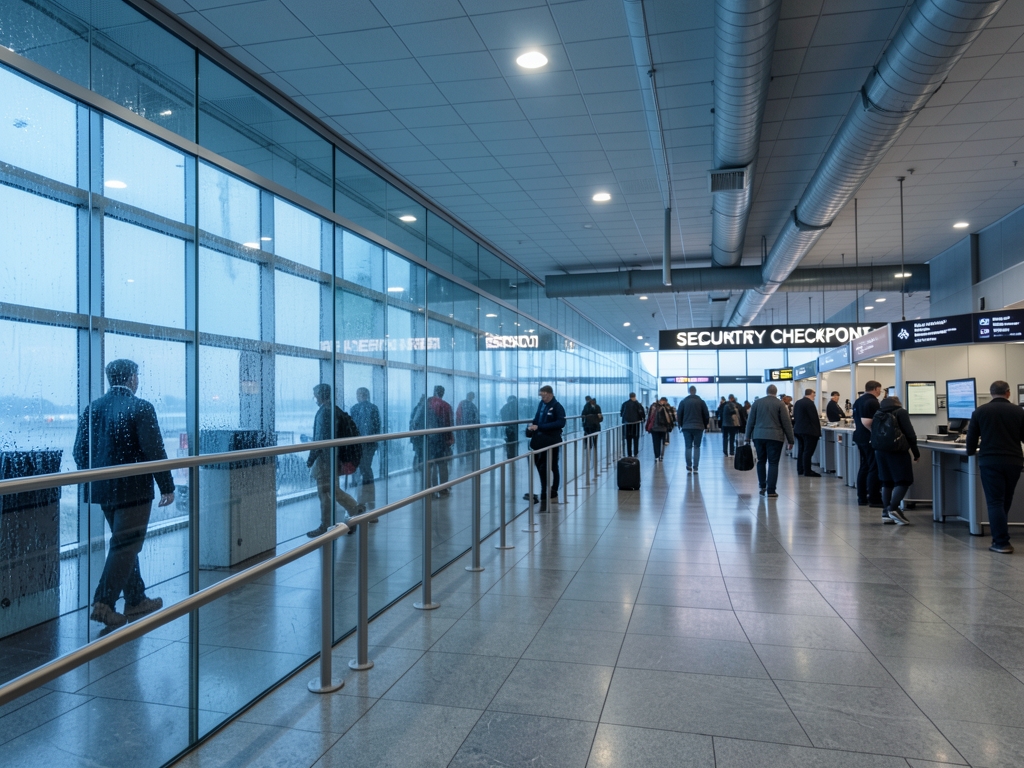
At JFK, the two stack: a CLEAR member with PreCheck uses CLEAR at the front, then follows the PreCheck-marked route into the dedicated screening lane. The check is to read the sequence rather than the brand names. That matters when you are diagnosing a JFK line: the sign you see first may not be the line that is costing you time.
For a JFK departure, ask which bottleneck you are actually trying to remove. If the delay forms before the document table, CLEAR is the relevant tool. If the long line is the one where shoes, belts, laptops, and jackets determine throughput, PreCheck is the relevant tool. If you already hold PreCheck, the question is whether the front-end line is worth adding to your routine; the X-ray/body scanner remains part of the trip.
The working rule is to evaluate CLEAR at JFK as an add-on to a PreCheck routine, not as a replacement for it. Watch one trip end to end: CLEAR lane, document verification, then the PreCheck lane to the X-ray/body scanner. If the checkpoint lane is where the time goes, CLEAR will not fix that part of the trip. If the document line is the visible problem and you already use PreCheck, the two programs fit together in the sequence.
The evidence: costs and coverage
CLEAR Plus is priced at $209 per year, and the site's own ranking page pairs that price with a 12-trip payoff, which works out to about $17.42 per trip ($209 ÷ 12). Those two figures should be read as a paired claim: if either one changes, the per-trip premium changes with it.
| Program | Cost | Coverage note |
|---|---|---|
| CLEAR Plus | $209/year | Payoff cited at 12 trips |
| TSA PreCheck | ~$80 for 5 years (~$16/year); 2026 renewals as low as $58.75 | Available at far more airports |
TSA PreCheck's standard enrollment fee is about $80 for five years, or roughly $16 per year, according to thepointsanalyst.com. For 2026, thetravel.com (Sep 11, 2026) reports tiered renewal fees as low as $58.75, so renewing members may annualize the cost below the headline ~$16 figure.
PreCheck is available at far more airports than CLEAR. NerdWallet and Condé Nast Traveler both conclude that PreCheck is better for most travelers because of that broader availability and an easier screening process; the exception they note is high-volume flyers using CLEAR lanes.
On those headline figures, CLEAR Plus costs about $193 more per year than PreCheck's roughly $16 annualized price. That gap is why the 12-trip breakeven matters: it is the point at which the extra cost is spread across enough departures to be competitive.
The practical check is to count only departures from airports that actually have CLEAR lanes, then compare that count with 12. If you are below 12, PreCheck's lower cost and wider coverage win on the evidence; at or above 12, CLEAR's premium can be justified only if you also hold or will hold PreCheck.

CLEAR vs PreCheck vs both: the table
Use this matrix as the final pick, not as a rerun of the cost math. The decision turns on traveler profile: how often you depart, whether your airport has CLEAR lanes, and whether you already have PreCheck. NerdWallet and Condé Nast Traveler both treat PreCheck as the broader default because it is available at more airports and makes screening less cumbersome; CLEAR Plus is the exception you stack only when your own line pattern supports it.
| Traveler profile | Winner | Why this wins | Check before paying |
|---|---|---|---|
| Occasional flyer, under 12 departures a year | TSA PreCheck | PreCheck's annualized enrollment cost is the low-cost baseline; CLEAR's per-departure price needs enough trips to earn its keep. | Confirm your PreCheck status is active and use the TSA program page for the current fee. |
| Frequent JFK departures, 12 or more a year, with long ID lines | CLEAR Plus stacked on PreCheck | This is the both-programs case: you pay for the identity-line skip and keep the shoes-on lane TSA describes for PreCheck. | Confirm CLEAR lanes at your terminal and that you already have PreCheck or will add it too. |
| International-heavy flyer | Global Entry instead of PreCheck alone | Wikipedia lists Global Entry members as PreCheck-eligible, so that trusted-traveler membership can replace a standalone PreCheck plan. | Check card benefits for Global Entry before paying CLEAR Plus's annual fee. |
For the occasional row, the rule is blunt: if your departures sit below the threshold, PreCheck wins. thepointsanalyst annualizes PreCheck's enrollment fee, while CLEAR is sold as a yearly membership you feel trip by trip. That broader footprint matters when you cannot count on CLEAR lanes at every departure. Do not buy CLEAR to solve one bad morning.
For the frequent JFK row, the winner is both, not CLEAR alone. The add-on only earns its place when the ID line is the recurring delay; if your PreCheck lane is already quick, stacking is hard to justify. If you fly from a CLEAR-equipped airport often enough and already have PreCheck, the combined purchase is the rational one.
For the international-heavy row, start with Global Entry rather than PreCheck alone. That eligibility changes the order of operations: check the trusted-traveler membership before paying for a separate CLEAR Plus year. Audit your credit card benefits first; if Global Entry is covered, take it. If CLEAR is the covered perk, still confirm that you have PreCheck and that your home airport has CLEAR lanes before calling CLEAR the winner.

The 12-trip math, checked
The $17.42 figure is simply $209 spread over 12 departures; it is the CLEAR Plus cost per departure at that count, not an established per-trip value or a break-even against PreCheck. Count only departures from airports with CLEAR lanes; a JFK round trip is one departure, not two, because you clear security once on the outbound leg. Compare the extra annual cost with the time you actually save before treating 12 departures as a decision rule.
At eight JFK departures a year, the same $209 spreads to $26.13 per trip ($209 ÷ 8). That is the price of unused value: unless your PreCheck lane wait costs you about $26 in time on each of those trips, CLEAR is the more expensive way to buy the same outcome.
Being wrong cuts both ways. Buy CLEAR without PreCheck and you still queue for standard physical screening at JFK—you have paid $209 to skip only the ID check. Buy CLEAR with too few qualifying departures and you are paying a $17.42 premium for trips you do not take.
| Qualifying departures | CLEAR cost per trip | Read |
|---|---|---|
| 8 | $26.13 | Above the $17.42 value; needs roughly $26 of wait cost per trip |
| 12 | $17.42 | Break-even |
| 16 | $13.06 | Below the value only if all 16 are CLEAR-equipped departures |
The practical test is simple: count qualifying departures, not total flights; require 12 or more; and treat PreCheck as a separate requirement, not an optional add-on. If your count is 11, you are one departure short and the unused value stays in the fee.
Against that, PreCheck’s roughly $16 per year (about $80 over five years) is the cheaper default unless your own departure count and lane waits clear the 12-trip hurdle.

What the 12-trip rule does not cover
The 12-trip rule has three edge cases where the count breaks: a lane can be unavailable, a traveler can be pulled for extra screening, or someone else can already be paying for CLEAR. Treat the count as a planning tool, not a guarantee that every departure will produce the same value. The practical rule is to count only trips where the benefit was actually usable and actually paid for by you.
Start with the lane check. At JFK, CLEAR lanes can be closed or merged during peak waves. If the CLEAR lane is down, your membership buys nothing that trip, even if you flew out of an airport that normally has CLEAR. Before you count a departure toward your 12, check the CLEAR app's live lane status and, if the status is unclear, treat that trip as a zero-value trip rather than assuming the lane will be there.
Next, build in TSA discretion. Oyster.com notes that TSA PreCheck members remain subject to the discretion of TSA agents and can still be singled out for pat-downs or extra security screenings. That does not make PreCheck useless; it means the 12-trip math assumes typical conditions, not worst-case. If your goal is a predictable security experience, compare the rule against the bad days you have actually had, not only the smooth ones.
The same caution applies in the other direction: neither program gives you a guaranteed wait time. A CLEAR lane can be unavailable, and a PreCheck traveler can still be pulled aside. So the breakeven count is not a promise of saved minutes on every trip; it is a threshold that works only when the lanes are operating and screening follows the normal path.
Finally, check whether a credit card or airline benefit already covers CLEAR before treating the purchase as necessary. If a perk appears to cover or reimburse CLEAR, verify whether it covers CLEAR Plus, whether it renews, and whether it is a true credit rather than a discount. If your out-of-pocket cost is already covered, the 12-trip count is no longer the right buy test.
Use a simple ledger: for each departure, note whether the CLEAR lane was available, whether screening was routine, and whether you paid for CLEAR yourself. Count only trips that pass all three checks. That turns the rule into a cleaner decision tool and keeps an edge-case trip from doing too much work in the annual calculation.
Two JFK flyers
For a 2026 JFK decision, this section does one thing: it runs a side-by-side annual cost worksheet for a 6-trip and a 20-trip JFK flyer, then hands you a copy-usable decision template. The inputs are the $209 CLEAR Plus annual price established in the cost check and the ~$16/year PreCheck line from The Points Analyst, which puts standard enrollment at ~$80 over five years. I am not re-deriving the breakeven here; I am applying it to two departure counts.
| Worksheet line | Flyer A: 6 JFK departures | Flyer B: 20 JFK departures, 25-minute ID line |
|---|---|---|
| PreCheck only | ~$16/year | ~$16/year |
| CLEAR Plus + PreCheck | $209 + $16 = $225/year | $209 + $16 = $225/year |
| Extra annual spend for CLEAR | $209 | $209 |
| Stacked cost per departure | $225 ÷ 6 = $37.50 | $225 ÷ 20 = $11.25 |
| Read against the $17.42-per-trip threshold | Loses by $209 of unused value | Wins if each ID-line skip saves 10+ minutes |
For Flyer A, the answer is arithmetic, not behavior. Six JFK departures mean the $209 add-on never gets used enough: PreCheck only is ~$16/year, stacked is $225, and the gap is $209 of unused value. The per-departure stacked cost is $37.50, well above the $17.42-per-trip threshold. If your own pattern looks like this, the worksheet says keep the $16 membership and leave CLEAR unenrolled.
For Flyer B, treat the 25-minute ID line as an illustration assumption, not a cited average. The $225 stacked annual cost spreads to $11.25 per departure at 20 departures. The comparison only works if the value of the time you actually save—based on your observed line waits—exceeds the extra cost. If your observed line is shorter, rerun the math with that number before enrolling.
For the two JFK flyers, compare the extra annual cost with the value of the time you expect to save. At six departures, the stacked cost is $225 ÷ 6 = $37.50 per departure; at twenty, it is $225 ÷ 20 = $11.25. Enroll in CLEAR Plus only if the value of the ID-line time you actually save is greater than the extra $209 annual cost over PreCheck, and confirm you already hold or will add PreCheck.
Worked Example: Run the Numbers
This illustration runs one numeric example end to end. Illustration inputs: scenario = one adult traveler departing from a home airport with CLEAR lanes, with a PreCheck lane wait long enough to make the comparison worth running; dates = the 2026 travel year, with the PreCheck price dated Oct. 31, 2025; party = that one adult, who already holds PreCheck. The CLEAR Plus annual input is set to $209 for the year; the PreCheck input is ~$80 for five years, which thepointsanalyst converts to about $16 per year.
Illustration step 1 — annualize PreCheck: ~$80 ÷ 5 years = ~$16 per year. Illustration step 2 — spread CLEAR Plus across the planned departures: $209 ÷ 12 = $17.416..., rounded to $17.42 per departure. Illustration step 3 — spread PreCheck across the same 12 departures: ~$16 ÷ 12 = ~$1.33 per departure. Each step uses the same 12-departure count so the comparison stays like for like.
Illustration step 4 — compare the per-departure inputs: $17.42 for CLEAR Plus versus ~$1.33 for PreCheck. The gap is about $16.09 per departure ($17.42 − ~$1.33), or about $193 for the year (~$209 − ~$16). That is the amount this example asks the traveler to cover in saved time and hassle; it is not a claim that CLEAR Plus has the lower sticker price.
Illustration step 5 — apply the trigger. The break-even trigger in this example is the 12th departure: at 12, the $209 CLEAR input becomes $17.42 per departure, and the example’s long-wait condition has 12 chances to pay off. Below that count, the same annual input is spread over fewer departures, so the example has not reached its stated trigger.
Winner for this illustration: CLEAR Plus, but only because the inputs combine a home airport with CLEAR lanes, an existing PreCheck member, 12 departures, and a PreCheck lane wait long enough to justify the premium. If the wait condition is removed, the cost winner is PreCheck at about $16 per year, per thepointsanalyst’s Oct. 31, 2025 calculation. The check to run before buying is simple: count departures from the CLEAR-lane airport first, then decide whether the 12th departure is a real annual pattern rather than an optimistic estimate.
Decision rules for 2026 enrollment
Start the 2026 decision with a count, not a brand preference: count departures, and only those from airports where CLEAR lanes are actually available. If your annual total is below 12 departures from CLEAR-equipped airports, buy TSA PreCheck alone. The Points Analyst puts standard enrollment at about $80 for five years—roughly $16 a year—and thetravel.com reports 2026 renewals from $58.75. For that traveler, PreCheck is the default even if one airport you use happens to have a CLEAR lane; paying for a second program before the count clears the line is the wrong order of operations.
If you reach 12 or more departures a year from JFK or another CLEAR hub, reverse the enrollment order: get PreCheck first, then add CLEAR Plus second. That sequence matters because CLEAR without PreCheck skips only half the process. Treat CLEAR Plus as the paid upgrade layered on top of the trusted-traveler lane, not as a substitute for it. If you are not willing to hold PreCheck, the case for paying out of pocket for CLEAR weakens, even at an airport where the CLEAR lane looks convenient.
The rule changes if someone else is paying. If your credit card or airline status reimburses CLEAR Plus, enroll regardless of trip count; the breakeven math only applies when you pay the $209 yourself. That does not mean skipping PreCheck. Keep or apply for PreCheck on its own timeline, then use the reimbursement for the CLEAR benefit. A reimbursed add-on can be worth taking even when your annual count is low; a self-funded add-on has to earn its place across the year.
To make this operational, keep two columns in your travel notes: departure airport and whether CLEAR is offered there. Mark only the departures that qualify, then save the tally with your travel documents so the next enrollment decision starts from evidence rather than from the memory of a frustrating line. If the tally is messy, fix the tally before you buy anything; the rule depends on a clean count, not on how slow security felt on a bad day.
Also worth reading Is the United Club Infinite Card 2025-2026 TSA PreCheck $78 vs CLEAR Alaska Hawaiian annual fee: $95 pays
What to do next
Frequently Asked Questions
How many annual departures make CLEAR Plus worth choosing over TSA PreCheck at JFK?
CLEAR Plus breaks even at 12 or more annual departures.
What does the per-trip premium over TSA PreCheck represent?
CLEAR Plus carries a per-trip premium over TSA PreCheck when its annual fee is spread across 12 trips.
What airport condition has to be met before CLEAR Plus can help?
CLEAR Plus requires an airport with CLEAR lanes, and it provides no benefit where CLEAR lanes are unavailable.
Does CLEAR Plus let a traveler skip the X-ray or body scanner?
CLEAR skips the ID check line but not physical screening, while TSA PreCheck affects the screening lane itself, and current CLEAR and TSA guidance for your terminal should be checked to confirm the sequence because CLEAR is not a substitute for the X-ray or body scanner.
Can CLEAR Plus work on its own instead of TSA PreCheck?
CLEAR Plus must be paired with TSA PreCheck, and it should be bought only by travelers who already hold or will also hold TSA PreCheck, because CLEAR expedites identity verification, not screening.
When does TSA PreCheck remain the lower-cost option?
TSA PreCheck's roughly annualized cost and standard enrollment fee make it the lower-cost option below the 12-trip threshold, and the CLEAR Plus advantage disappears if PreCheck waits are short.
Quick answers
| At JFK in 2026, when does CLEAR Plus beat TSA PreCheck? | At JFK in 2026, CLEAR Plus at $209 per year beats TSA PreCheck only for travelers making 12 or more annual departures. |
| What premium does CLEAR Plus carry when spread across 12 trips? | At $209 per year, CLEAR Plus carries a $17.42-per-trip premium over TSA PreCheck when spread across 12 trips. |
| What does CLEAR Plus require? | CLEAR Plus requires an airport with CLEAR lanes. |
| When should you buy CLEAR Plus? | Buy CLEAR Plus only if you already hold or will also hold TSA PreCheck, because CLEAR expedites identity verification, not screening. |
| How do CLEAR and PreCheck differ at JFK? | The useful distinction is mechanical: CLEAR is used to verify identity before physical screening, while TSA PreCheck affects the screening lane itself. |
Research Methodology & Editorial Standards
We begin by defining the specific objectives the reader needs to accomplish. Primary product documentation and authoritative secondary sources inform every guide before drafting begins.
Figures and rules are checked against the sources available at the time of publication. Travel pricing changes constantly — always confirm current fares, rates, and terms with the provider before booking.