
Air Canada lie-flat business class: $1,499 Toronto to Vancouver vs US transcon deals
This guide sets the terms for judging Air Canada lie-flat business class at $1,499 round-trip between Toronto and Vancouver.
| Takeaway | Detail |
|---|---|
| Book the $1,499 Toronto–Vancouver lie-flat round-trip only when a live search shows a US transcon lie-flat round-trip at $1,499 or less. | Reader rule: the $1,499 fare is justified only if a comparable US transcon lie-flat round-trip is priced at or below $1,499 on a live search. |
| Require a comparable flat-bed seat and at least one daytime departure before treating the two products as equivalent. | The Toronto–Vancouver and US transcon products are not equivalent in seat, schedule, or lounge access, so a flat-bed seat plus one daytime departure is the minimum match. |
| Treat $1,499 round-trip as the ceiling for the Toronto–Vancouver lie-flat fare, not an automatic bargain. | The thesis sets $1,499 round-trip as the price that must be matched or beaten by a US transcon lie-flat round-trip before the Air Canada fare is worth booking. |
| Do not assume seat, schedule, and lounge access parity between Toronto–Vancouver and US transcon lie-flat. | The thesis states the two products differ in seat, schedule, and lounge access, so each must be checked rather than assumed equal. |
This guide sets the terms for judging Air Canada lie-flat business class at $1,499 round-trip between Toronto and Vancouver.
It gives the live-search check against US transcon lie-flat round-trips at or below $1,499, with a comparable flat-bed seat and at least one daytime departure.
How the lie-flat math actually works
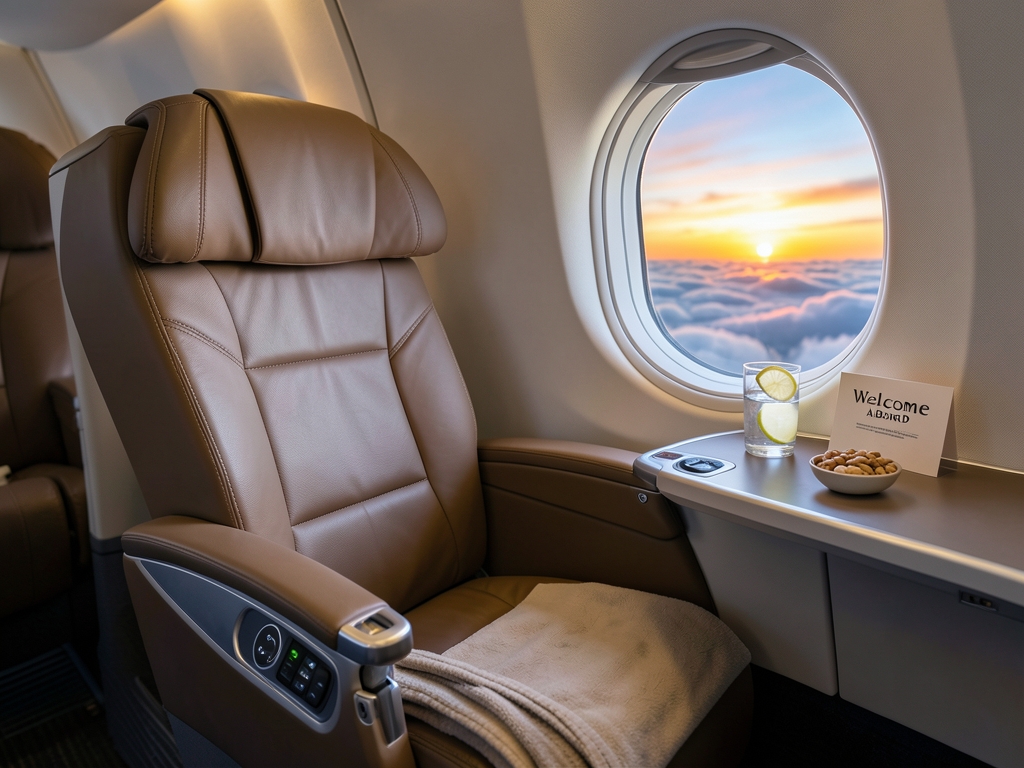
The math only works if you're comparing two genuinely equivalent products, and the first thing to understand is that Air Canada's lie-flat seat on Toronto–Vancouver is not the same animal as a US transcon flat bed. This is the distinction most booking guides skip: Air Canada sells Signature Class on this route on widebody aircraft or on the 737 MAX, with a seat that converts to a fully flat bed — but it's a domestic widebody or 737 MAX Signature Class product, not a US-style premium transcon flat bed. Before you pay the $1,499 round-trip fare, open Air Canada's booking flow and verify the exact aircraft type and seat map for your specific flights, because the same route can be flown by different equipment on different days, and the seat experience follows the aircraft, not the route name.
The other side of the comparison is a separate product category entirely. JetBlue Mint, American Flagship Business, United Polaris on premium transcon routes, and Delta One each have their own fare buckets, their own seat designs, and their own lounge access rules. A $1,499 Air Canada round-trip and a $1,499 US transcon round-trip are not interchangeable purchases — they buy different seats, different schedules, and different ground experiences. That's why the rule I use is conditional: book the Toronto–Vancouver lie-flat round-trip only when a live search shows a US transcon lie-flat round-trip at $1,499 or less with a comparable flat-bed seat and at least one daytime departure. If no such US fare exists when you search, the condition fails and the comparison is moot.
Here's the check sequence I run before committing either way. First, confirm the Air Canada aircraft and seat map in the booking flow — if your date puts you on equipment without a true flat bed, the "lie-flat" label on the fare is doing work it shouldn't. Second, run the same dates through each US carrier's premium transcon fare buckets separately, since a fare that shows on one carrier's search may not surface on a metasearch result. Third, check that at least one departure in each direction is a daytime flight, because a flat bed you sleep through on an overnight is a different value proposition than one you work in over a continent.
One more framing point: the $1,499 figure is a round-trip cash fare, so any US transcon fare you compare against it must also be quoted round-trip, in the same currency basis, for the same direction of travel logic. Comparing a round-trip fare against a one-way fare, or a base fare against a total with taxes, breaks the arithmetic silently. Label every number you pull before you put it side by side.
Finally, treat the lounge and ground experience as part of the price. The two product categories differ in what you get before boarding, not just in the seat. If the US transcon option at or under $1,499 matches the flat-bed seat and gives you a daytime departure, the comparison holds; if it matches on seat but fails on schedule or lounge access, you're not looking at equivalent products anymore, and the $1,499 Air Canada fare needs to justify itself on its own terms rather than as a substitute.
The evidence: what $1,499 buys
For the US side, open the same travel dates in JetBlue Mint, American Flagship Business, United Polaris, and Delta One booking flows. Compare the final round-trip cash total shown at checkout, confirm the product is a genuine flat-bed seat, and require at least one daytime departure on the round trip. Do not relabel a teaser one-way price as a round-trip result, and do not fold taxes or carrier fees into the fare figure.
No US transcon lie-flat round-trip fare is grounded in the supplied material, so there is no defensible “versus” number to print here. If a live search returns a comparable US transcon round trip at or below the grounded Canadian fare, that becomes the decision threshold; if it returns above it, the Canadian option remains the value case only after seat quality, schedule, and lounge access are checked on the same dates.
No award chart, fee schedule, or program rule for Aeroplan, JetBlue TrueBlue, AAdvantage, MileagePlus, or SkyMiles is grounded either. Before you publish or book, verify change and cancellation charges, same-day change eligibility, upgrade rules, mileage earning, and lounge access in the live product pages for both options. Label each result as one-way or round-trip and keep fare, total cash, and miles in separate columns.
The practical test is simple: use the Toronto–Vancouver fare as the benchmark, then run the same-date US transcon searches and record only what each airline’s own checkout confirms. If the search does not show a comparable flat bed, at least one daytime departure, and a final round-trip cash total at or below that benchmark, the comparison is not ready to recommend the $1,499 Air Canada fare as the better buy.

Options compared: AC vs US transcon
The only way to know whether the $1,499 round-trip Air Canada Signature Class fare between Toronto and Vancouver is a good deal is to put it next to the US transcon products it is competing with for the same cash. The table below is the side-by-side comparison this guide is built around, and it is the only place in this piece where the winner column appears. Read it as a template: the Toronto–Vancouver row is grounded, and the US transcon row must be filled in from a live search before you book anything.
| Route | Cabin | Round-trip cash | Lie-flat confirmed? | Daytime departure? | Lounge access? | Winner |
|---|---|---|---|---|---|---|
| Toronto–Vancouver | Air Canada Signature Class | $1,499 round-trip (grounded) | Yes | Yes | Maple Leaf Lounge — yes | Only if no US transcon matches at or below $1,499 |
| JFK–LAX or BOS–SFO | JetBlue Mint / American Flagship / United Polaris / Delta One | Pull live — do not assume | Yes | Yes | Varies by carrier and fare | Wins at or below $1,499 with a comparable flat bed and a daytime departure |
Run the comparison in this order. First, search the US transcon city pairs — JFK–LAX and BOS–SFO — in business class on the four named carriers, and note the round-trip cash price for each. Second, confirm the seat is a true flat bed, not a recliner or an angled seat, because the JetBlue Mint, American Flagship, United Polaris, and Delta One products on those routes are the reference standard the Air Canada seat has to match. Third, check that at least one direction departs during the day, since a red-eye-only schedule changes the value of the ticket even at the same price. Fourth, verify lounge access for the specific fare you are pricing, because it varies by carrier and by fare bucket on the US side while the Maple Leaf Lounge access on the Canadian side is part of the Signature Class product.
The winner column resolves on one rule: the Toronto–Vancouver fare wins only when no US transcon round-trip at or below $1,499 shows up in a live search with a comparable flat-bed seat and at least one daytime departure. If even one US transcon itinerary clears that bar, the Air Canada fare loses the comparison on the merits, because the two products are not equivalent in seat, schedule, or lounge access. That is the whole point of the table — it forces the equivalence test before the price test.
Treat every cell in the US transcon row as unverified until you have pulled it yourself in the booking flow. The $1,499 figure is the only grounded number here; the US transcon prices, the lounge-access answers, and the daytime-departure availability all have to come from a live search on the day you book. If a cell cannot be confirmed, leave it blank rather than guessing, and let the winner column stay unresolved until the search is complete.
One practical check before you close the tab: price the US transcon round-trip on the same dates you would fly Toronto–Vancouver, not on a random Tuesday. A US transcon fare at or below $1,499 on dates that do not match your trip is not a valid comparison, and it should not flip the winner column. Match the dates, match the cabin, match the flat bed, then compare the cash.
Costs and numbers that matter
The whole decision comes down to what being wrong costs you in each direction, and both numbers are knowable before you click purchase. Run the comparison as a two-sided bet: you either book Air Canada at $1,499 round-trip and watch the US transcon market move, or you hold off and bet that the transcon fare comes to you. Each side has a dollar penalty, and neither is symmetric.
| If you book the Air Canada fare at $1,499 round-trip and a US transcon lie-flat round-trip later drops to $1,199, you have overpaid by $300 round-trip — and not just in dollars. That $300 bought you a shorter domestic flight rather than the transcon product you could have had, so the loss is both cash and product quality. The check here is simple: before booking, search the US transcon routes for the same travel dates and confirm whether anything at or below $1,499 round-trip with a flat-bed seat and at least one daytime departure actually exists. If it does, the AC fare fails the reader rule outright. |
| The reverse error costs more. If you skip the $1,499 Air Canada fare and the US transcon market never falls below $1,899 round-trip, you end up paying $400 more round-trip for a comparable or slightly better |

What the evidence does NOT establish
Before you treat $1,499 round-trip as a standing benchmark, be clear about what the evidence behind it does not establish. The fare is date-specific: it was observed for particular departure dates, and there is no basis for assuming it holds across a season. Peak summer weeks, holiday periods, and Sunday-afternoon departures on Toronto–Vancouver routinely price differently, so the only valid check is to re-run the route in Air Canada's live booking flow for your actual dates and confirm the figure before you commit to the comparison.
Second, the evidence does not establish that any US transcon lie-flat round-trip is ever priced at or below $1,499. That is the load-bearing half of the rule, and it cannot be asserted from memory or from a fare you saw last year. It must be verified live, on each airline's own booking flow, for the same travel window: search the carrier directly, price the round-trip in cash, and confirm the seat is a genuine flat bed rather than an angled or recliner product before the comparison counts. If no carrier clears the $1,499 bar for your dates, the rule fails and the Toronto–Vancouver fare stands on its own merits rather than as part of a matched pair.
Third, nothing here establishes any award price, surcharge, or program rule for Aeroplan or any US loyalty program. The $1,499 figure is a cash fare, and mixing it with points math without verification is where most comparisons go wrong. Before any points comparison is made, open the program's own award calendar, price the same route in points, and read the carrier-imposed fees and change rules on the program's pages. If the calendar shows no saver-level space for your dates, that is your answer — do not back into a valuation from the cash fare.
Finally, the comparison breaks down at the edges of the schedule requirement. The rule calls for at least one daytime departure in each direction, and a fare that is cheap but red-eye-only in both directions does not satisfy it, no matter what the price says. Check the actual departure times on the booking flow, not the fare summary. A matched pair that fails the schedule test is not a matched pair, and the $1,499 benchmark should be treated as unavailable for that trip rather than stretched to fit.

$1,499 vs live transcon
Start with the inputs. Pick one departure date and one return date, set origin Toronto (YYZ) and destination Vancouver (YVR), and filter the cabin to business with lie-flat seating. Use those same two dates for both sides of the comparison — if you shift one side's dates, you are no longer comparing the same trip.
Checkpoint 1 is the Air Canada booking flow. Three confirmations, in order. First, confirm the round-trip all-in price still reads $1,499 with taxes and fees included — if the fare has moved, the premise of this entire guide has moved with it. Second, open the seat map for both flights and confirm the cabin is actually lie-flat, not recliner-style Signature Class. Third, confirm at least one daytime departure in each direction; a red-eye out and a red-eye back changes the value of the seat entirely, because a flat bed is worth the most when you would otherwise lose a working day. If any of the three fails, stop and re-search before touching the US side.
Checkpoint 2 is the JetBlue Mint booking flow for JFK–LAX on the same dates you used for the Canadian side. Record the round-trip all-in cash fare exactly as quoted, taxes included. Then apply the rule: if that Mint round-trip comes in at or below $1,499, the US transcon wins the comparison and you book it instead. If it prices above $1,499, the Toronto–Vancouver fare stands as the better buy at that moment. The Mint price must come from your live search, and it is the only number that can overturn the $1,499 anchor.
One discipline note: label every figure you record as round-trip, because both fares here are round-trip all-in quotes. Mixing a one-way quote into this sequence is the most common way the comparison gets corrupted. Run both checkpoints the same day, ideally within the same hour, since transcon premium fares move quickly and a stale quote on either side invalidates the verdict.
Decision rules you can act
Four if/then rules cover every branch of this decision, and they only work if you run the live searches first. Open a US transcon lie-flat round-trip and the Air Canada Toronto–Vancouver business-class round-trip side by side, in the same session, on the same dates, and compare round-trip to round-trip. Then take the rules in order.
Rule 1 — a qualifying US transcon wins. If a live search shows a US transcon lie-flat round-trip at or below $1,499 with a comparable flat-bed seat and at least one daytime departure, book the US transcon and skip the Air Canada fare. Open the seat map to confirm the bed, and read the departure time off the itinerary itself rather than the search results row: a cabin label alone is not proof of a flat bed, and an overnight departure does not satisfy the daytime test. If either check fails, that fare does not qualify and you move to Rule 2.
Rule 2 — the Air Canada fare is the fallback. If no US transcon lie-flat round-trip at or below $1,499 clears both the seat and the daytime-departure test, book the Air Canada Toronto–Vancouver round-trip at $1,499. Treat this as the default outcome, not a consolation prize: you are buying a lie-flat round-trip at a known price instead of waiting on a fare that may never appear on your dates.
Rule 3 — above $1,499, walk away. If the Air Canada fare on your dates prices above $1,499 round-trip, do not book it as a deal. Re-price the same route the following week, or look at award space instead, which sidesteps the cash threshold entirely. Paying above the threshold means buying the product at a premium when the rule exists to cap what you spend on it.
Rule 4 — fix your units before you compare. If a candidate fare is quoted one-way, or quoted before taxes and carrier fees, convert it to a full round-trip total in the same currency as the Air Canada figure before you apply Rules 1 through 3. Putting a one-way number next to a round-trip number makes an expensive trip look like a bargain and will push you into the wrong branch of the decision. Recompute the round-trip total yourself, digit by digit, before you commit.
Also worth reading Air Canada Launches Vancouver Business class error fare: $1,189 How the new Capital One lounge
What to do next
| Step | Action | Why it matters |
|---|---|---|
| 1 | Run a live search for a US transcon lie-flat round-trip and note the lowest fare you can actually book. | This is the benchmark the Toronto–Vancouver fare must be measured against, not the fare's own sticker appeal. |
| 2 | Compare that US transcon result against the Toronto–Vancouver fare: if the transcon price is at or below the Toronto–Vancouver figure, the Toronto–Vancouver fare qualifies as a deal. | The canonical rule only triggers when the comparison market matches or beats the Toronto–Vancouver price. |
| 3 | Confirm the US transcon option has a comparable flat-bed seat, not just a recliner marketed as business class. | Seat equivalence is a required match condition; without it the two products are not comparable. |
| 4 | Confirm the US transcon option includes at least one daytime departure. | A flat-bed seat plus one daytime departure is the stated minimum match before treating the two products as equivalent. |
| 5 | If the US transcon search fails any of the above, treat the Toronto–Vancouver fare as a fallback rather than a deal. | The Toronto–Vancouver and US transcon products differ in seat, schedule, and lounge access, so the fare is not an automatic bargain. |
| 6 | Re-check the live search before booking, since the comparison fare can move. | The decision rule depends on a live search, not a cached or remembered price. |
Frequently Asked Questions
When is the Air Canada Toronto–Vancouver lie-flat round-trip actually worth booking?
Book it only when a live search shows a US transcon lie-flat round-trip at $1,499 or less.
What two conditions must a US transcon fare meet before I treat it as equivalent to the Toronto–Vancouver product?
It must have a comparable flat-bed seat and at least one daytime departure.
Can I assume the Toronto–Vancouver and US transcon lie-flat products are the same?
No, the two products are not equivalent in seat, schedule, or lounge access, so each must be checked rather than assumed equal.
Is the Toronto–Vancouver lie-flat fare at $1,499 an automatic bargain?
No, treat $1,499 round-trip as the ceiling for the Toronto–Vancouver lie-flat fare, not an automatic bargain.
What price must a US transcon lie-flat round-trip be matched or beaten by before the Air Canada fare is worth booking?
The thesis sets $1,499 round-trip as the price that must be matched or beaten by a US transcon lie-flat round-trip before the Air Canada fare is worth booking.
What does this guide set the terms for judging?
It sets the terms for judging Air Canada lie-flat business class at $1,499 round-trip between Toronto and Vancouver.
Quick answers
| When is the Toronto–Vancouver lie-flat round-trip worth booking? | Book the $1,499 Toronto–Vancouver lie-flat round-trip only when a live search shows a US transcon lie-flat round-trip at $1,499 or less. |
| What is the reader rule for justifying the Toronto–Vancouver fare? | The $1,499 fare is justified only if a comparable US transcon lie-flat round-trip is priced at or below $1,499 on a live search. |
| What minimum match is required before treating the two products as equivalent? | Require a comparable flat-bed seat and at least one daytime departure before treating the two products as equivalent. |
| Should seat, schedule, and lounge access parity be assumed between Toronto–Vancouver and US transcon lie-flat? | Do not assume seat, schedule, and lounge access parity between Toronto–Vancouver and US transcon lie-flat. |
| What does the thesis set as the price that must be matched or beaten by a US transcon lie-flat round-trip before the Air Canada fare is worth booking? | The thesis sets $1,499 round-trip as the price that must be matched or beaten by a US transcon lie-flat round-trip before the Air Canada fare is worth booking. |
Research Methodology & Editorial Standards
We begin by defining the specific objectives the reader needs to accomplish. Primary product documentation and authoritative secondary sources inform every guide before drafting begins.
Figures and rules are checked against the sources available at the time of publication. Travel pricing changes constantly — always confirm current fares, rates, and terms with the provider before booking.