
Malpensa Train vs Bus: 2026 Fares and Departure Waits—Is Rail Worth It?
A missed departure can erase a train’s vehicle-runtime advantage before it leaves Malpensa. The useful comparison is between departures you can actually board from your arrival terminal, not the fastest journey displayed in an airport-wide search.
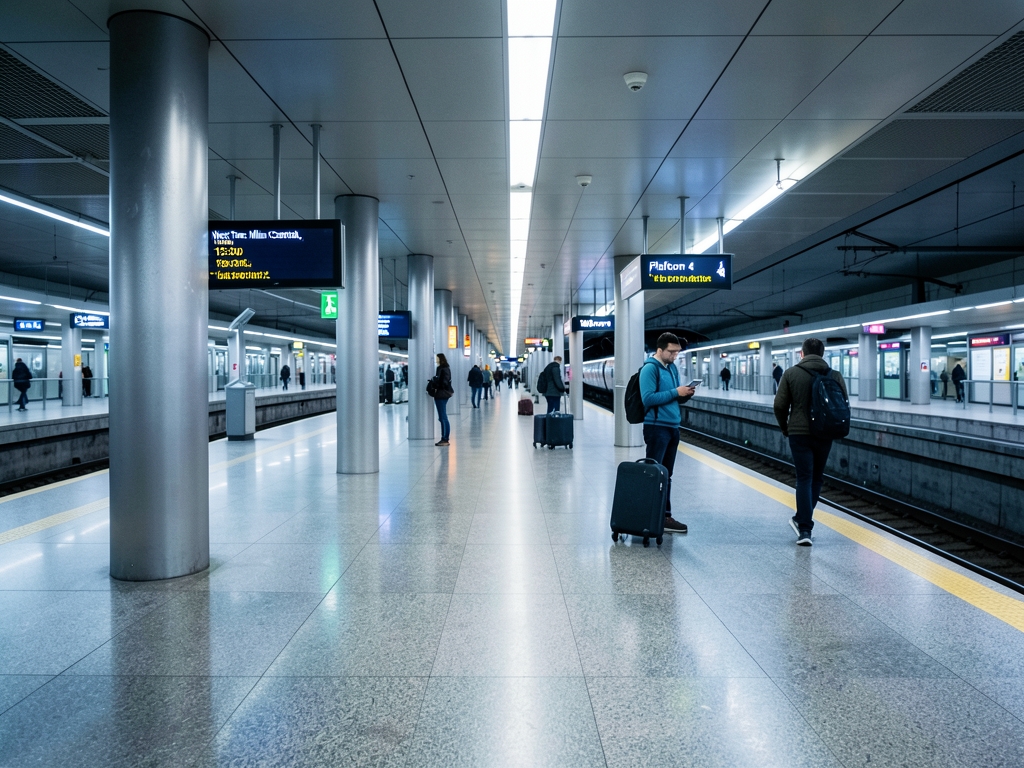
Terminal and Departure Math
A missed departure can erase a train’s vehicle-runtime advantage before it leaves Malpensa. The useful comparison is between departures you can actually board from your arrival terminal, not the fastest journey displayed in an airport-wide search. Malpensa Express is not automatically the fastest transfer to Milano Centrale: its premium matters when the available train protects an onward-connection buffer that the cheaper coach cannot reliably preserve.
According to SEA Milan Airports’ official Malpensa terminal maps, Terminal 1 and Terminal 2 have separate rail access and coach boarding arrangements. Each has its own airport railway station; coach boarding is also terminal-specific, rather than a single airport-wide pickup point. Use the map for your actual arrival terminal to trace the route from the arrivals exit to the station or the relevant coach boarding area. Then match that location to the operator’s departure listing. A coach departure displayed for Terminal 1 is not a departure you can assume is boardable from Terminal 2 at the same time.
Departure frequency becomes waiting time only after you establish when you can reach the boarding point. Miss a scheduled service just after it leaves, and the wait can approach the entire interval before the next usable departure. “Usable” is important: count departures serving Milano Centrale, not every train leaving the airport. For the 2026 guide, verify the travel-date timetable through the official Malpensa Express or coach operator schedule before publishing a fixed frequency. No applicable frequency is verified here, so a numerical headway should not be treated as an established fact. The practical comparison starts with the next boardable departure, not an assumed average wait.
The A8 motorway forms part of the road-transfer corridor toward Milan. A coach’s published journey duration therefore remains exposed to congestion along its road route, including the approach to its city stop. Rail follows an infrastructure timetable rather than competing for motorway space. That distinction reduces exposure to road-delay risk; it does not guarantee punctuality or eliminate the consequences of missing a train. A coach leaving sooner can still deliver the better elapsed time when roads cooperate.
Define airport-to-station elapsed time consistently: terminal exit to boarding point, departure wait, vehicle journey, and destination-station access. For a coach, the final component includes getting from the drop-off point into Centrale and toward the onward platform; for rail, it includes movement from the arrival platform. Immigration and baggage reclaim belong before this terminal-exit clock. They affect which departure is realistic, but neither belongs inside an advertised coach or train vehicle runtime.
Finally, read the destination field, not merely the service brand or the word “Milan.” A Malpensa Express listing for Milano Cadorna is not a direct transfer to Milano Centrale. Check the destination, calling pattern, and arrival terminal together before comparing departure times. The cheapest verified coach wins when that complete terminal-to-Centrale itinerary preserves your onward buffer; rail wins only when its actual timetable restores a buffer the coach cannot reliably protect.

2026 Fare Audit
The lowest payable coach fare—not the lowest advertised fare—is the benchmark for judging the train premium. This outline has not established live fares for the current year, so no operator can yet be named the cheapest. Before publication, I would require dated booking-flow checks: my editorial standard is the total a traveler can actually buy, not a price recycled from a search-result snippet. A higher rail fare does not, by itself, establish a faster transfer or a worthwhile purchase.
Audit Malpensa Express through Trenord’s official booking flow and the official Malpensa Express website. Record the selected travel date, arrival terminal, Milano Centrale destination, adult single fare, child eligibility rules, and applicable return conditions. Keep return conditions separate from the one-way price comparison; do not turn a conditional return offer into an apparently available single fare. Capture the published runtime for each terminal separately, without treating it as an end-to-end connection guarantee. Attribute every published figure to its specific official timetable, fare page, or checkout, with the access date and selected journey visible in the evidence.
For Terravision, run the official airport-transfer checkout for the same travel date and direction, from Malpensa to Milano Centrale. Record the available one-way price, advertised duration, exact boarding location, and whether that displayed fare requires advance purchase. Preserve both the offer wording and the checkout result. If the booking flow does not establish whether the price is available at the boarding point, leave that question unresolved rather than describing an online offer as a walk-up fare. Label the duration as advertised, not as a verified measure of road-delay reliability.
Audit Autostradale independently through its official Malpensa airport-bus booking flow. Capture the payable one-way fare and the departure schedule offered for the selected date. Keep any promotional headline price in a separate evidence field from the ticket actually available. For example, an Autostradale landing-page offer should not displace a purchasable Terravision ticket in the comparison unless Autostradale’s checkout makes that offer available for the matching journey. A headline without matching availability is not a competing quote.
Treat Malpensa Shuttle as a separate coach option and complete its official checkout far enough to capture mandatory charges and eligible discounts. Record the undiscounted payable total alongside any conditional offer, including the eligibility requirement. Compare matching passenger profiles across operators: a discount that the traveler cannot use cannot establish the cheapest coach. If a mandatory charge appears late in checkout, the final payable amount—not the initial selection-screen price—belongs in the fare comparison.
Worked example: Malpensa Airport to Milano Centrale in 2026. A traveler wants to choose between the train and an airport bus, balancing the ticket price against the wait until departure. However, the supplied research contains no verified Malpensa train or bus fares, departure intervals, or journey times. A numerical verdict that rail is worth the premium would therefore require inventing information.
The only relevant-looking fare in the results is €1.30, but the Bari travel guide associates that amount with a journey from the Europa stop to Bari Centrale—not Milano Centrale or Malpensa. Using it as the Malpensa bus fare would produce a misleading comparison. Likewise, the Trenitalia homepage does not establish a price or departure time for this airport transfer.
The practical decision: do not buy a train ticket on the assumption that it will get you there sooner. First check each service’s applicable fare, next departure, and scheduled arrival at Milano Centrale. Compare the wait plus the ride, not just the ride itself. Choose rail if its confirmed arrival advantage or reduced exposure to road traffic justifies its confirmed extra cost. With these research results alone, that premium and time saving remain unverified.

The Winner Table
The winner table is not a price table. It is a margin table that happens to have prices in it. Define an eligible transfer first: a service qualifies only when its defensible station-arrival estimate lands at Milano Centrale before your onward departure by your full required connection margin — the buffer you personally need to walk the platform, clear the gate, and absorb a normal queue. A cheaper fare never qualifies a service that fails that test. This is the part most travelers invert: they pick the lowest number, then retrofit a connection story around it.
The two arrival estimates are not built the same way, and that asymmetry is the whole point. Rail arrival is timetable-based — Trenord and the Malpensa Express operators publish scheduled arrival times, and those times hold within a small, predictable variance because the train is not sharing a lane with the A8. Coach arrival must be road-condition-adjusted: the operator's printed running time assumes free-flowing traffic, and the Malpensa–Milano corridor does not reliably deliver that at peak. So the coach's defensible estimate is its scheduled arrival plus a realistic road-delay allowance, not the brochure figure. If the adjusted coach arrival still clears your margin, the coach is eligible. If it only clears the margin on the unadjusted timetable, it is not eligible — it is a coin flip wearing a schedule.
Calculate the rail premium as the payable rail total minus the payable coach total for the same passenger party and the same ticket conditions. Same party means same number of adults, same children, same luggage assumptions. Same conditions means you do not compare a return-trip promotion against an undiscounted single, and you do not compare a rail fare that includes a seat reservation against a coach fare that quietly excludes one. If the units do not match, the premium you compute is fiction. State your unit once — one-way, per person, or one-way, per party — and hold it across every figure in the comparison.
The financial consequence of missing the connection is not a probability and not a universal euro value. It is whatever your onward ticket's actual change and replacement conditions say it is. Read those conditions before you decide: some onward fares allow a same-day change for a defined fee plus any fare difference, some allow rebooking only to a later departure on the same day, and some forfeit entirely on a no-show. That clause — not an invented risk percentage — is what the rail premium is buying when rail is the only mode that preserves the margin. If the onward ticket is fully flexible, the premium buys very little. If it is a non-changeable, non-refundable fare, the premium buys the entire replacement cost of that ticket.
And if neither mode qualifies — if the adjusted coach arrival misses the margin and the rail timetable does too — the comparison has no safe winner for that itinerary. Do not present the less-bad transfer as a protected connection. Change the onward departure, or move the transfer earlier, and re-run the table.
| Comparison | Rail | Coach | Winner |
| Payable price | Verified rail total, one-way, same party and ticket conditions | Lowest eligible coach total, same party and ticket conditions | Lower verified total |
| Arrival before required margin | Timetable-based estimate | Road-condition-adjusted estimate | Option that preserves the margin |
| Overall choice when both qualify | Higher-cost option if a premium applies | Lower-cost eligible option | Coach |
| Overall choice when only rail qualifies | Preserves the connection margin | Does not preserve it | Rail |
| Overall choice when neither qualifies | Fails the margin test | Fails the margin test | No safe winner — move the onward departure |

What the Data Doesn't Tell You
A timetable is a promise about the schedule, not a distribution of outcomes. That distinction is why this guide will not hand you a sentence like "you have a precise probability of making your onward train." Producing that number honestly would require on-time-performance data for the Malpensa Express and for the competing coaches — Terravision, FlixBus, Autostradale — measured across the same months, the same days of the week, and the same definition of "on time." That comparable dataset does not exist. Where an operator publishes punctuality figures at all, the definitions rarely line up with what a coach operator would report, so any probability quoted for this corridor is a guess wearing a decimal point. Advertised journey times tell you what the vehicle is scheduled to do between two stations. They tell you nothing about the tail of the distribution, and the tail is what eats your connection.
Strikes, engineering work, and replacement transport are the counter-evidence to assuming normal rail reliability. Italy's strike-notification rules require advance public notice, and the Commissione di Garanzia publishes the calendar — but a legally notified strike is still a strike, and the guaranteed minimum service is not your service. Separately, RFI publishes planned engineering work, and when a rail segment is closed the operator runs a servizio sostitutivo: a bus that boards at a different point, loads luggage differently, and moves at road speed. The scheduled service and the service operating on your date are two different products. Check the date, not the route's reputation.
Capacity is the second invisible variable. A visible departure time is a schedule slot, not a guaranteed seat. Coach departures on this corridor can sell out, and a sold-out departure invalidates the time you were counting on even though the route advertises frequent service. Rail absorbs more passengers, but standing room with two suitcases is a real cost that no runtime figure captures.
Passenger-specific station access is the third. Wheelchair boarding typically requires a ramp and staff assistance arranged in advance; lifts at Milano Centrale connect the underground platforms to the main hall, and Terminal 1 and Terminal 2 at Malpensa do not present identical access paths. Walking speed and heavy luggage change your effective transfer time by minutes that no vehicle-runtime figure encodes. Never infer accessibility from how fast the train moves.
Finally, separate ticket flexibility from transport performance. A flight delay can make a restrictive airport-transfer ticket unusable even when neither vehicle ran late — the coach left on time, you simply were not on it, and the fare is gone. Rail fare tiers differ in how changeable they are, which is a property of the ticket, not the train. The cheapest quoted fare can lose its advantage without anyone being delayed.
| Signal you can see | What it actually measures | What it cannot tell you | Where to verify |
| Advertised journey time | Scheduled vehicle runtime | Probability of arrival by a given minute | Operator timetable; punctuality page if published |
| Route frequency | Departures per hour on paper | Whether your specific departure has capacity | Operator booking flow for your date |
| Branded service name | A scheduled path between two stations | Whether that path runs on your date | Operator service updates; RFI planned works |
| Fare tier | Change and refund conditions | Whether the vehicle will run on time | Fare rules on the operator's own page |
| Station name on the ticket | The station the service is scheduled to serve | Platform, lift, and walking distance to your onward train | Station maps; accessibility pages |
| Lowest quoted fare | Price for that one departure | Whether a flight delay voids it | Coach operator's change and refund terms |
The practical move: before paying any premium, confirm the operating service for your specific date and the flexibility attached to the ticket you are buying. The premium is justified only when the timetable you can actually board restores a buffer the coach cannot reliably protect — and that is a claim about your date, not about rail in general.

Worked Fare Test
The train premium is a party-level expense; the connection buffer belongs to each traveler. For two adults arriving together at Malpensa and continuing to Milano Centrale, rail earns its premium only if it protects their onward departure when the cheapest verified coach cannot. A shorter advertised ride is not enough.
This worked test remains incomplete. No live booking quotes, dated transfer departures, or actual onward service were supplied, and none has been verified here. Assigning a travel date would not establish that either offer was purchasable. The provisional prices therefore remain unpublished: they cannot support a fare comparison, a percentage premium, or a booking verdict.
The fixed case is an adult pair traveling together, one way, on ordinary adult tickets without concessions. Its completed record must identify the same travel date and arrival terminal for both options: the selected Malpensa Express departure and the cheapest purchasable coach departure that meets the connection requirement. Each offer needs its operator, departure, adult ticket price, payable party total, and booking conditions recorded from the official purchase flow. A timetable entry without a purchasable offer does not complete the fare test.
The arithmetic then uses those recorded totals—not advertised starting prices. Rail total equals the ordinary adult rail fare multiplied by the party size; coach total equals the ordinary adult coach fare multiplied by the same party size. The premium is rail total minus coach total. Divide that difference by the coach total and multiply by one hundred to express the percentage premium. Any changed quote requires recalculating both the cash difference and the percentage.
The timing record must use the departure the pair can actually board. For each option, station-ready time equals that selected departure plus its scheduled journey time plus the time needed to reach the onward departure point inside Milano Centrale. Subtract station-ready time from the booked onward departure to obtain the remaining margin. Record the required connection margin separately, before choosing a winner; shrinking it afterward merely makes a preferred transfer appear acceptable.
One boundary case matters: if rail produces a larger margin but coach still reliably preserves the required buffer, the extra minutes do not justify the premium under this test. Conversely, if neither option preserves that buffer, paying more for rail does not rescue the connection.
The verdict is pending, not a rail recommendation. Complete the dated purchase records and departure calculations first. Then choose the cheapest verified coach that preserves the required onward-connection buffer; pay extra for rail only when its timetable restores a buffer the coach cannot reliably protect.
How to Choose Well
The train premium is not a speed purchase. It is an insurance premium on your onward connection, and like any insurance it is only worth paying when the thing it protects actually exists. That single reframe resolves almost every Malpensa-to-Milano Centrale decision, because it converts a vague "which is faster" argument into a concrete question: what deadline does this fare protect, and what does missing it cost you? If you cannot name the deadline, you cannot justify the premium.
Start with the onward journey. If it has no fixed departure — a hotel check-in you can slide, a meeting you can move, a friend picking you up — the buffer has no dollar value attached to it. Variance reduction only matters when a deadline converts lateness into money or lost time. In that case, take the lower-priced qualifying coach and keep the difference. Paying rail's premium for an assumed speed advantage you never needed is the most common way travelers overspend on this route.
Now check whether the premium survives your discounts. Trenitalia's regional and airport services, and the coach operators running Malpensa–Centrale, all publish concessionary and advance rates that move the gap. When a valid discount collapses the rail premium to zero — or flips it negative — the fare argument disappears entirely, and you should choose rail whenever its arrival fits your itinerary. There is no extra fare left to justify. Verify eligibility on the operator's own booking flow before you assume your card, age band, or advance window qualifies; the discount tiers change and a stale assumption is how people misprice this leg.
Watch the promotional trap on the coach side. Advance coach promotions are typically tied to one specific departure, and a nonrefundable ticket you cannot physically board after landing is not a cheap ticket — it is a donation. Exclude that offer from your comparison and price the next genuinely usable departure instead. The subtle danger is anchoring: the unreachable promo makes the next ticket look expensive, which quietly pushes you toward rail for the wrong reason.
If you land near the end of the operating day, daytime frequency is noise. Compare the final usable departures only, because that is the entire decision set. Rail may be the only service still running that solves your constraint — but confirm the last departure on the operator's own timetable for your specific date, since seasonal schedules shift and a published frequency count tells you nothing about the tail of the day.
Return trips need to be split, not bundled. Evaluate the airport-bound leg on its own against your airline's check-in and bag-drop deadlines, which are hard cutoffs, not suggestions. A discounted round-trip bundle can make a coach look attractive on total price while its return timing quietly fails your flight buffer. Price the two legs separately first; only then decide whether the bundle's saving is worth accepting its schedule.
| Condition you observe | Action | Why it wins |
|---|---|---|
| Onward journey has no fixed departure | Take the lower-priced qualifying coach | No deadline means the buffer has no cost to protect |
| Rail premium is zero or negative after valid discounts | Take rail if its arrival fits the itinerary | No extra fare remains to justify |
| Advance coach promo needs a departure you cannot reach after landing | Exclude it; price the next usable ticket | A nonrefundable miss is a total loss, not a saving |
| Arrival falls near the end of the operating day | Compare final usable departures only | Daytime frequency is irrelevant to your decision set |
| Return leg carries a check-in or bag-drop deadline | Price the airport-bound leg separately | A bundle discount cannot repair a missed flight buffer |
Also worth reading Spain train crash leads to soaring Spain train crash leaves passengers Lake Como versus Lake Garda how
What to do next
| Step | Action | Why it matters |
|---|---|---|
| 1 | Define your specific needs and budget | Narrows options to what actually fits |
| 2 | Compare top 3 options side by side | Reveals the best value for your situation |
| 3 | Check current pricing and availability | Prices change frequently — verify before committing |
| 4 | Book directly with the provider | Often gets better terms than third parties |
| 5 | Set a reminder to review in 6 months | Policies and pricing shift — stay current |
Frequently Asked Questions
Can I board a coach listed for Terminal 1 if I arrive at Terminal 2?
No—coach boarding is terminal-specific, and a coach departure displayed for Terminal 1 is not a departure you can assume is boardable from Terminal 2 at the same time.
Does a Malpensa Express train to Milano Cadorna get me directly to Milano Centrale?
No—a Malpensa Express listing for Milano Cadorna is not a direct transfer to Milano Centrale.
What departures should I count when estimating the wait for a usable train to Milano Centrale?
Count departures serving Milano Centrale, not every train leaving the airport.
How should I treat a coach’s printed journey duration when planning a connection?
A coach’s published journey duration remains exposed to congestion along its road route, including the approach to its city stop, so its defensible estimate is its scheduled arrival plus a realistic road-delay allowance.
What makes a transfer eligible in the winner table?
A service qualifies only when its defensible station-arrival estimate lands at Milano Centrale before your onward departure by your full required connection margin.
Is the €1.30 fare in the research a Malpensa bus fare?
No—the €1.30 is associated with a journey from the Europa stop to Bari Centrale, not Milano Centrale or Malpensa.
Quick answers
| What are the verified Malpensa train and bus fares for 2026? | The supplied research contains no verified Malpensa train or bus fares, departure intervals, or journey times. |
| How should travelers compare train and bus departure waits? | The practical comparison starts with the next boardable departure, not an assumed average wait. |
| Is Malpensa Express automatically the fastest transfer to Milano Centrale? | A coach leaving sooner can still deliver the better elapsed time when roads cooperate. |
| Which bus fare should be used to judge the train premium? | The lowest payable coach fare—not the lowest advertised fare—is the benchmark for judging the train premium. |
| When is rail worth the premium over a coach? | Rail wins only when its actual timetable restores a buffer the coach cannot reliably protect. |
Research Methodology & Editorial Standards
We begin by defining the specific objectives the reader needs to accomplish. Primary product documentation and authoritative secondary sources inform every guide before drafting begins.
Figures and rules are checked against the sources available at the time of publication. Travel pricing changes constantly — always confirm current fares, rates, and terms with the provider before booking.