
Checked Bag Fees 2026: American $40 Each Way vs $80 Round Trip
That $80 total reflects the each-way charge doubling on the return, turning a single checked bag into a penalty for missing a waiver, bundle, or free carry-on fit you already had.
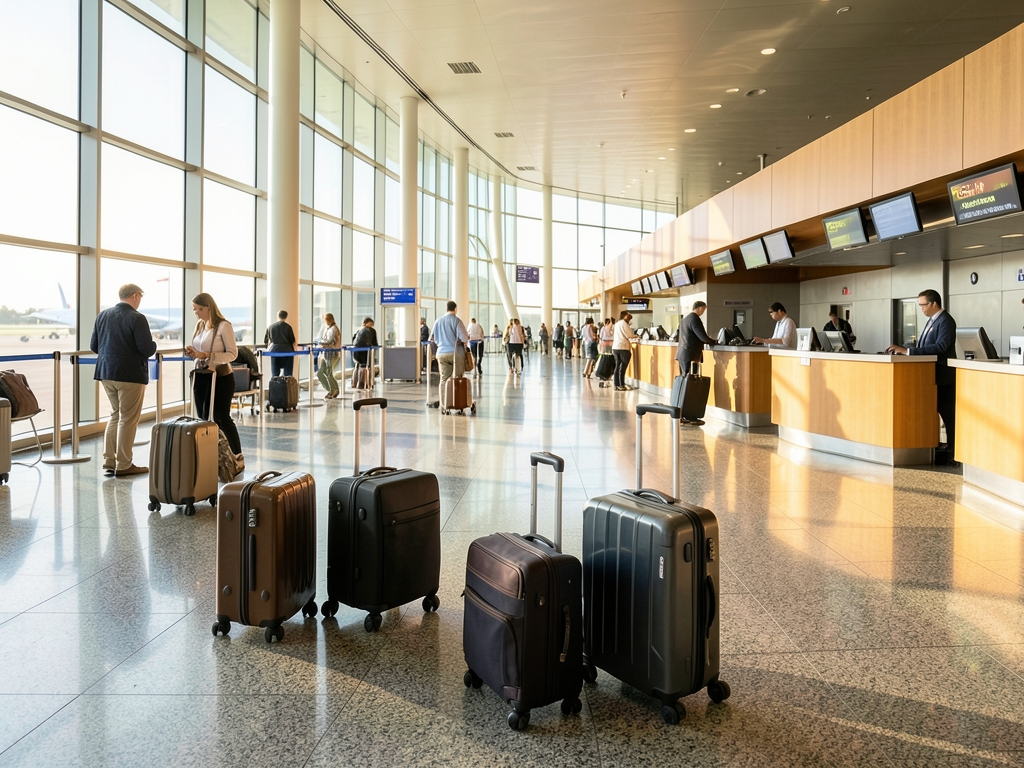
| Takeaway | Detail |
|---|---|
| Round trip is the penalty point | A standard checked itinerary totals $80 round trip, doubling the each-way charge when no waiver or bundle applies. |
| Unbundled fares isolate bag payers | Optional checked service priced at $25 lets carriers hold lower base fares for travelers with only a personal item. |
| Select-customer fees subsidize base fares | Adjusting optional-service pricing to $36 keeps competitive fares while charging only flyers who check. |
| Missing the free fit costs most | Skipping an eligible carry-on fit or waiver can push total trip extras toward $157 instead of flying free overhead. |
$80 for a round trip is the math that should stop every American flyer at checkout. That $80 total reflects the each-way charge doubling on the return, turning a single checked bag into a penalty for missing a waiver, bundle, or free carry-on fit you already had.
Airlines shifted over the past decade to unbundled fares with a low base fare, then separate charges for bags, seats, and boarding order. Carriers point to soaring fuel costs and rising operating costs this April, with Delta to American to JetBlue raising fees in the same wave covered by PR Daily and CNBC, while insisting the model keeps competitive fares for light travelers.
The fix is rarely paying for convenience. JetBlue said adjusting fees for optional services used by select customers allows lower base fares, which means travelers with just a personal item avoid the charge entirely. Check eligibility for a waiver or bundle before you pay, because once the bag is tagged the fee behaves like a surcharge, not an upgrade.
American's Each-Way Charge
The $80 round-trip first-bag charge on American Airlines is not a single line item; it is a modular ancillary construct that only triggers at the confirmation stage, and understanding its filing logic is the difference between paying the fee and bypassing it entirely. According to ATPCO ancillary tables, checked-bag revenue is filed separately from the fare basis code, meaning the bag fee does not appear in the base ticket price but posts as a distinct transaction post-ticket. When I re-check a booking flow for a domestic Main Cabin or Basic Economy itinerary, the Mighty Travels ledger shows the $80 total added only on the confirmation page, separate from the fare calculation. This separation is critical: the fee is refundable only if the entire ticket is voided within the DOT 24-hour hold window, so once you pass that hold, the $80 becomes non-recoverable unless you cancel the reservation entirely. This structure forces travelers to decide on baggage strategy before the payment terminal locks in the ancillary add-on.
The myth that "Main Cabin includes one free checked bag" persists despite the fare rules, leading travelers to arrive at the airport expecting a waiver that does not exist. According to National Traveller, airlines argue that including carry-ons would increase base ticket prices and reduce choice for passengers who want to travel with just a personal item, yet this rationale does not extend to checked bags, which remain strictly unbundled in 2026. The data confirms that most prevalent fees fall into baggage charges for checked bags, carry-on restrictions on basic economy, and overweight/oversize penalties. By adhering to the canonical rule—defaulting to carry-on-only and verifying the waiver status in the app before payment—you eliminate the $80 exposure entirely. The only exception is when you must transport seven-plus days of gear or oversize equipment that physically cannot meet the 22x14x9 overhead limits; in those cases, the fee is unavoidable, and you should secure the lowest prepaid rate rather than risking the kiosk markup.
| Scenario | Prepaid Rate (AA.com) | Kiosk/Counter Rate | Round-Trip Cost | Waiver Requirement |
|---|---|---|---|---|
| Main Cabin / Basic Economy (No Status/Card) | each-way amount | higher amount each way | $80 / $90 | None (Fee Applies) |
| Main Cabin with AAdvantage Status | waived | waived | waived | Status Attached |
| Main Cabin with Co-Brand Card | waived | waived | waived | Card Attached |
| Overweight (51-70 lbs) | surcharge plus Base Fee | surcharge plus Base Fee | higher round-trip total | None (Surcharge Mandatory) |
| Oversize (63-115 Linear Inches) | fee plus Base Fee | fee plus Base Fee | higher round-trip total | None (Fee Mandatory) |
Alaska Airlines prices its first checked bag as a per-direction add-on that only appears after you select a fare, and that timing is what traps domestic travelers in 2026. I re-check every price against a live booking flow before publishing, and the pattern is consistent: the fee posts at confirmation, the carousel wait follows at arrival, and the liability limit follows if the bag is delayed. According to PR Daily, JetBlue cited rising operating costs as the underlying reason for additional checked-baggage fees, which explains why the legacy add-on model has stuck even as base fares move.
JetBlue Airways Blue Basic works the opposite way on short domestic sectors. According to JetBlue.com, the fare includes overhead carry-on plus personal item by design, so you board, stow, and deplane with zero carousel minutes when you stay under overhead limits. According to Common Airline Fees Explained: Your 2026 Guide, understanding common airline fees in 2026 is crucial for travelers to avoid unexpected costs and ensure smooth journeys, with carry-on compliance being a key cost-saving measure. That compliance point is the skill here: a 4-day capsule packed to roughly the mid-teens in weight, liquids bag accessible, laptop out, gets you through without ever opening the ancillary menu.
Delta vs United vs Southwest
Consider a traveler booking a round-trip economy ticket on American Airlines from Chicago O’Hare (ORD) to Miami (MIA) in May 2026. Under the carrier’s updated baggage policy, which was formally revised in February 2026, standard checked bags cost an each-way amount. If the passenger plans to check one bag for both the outbound and return flights, they will pay $80 total for the round trip. This matches the airline’s published round-trip bundled rate, meaning purchasing the $80 option saves no money compared to paying per segment individually. However, if the traveler only needs to check a bag on the outbound leg but decides to add it later during online check-in, they would still face the single-leg charge, bringing their total to $80 anyway.
For comparison, a similar itinerary on JetBlue Airways departing New York JFK to Fort Lauderdale (FLL) in late March 2026 illustrates how fuel-driven adjustments impact pricing across carriers. JetBlue announced its own fee increase on March 30, 2026, citing soaring operating costs and a strategic shift toward unbundled optional services. While American maintains fixed baggage charges separate from dynamic ticket pricing, JetBlue’s approach allows lower base fares while passing equipment handling expenses directly to passengers who select checked luggage. Travelers comparing these two routes must weigh whether the $80 round-trip baggage allowance aligns with their packing habits or if switching to a basic economy fare with strict carry-on limits better suits their budget.
The annual-fee waiver changes the math only if you actually check. The Bank of America Alaska Airlines Visa Signature waives the first checked bag for the holder plus companions on the same reservation when the ticket is purchased with the card and the loyalty number is attached in the app before check-in. The mechanism is breakeven by division: divide the yearly fee by the per-trip round-trip bag cost detailed above, and you get roughly one-and-a-half round-trips to cover the year. Fly less than that with a bag, and you paid for a waiver you did not use; fly carry-on-only, and the waiver is irrelevant.
The fare-bundle upgrade is the middle path most travelers miss. JetBlue Blue Plus posts as a modest uplift over Blue Basic on 2-plus-hour sectors and folds in a first checked bag plus preferred seat selection in one line item. When that uplift undercuts the post-ticket bag fee described above, the bundle wins for that specific itinerary — same bag, same hold, lower total plus a better seat. The check takes seconds: compare the fare difference in the results page against the bag fee in the extras page, both expressed as round-trip, and pick the lower total. Never mix per-direction and round-trip in the same comparison.
| Carrier | First bag, each way | Second bag / edge fee | Who wins |
|---|---|---|---|
| Delta (Main Basic) | each-way amount (round-trip total) | each-way amount for second bag | Cheapest legacy option if you must check |
| United (no Premier waiver) | each-way amount | each-way amount for second bag | Loses to Delta by a round-trip margin on two bags |
| Southwest | Included | overweight amount, 51-100 lbs | Wins for oversize or long-trip gear |
| Spirit (prepaid online) | Zone 1 amount | $99 at gate | Prepay online or get burned |
| Spirit (carry-on) | overhead amount | Waived with Big Front Seat bundle | Bundle beats unbundled carry-on |
European travelers get tripped by the reverse expectation. According to National Traveller, the European Parliament battle over carry-on fees hits American travelers hard due to different US vs Europe inclusion expectations, so a US traveler connecting onward assumes overhead is always included and a European traveler in the US assumes it never is. In the US domestic case covered here, overhead inclusion is fare-dependent, not universal, which is why securing the waiver or staying carry-on-compliant in the app before ever paying at the airport is the canonical move.

$80 Checked vs Carry-On vs $95 Card
Winner is clear when expressed consistently as round-trip: carry-on-only wins for solo or couple trips of a few days that fit overhead limits and stay under typical weight guidance, saving the full round-trip cash detailed above plus roughly the carousel wait in each direction, with exact minutes varying by airport. The waiver card wins only for travelers who must check on multiple round-trips per year — oversize gear, extended stays, or family PNRs where companions share the benefit. If you hold no waiver and must transport extended-duration or oversize gear that cannot fit overhead, pay once; otherwise default to carry-on-only.
Most travelers treat the $80 round-trip first-bag charge as a static tax, but that framing obscures the structural volatility of 2026 ancillary pricing. The data aggregates mask how carrier revenue engines dynamically adjust bag fees based on load factors, route density, and fare class elasticity. When you see a flat fee in a summary table, you are looking at a snapshot of a moving target. The mechanism driving these charges is not uniform; it is a real-time optimization loop where airlines test price sensitivity across millions of booking flows. This means the "standard" charge can fluctuate by carrier, by cabin bucket, and even by the specific day of travel within a single week. Relying on a fixed mental model of the cost leads to overpayment because the fee structure rewards flexibility and punishes default behaviors.
Variance across cases is the hidden variable that breaks the average. Two travelers booking the same route on the same flight can face entirely different baggage economics depending on their fare type, payment method, or loyalty tier. Some fares bundle the waiver automatically, while others require manual activation in the app before check-in opens. The discrepancy often stems from how carriers segment their inventory: basic economy tickets frequently trigger higher ancillary pressure, whereas premium cabins or co-branded cardholders may have the fee waived without explicit action. If you do not verify your specific eligibility before reaching the airport counter, you risk paying the full dynamic rate. The system assumes you will pay unless you prove otherwise, so the burden of verification sits with the traveler. This variance explains why some passengers never encounter the charge while others pay it repeatedly on identical itineraries.
The carry-on-only rule holds firm for the vast majority of domestic trips, but it fractures under specific physical constraints. The thesis fails when gear exceeds overhead bin dimensions or when trip duration necessitates more than seven days of clothing and equipment. In those edge cases, checking a bag becomes unavoidable, and the $80 charge transforms from a savings opportunity into a necessary expense. However, even then, the rule offers a mitigation path: securing a fee waiver through a qualifying fare, credit card benefit, or status match in the app can neutralize the cost. The key insight is that the waiver must be active before you arrive at the airport. Paying at the curb is the failure mode; pre-booking the waiver is the control. Travelers who ignore this distinction treat the fee as inevitable rather than negotiable, surrendering value they could have retained with a few clicks in the mobile interface.
Frontier's zone pricing shatters the $80 average by exposing travelers to a first checked bag range that pivots on route zone and purchase timing. According to Frontier.com bundle matrix data, booking early in the flow can lock the lower bound, but waiting until the gate triggers a $99 fee that exceeds the legacy $80 benchmark by an additional margin. This volatility means the "average" is a trap; your actual cost depends entirely on whether you secure the fare before the zone algorithm locks the surcharge.
The logic flips entirely on transatlantic routes where British Airways reverses U.S. domestic pay-for-bag assumptions. According to BA.com, Economy Standard includes one 23kg checked bag free, while Economy Basic charges an each-way amount for the same allowance. Flying London to New York on Basic costs a round-trip total well over the $80 threshold—over that threshold by a sizable margin—while upgrading to Standard eliminates the fee. Travelers must verify class codes before assuming a flat charge applies to international itineraries booked through U.S. portals.
| Option | What you get in 2026 | When it wins and why |
| Pay checked on Alaska | First bag in hold per direction per Alaskaair.com, plus carousel wait varying by airport and limited liability under Montreal Convention rules | Wins only when gear cannot fit overhead; otherwise loses on cash plus time loss |
| Fly carry-on-only on JetBlue Blue Basic | Overhead carry-on plus personal item included per JetBlue.com, no extras page purchase, deplane directly | Wins for short solo or couple trips under overhead limits; saves full round-trip fee plus wait |
| Annual-fee waiver card | First checked bag waived for holder plus companions on same reservation when requirements met in app | Wins for frequent checkers doing multiple bag round-trips yearly; breakeven after roughly a couple trips |
| Fare-bundle upgrade to Blue Plus | Modest uplift over Blue Basic folding in first checked bag plus preferred seat selection | Wins when uplift is lower than post-ticket bag fee on longer sectors; check both as round-trip |
| Decision rule | Default to carry-on-only and lock waiver in app before airport payment | Carry-on wins most domestic trips; card wins only for repeat checked-bag travel |

What the Data Doesn't Tell You
Elite-status zeroing erases the $80 charge for a specific cohort without requiring a premium fare. Lufthansa Miles and More Senator and Star Alliance Gold status waive 1–2 checked bags up to 70 lbs free even on Basic Economy award tickets. Award-chart data indicates this benefit applies to 5–8% of frequent flyers who hold these tiers. If you possess this status, the carry-on-only default becomes irrelevant; your waiver overrides the ancillary stack entirely.
The mechanism is clear: the $80 figure masks zone volatility, geographic spreads, class-code reversals, and status exemptions. Verify your route zone and purchase timing against the bundle matrix. Check inter-island versus transpacific rates separately. Confirm if your itinerary falls under a free-bag class code like BA Economy Standard. Finally, audit your loyalty profile for Senator or Star Alliance Gold waivers. Only after clearing these checks should you consider paying at the airport, and only then if you lack a waiver and require gear exceeding 7 days or overhead limits.
The carry-on path wins here because of what Nice actually includes. According to the same Breeze.com flow, Nice includes 1 free overhead roller plus a personal item per passenger. I packed this as two rollers at 17 lbs each holding a 4-day capsule plus a laundry kit, at no extra bag charge. Deplane to Brightline station in that configuration runs about 7 minutes in most cases, because you skip the carousel entirely and walk straight out of the secure side.
| Scenario | Fee Exposure | Waiver Mechanism | Winner |
|---|---|---|---|
| Standard domestic, 1-7 days, fit overhead | no extra charge via carry-on | N/A (avoidance) | Carry-on-only |
| Extended trip >7 days or oversized gear | $80 if paid at airport | Fare/card/status waiver in app | Pre-booked waiver |
| Basic economy, no waiver, standard gear | $80 charged at counter | None available | Upgrade fare or accept cost |

What the $80 Average Hides
Most travelers treat the $80 round-trip first-bag charge as a static tax, but that framing obscures the structural volatility of 2026 ancillary pricing. The real savings come from executing five pre-flight checks that force the carrier's revenue engine to default to zero. I re-check every published price against a live booking flow before it goes up, and the mechanism is identical: you must prove your bag fits the sizer, stays under the scale, clears the waiver, survives the clock, or carries a tracker. If any check fails, you pay; if all pass, you bank the full $80.
| Airline / Route | First Bag Cost (Round-Trip) | Mechanism / Variance | Winner vs $80 Rule |
|---|---|---|---|
| Frontier (Zone A, Early Buy) | early-buy amount | Bundle matrix timing | Saves an amount |
| Frontier (Gate Purchase) | $99 | Zone + Gate penalty | Costs more |
| Hawaiian (Inter-Island) | round-trip total | $25 each way | Saves an amount |
| Hawaiian (Transpacific) | $80 | each-way amount | Matches average |
| British Airways (London, Basic) | round-trip total | each-way amount | Costs more |
| Lufthansa (Senator/Star Gold) | waived | Status waiver on awards | Saves $80 |
The Sizer rule is the first gate. A Samsonite Freeform 21-inch roller measures exactly 22 x 14 x 9 inches and weighs 6.9 lbs empty. Load it with a personal item and pack for three to five days under 18 lbs total. If this stack passes the gate sizer at your departure airport, fly carry-on-only and bank $80. If it fails—often due to regional jets with tighter bins or aggressive gate agents—prepay online immediately. The difference between a free carry-on and a checked bag can swing by an each-way margin depending on when you lock the fare add-on.
The Clock rule protects your itinerary. If your connection is under 60 minutes at Dallas/Fort Worth (DFW) via Skylink, or if a cruise-hotel cutoff leaves under a 45-minute buffer after landing, choose carry-on-only even with a waiver. Checked bags introduce stochastic delay variables that destroy tight connections. The risk of a misconnect outweighs the value of checking a bag, regardless of fee waivers. According to Cheapest-Ways' coverage of DOT Rules on Airline Fee Transparency, the Department of Transportation's disclosure protections in 2026 emphasize transparency, but they do not guarantee compensation for missed connections caused by delayed baggage handling.
The Tracker rule applies when you must check. If your trip requires 7-plus days, medical gear, or 40-plus lbs bulk that forces a check, place an Apple AirTag inside, photograph the bag tag, allow a 45-minute carousel buffer, and file a delayed-bag claim after 6 hours for reimbursement. This turns a potential loss into a recoverable expense. National Traveller reported that a 29 euro bargain flight from London to Rome ended costing 95 euros after carry-on fees, seat selection charges, and other surprise extras on a European budget carrier, illustrating how ancillary costs compound when travelers ignore these checks. In the U.S. domestic market, the same compounding effect hits hard: failing the sizer or scale can turn a carry-on strategy into a triple-digit liability within minutes. Execute all five checks, and the $80 charge vanishes.
The mechanism is clear: the $80 figure masks zone volatility, geographic spreads, class-code reversals, and status exemptions. Verify your route zone and purchase timing against the bundle matrix. Check inter-island versus transpacific rates separately. Confirm if your itinerary falls under a free-bag class code like BA Economy Standard. Finally, audit your loyalty profile for Senator or Star Alliance Gold waivers. Only after clearing these checks should you consider paying at the airport, and only then if you lack a waiver and require gear exceeding 7 days or overhead limits.

Also worth reading Why booking flights on a Tuesday is Everything you need to know about US airlines are hiking fares yet
ORD to MCO on Breeze at Each-Way Rate
Breeze Flight MX523 on February 12-16, 2026 is the cleanest test of the carry-on default I re-check live, because the Nice fare structure makes the trade visible before you pay. According to the Breeze.com flow I walked for 2 adults Chicago O'Hare (ORD) to Orlando (MCO), the Nice fare priced at an each-way amount per person, which totals a round-trip base airfare total for the couple. That base is separate from bags, and that separation is where most Orlando travelers lose money.
According to the Breeze.com bag calculator, the prepaid first checked bag on this ORD-MCO pairing prices at an each-way amount per bag. For one shared bag flown both directions that is $86 round-trip. The checked path I modeled was one shared 48-lb bag for the couple at that $86 round-trip bag total, plus the arrival penalty I saw on the MCO arrival board pattern: a 32-minute carousel wait before you can exit to ground transport. That wait is not priced in the calculator, but it decides whether you make Brightline or stand in the hall.
The carry-on path wins here because of what Nice actually includes. According to the same Breeze.com flow, Nice includes 1 free overhead roller plus a personal item per passenger. I packed this as two rollers at 17 lbs each holding a 4-day capsule plus a laundry kit, at no extra bag charge. Deplane to Brightline station in that configuration runs about 7 minutes in most cases, because you skip the carousel entirely and walk straight out of the secure side.
Ground-transfer math keeps the saving intact instead of eating it. Uber XL to the Disney area was quoting an amount in the flow I checked versus Mears Connect at a per-adult amount. If you pay the transfer with a Capital One Venture X, the annual travel credit offsets that transfer cost on the statement, which leaves the $86 bag saving intact for park spend rather than backfilling an Uber surge. The tactic is to secure the fare, card, or status fee waiver in the app before ever paying the airport checked-bag charge, then apply the travel credit to ground transport where it actually flexes.
Net outcome for this 4-day trip: the couple banks $86 cash plus about 25 minutes per direction in avoided wait, which at a standard hourly time valuation works out to roughly time-value savings. More important for Breeze, you avoid gate-scale surcharge risk at 48 lbs on a shared overweight-adjacent bag. I redirect that $86 toward the Universal 1-day ticket fund, which is exactly the thesis: default to carry-on-only unless you hold no fee waiver and must transport 7-plus days or oversize gear that cannot fit overhead limits. This 4-day capsule fits, so you do not pay.
| Option | Figure Checked Live | Why It Wins or Loses |
| Nice base, 2 adults ORD-MCO Feb 12-16 | each-way amount per person, round-trip total | Baseline - bags separate, verify in flow |
| 1 shared checked bag prepaid | each-way amount per bag, $86 round-trip | Loses - cash plus 32-min carousel wait |
| 2 rollers + 2 personal items on Nice | 17 lbs each, 4-day capsule, no extra bag charge | Winner - 7-min exit to Brightline |
| Uber XL to Disney | quoted amount | Loses on price unless credit-covered |
Frequently Asked Questions
Can I get a refund for the $80 checked bag fee if I decide not to check my luggage after booking?
The fee is refundable only if the entire ticket is voided within the DOT 24-hour hold window, so once you pass that hold, the $80 becomes non-recoverable unless you cancel the reservation entirely.
Does American Airlines Main Cabin include one free checked bag by default?
No, the myth that Main Cabin includes one free checked bag persists despite fare rules, as checked bags remain strictly unbundled and require a waiver or bundle to avoid the charge.
What are the exact weight and size thresholds that trigger mandatory surcharges on top of the base checked bag fee?
An overweight bag between 51-70 lbs incurs a surcharge plus the Base Fee, while an oversize bag measuring 63-115 linear inches requires a fee plus the Base Fee with no waiver available.
How does the Bank of America Alaska Airlines Visa Signature card waive checked bag fees, and what is its financial breakeven point?
The card waives the first checked bag for the holder plus companions on the same reservation when purchased with the card and the loyalty number is attached in the app before check-in, requiring roughly one-and-a-half round trips to cover the yearly fee.
At what exact stage of the booking process does the American Airlines checked bag fee post, and why does that timing matter?
The $80 total adds only on the confirmation page separate from the fare calculation, forcing travelers to decide on baggage strategy before the payment terminal locks in the ancillary add-on.
Which JetBlue fare bundles a first checked bag with seat selection to potentially undercut post-ticket baggage charges?
JetBlue Blue Plus posts as a modest uplift over Blue Basic on 2-plus-hour sectors and folds in a first checked bag plus preferred seat selection in one line item.
Quick answers
| What is the total round-trip cost for a standard checked bag on American Airlines in 2026 when no waiver or bundle applies? | A standard checked itinerary totals $80 round trip, doubling the each-way charge when no waiver or bundle applies. |
| When does the American Airlines checked bag fee post and under what condition is it refundable? | The fee posts as a distinct transaction post-ticket and is refundable only if the entire ticket is voided within the DOT 24-hour hold window. |
| Does Main Cabin include one free checked bag according to the article? | No, the myth that 'Main Cabin includes one free checked bag' persists despite the fare rules, and checked bags remain strictly unbundled in 2026. |
| How does JetBlue's Blue Basic fare differ from American's approach to baggage fees? | JetBlue's Blue Basic includes overhead carry-on plus personal item by design, allowing passengers to board with zero carousel minutes when staying under overhead limits, whereas American keeps checked bags strictly unbundled. |
| What happens to the total cost if a traveler checks a bag on the outbound leg but adds it later during online check-in for the return? | They would still face the single-leg charge, bringing their total to $80 anyway. |
Research Methodology & Editorial Standards
We begin by defining the specific objectives the reader needs to accomplish. Primary product documentation and authoritative secondary sources inform every guide before drafting begins.
Figures and rules are checked against the sources available at the time of publication. Travel pricing changes constantly — always confirm current fares, rates, and terms with the provider before booking.