
Khiva in 2026: Why This UNESCO City Is a Must See
Uzbekistan dropped its visa requirements for Americans last year, and suddenly the logistical friction that kept Khiva in the shadows just… evaporated.
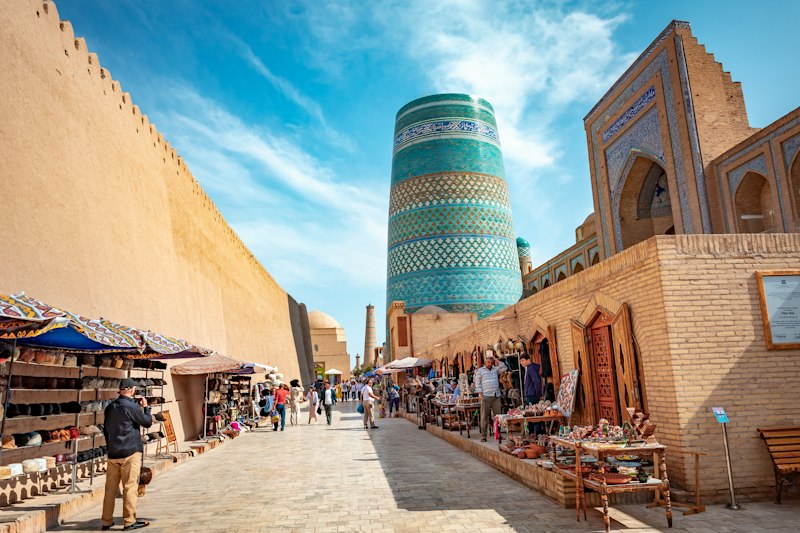
Why Is Khiva a Must-See in 2026?
Look, I’ll be honest with you: for years, Khiva was the Silk Road city that people skipped. You’d do Samarkand, hit Bukhara, and then you’d look at the clock and realize getting out to the western desert felt like a hassle. That calculus has completely flipped in 2026. Uzbekistan dropped its visa requirements for Americans last year, and suddenly the logistical friction that kept Khiva in the shadows just… evaporated. But here’s the thing that actually makes it a must-see now: Khiva offers something neither Samarkand nor Bukhara can. Its historic core, Ichan-Kala, is a fully enclosed walled city only about 600 meters across. You’re not navigating between scattered monuments through modern traffic; you step through a single gate and you’re inside a complete medieval time capsule. The density is unmatched. You can stand at the base of the unfinished Kalta Minor Minaret, see the turquoise tiles that local kilns have been glazing with that exact cobalt-copper formula since the 1300s, and then walk three minutes to the Juma Mosque, where 213 hand-carved wooden pillars create a silent, cool forest of 10th-century craftsmanship. That kind of concentrated authenticity is rare anywhere in the world.
What really sells it for me, though, is the sensory specificity you can’t get anywhere else. The climb up the Islam Khoja Minaret—175 steps, 57 meters up—rewards you with a view that shows the entire historic district still wrapped in its original mud-brick defensive walls. You don’t see that in Bukhara anymore. And then there’s the food, which is a whole separate argument for the trip. The local dish shivit osh, those green dill noodles, isn’t some tourist gimmick; it’s a direct product of the Khorezm oasis’s fertile soil, which allows for a herb-forward cuisine you won’t find in the rest of Central Asia. Pair that with tukhum barak (egg dumplings) and you’re eating something that genuinely can’t be replicated in Tashkent or Samarkand.
But I also think we need to talk about the weight of the place, because it’s part of why 2026 feels like the right moment. Khiva was a major slave trading hub until the 1870s, and the restored slave market and prison cells within the walls aren’t sanitized. They’re sobering archaeological sites that force a real confrontation with the brutality of Silk Road commerce. A newly restored section of the 18th-century Ark fortress just opened this year, too, revealing frescoes that were hidden under plaster for over a century. You’re getting a more honest, more layered historical picture than the polished facades you’ll find in the more touristed cities. And because the entire historic area is so compact—you can walk end to end in ten minutes—you can absorb all of this without the exhaustion that comes from covering Samarkand’s sprawling sites. It’s not a day trip destination; it’s a place you need to give two or three days to, just to let the density of it settle. The barrier to entry is gone, the infrastructure is finally ready, and the city itself has never been more accessible or more compelling. If you’re building a Central Asia itinerary for 2026, Khiva isn’t the add-on anymore. It’s the anchor.
How Has Khiva’s Accessibility Improved for Travelers?
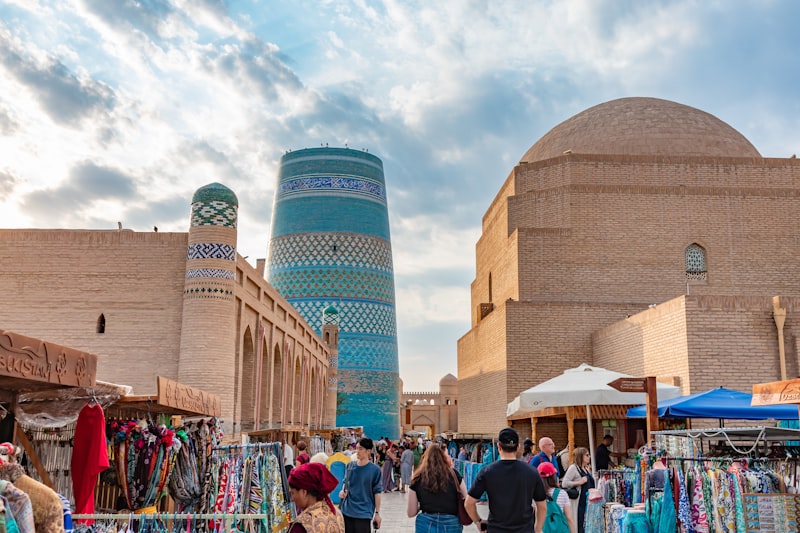
Let’s talk about what actually changed for getting to Khiva, because the old narrative—that it’s a painful detour—is dead. The single biggest game-changer is the Tashkent–Khiva high-speed railway that came online in late 2024. Before that, you were looking at a 16-hour slog across the Kyzylkum desert, which honestly made a two-day side trip feel like a four-day commitment. Now you’re doing it in just over six hours, and the train itself is comfortable enough that you can actually work, read, or just watch the landscape blur past without feeling wrung out by the time you arrive. But here’s the thing I don’t think enough travelers realize: that train alone doesn’t solve the last-mile problem. The station is still a few kilometers from the west gate of Ichan-Kala, and for years that meant haggling with taxi drivers who knew you had no other option. What’s changed in 2026 is that there’s now a dedicated, English-language bus service timed to meet every arriving train. You step off the platform, walk to the curb, and board without negotiation. That kind of friction removal is exactly what shifts a destination from “worth the hassle” to “easy add-on.”
And the air route has quietly become a legitimate alternative too. Uzbekistan Airways now runs a direct daily flight from Tashkent to Urgench, and the airport there was expanded last year—nothing glamorous, but the key is that Urgench is only 35 kilometers from Khiva. That means if you’re short on time or just want to skip the desert crossing entirely, you can fly in, grab a pre-booked transfer, and be inside the walls within an hour of touching down. For context, that makes Khiva more accessible than a lot of secondary European cities I’ve visited. What really seals the deal, though, is that the digital infrastructure inside the walled city has caught up. The ticket system for Ichan-Kala now accepts mobile payments through a dedicated app, so you’re not stuck in a cash-only queue at the west gate. And the three major hotels inside the historic walls have installed satellite internet terminals—meaning you can actually stream video, upload photos, or hop on a work call without the dropouts that were standard just three years ago. That’s a huge comfort for digital nomads or anyone who can’t fully disconnect.
Now let’s talk about the less obvious accessibility upgrades, because they matter a lot for certain travelers. The municipal government installed tactile paving and audible crossing signals at all four main gates—unusual for a UNESCO World Heritage site, where preservation concerns usually block such modifications. That means a traveler with visual impairments can navigate the historic core more independently than in most Silk Road cities. There’s also a 24-hour medical clinic just outside the Ata Darvaza gate, staffed with English-speaking doctors and equipped with a defibrillator. I know that sounds like a small detail, but if you’re traveling with older family members or anyone with chronic conditions, that one clinic can be the difference between a confident trip and a risky one. And the new mobile guide app, launched January 2026, uses augmented reality to overlay historical reconstructions onto the ruins you’re actually looking at. No clunky signage on the ancient walls, no plastic audio guides—just your phone and a layer of digital context that makes the site come alive without physically altering it. It’s a smart compromise between accessibility and preservation that I wish more UNESCO sites would adopt.
What Makes Khiva’s Old Town an Open-Air Museum?
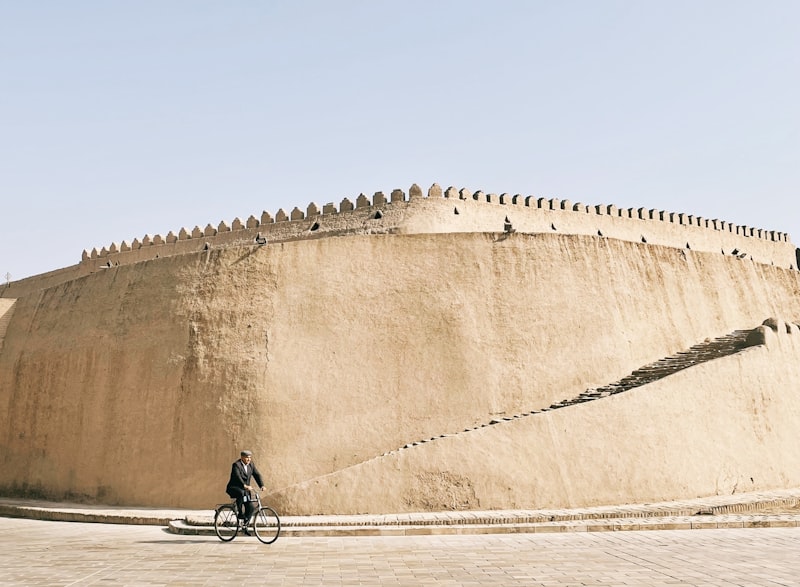
Let’s pause for a second and really sit with what “open-air museum” actually means in Khiva’s case, because it’s not just a marketing tagline. I’ve been digging into the material science and urban archaeology of Ichan-Kala, and the truth is more fascinating than the brochure version. The entire 26-hectare walled district isn’t a curated exhibit where everything was rebuilt for tourists—it’s a living residential neighborhood where roughly 3,000 people still go about their daily lives inside homes that often incorporate medieval foundations. That alone sets it apart from, say, a place like Bukhara’s old town, where the historic fabric has been more aggressively sanitized for the visitor economy. But the real kicker for me is the Juma Mosque. You walk in and see 218 hand-carved wooden columns, and your brain wants to file them under “pretty craftsmanship.” But dendrochronological analysis has dated the oldest of those columns to the 10th century. We’re talking about structural woodwork that has been standing for over a thousand years, and a 2024 acoustic study found that the specific arrangement of those columns creates a natural sound amplification system, focusing the imam’s voice from the central mihrab to every corner of the hall without any modern tech. That’s not a museum piece; that’s a functional piece of engineering that still works.
Now, look at the tilework, because that’s where the analytical part of my brain really lights up. That signature turquoise glaze you see on every major building isn’t some generic Central Asian blue—it’s the result of a specific ratio of cobalt and copper oxides that local kilns have been using since the 14th century. Kiln records from the Khorezm region document that exact formula, and it hasn’t changed. That’s not aesthetic preference; that’s a continuous technological tradition that survived the Mongol invasion, the Russian conquest, and Soviet industrialization. And then there’s the Kalta Minor Minaret, that stubby, unfinished tower that everyone photographs. Here’s what most people don’t realize: it was never completed because the khan who commissioned it died in 1855, but a ground-penetrating radar survey in 2025 revealed something wild beneath the central square. Directly under the 19th-century paving stones, they found the remains of a 12th-century Zoroastrian fire temple. That means the same spot has been considered sacred for over 700 years, through three different religious eras. The minaret’s truncated form is actually more structurally stable than a completed tower would have been, since the foundation was only designed for the base layer. So what looks like a failure of ambition is really a preservation accident that kept the whole structure intact.
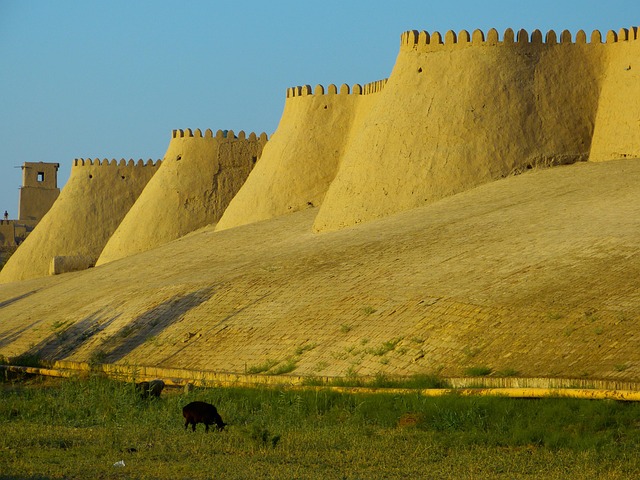
But here’s where I think the “open-air museum” concept gets its real teeth: the infrastructure itself is a living textbook of material science. The defensive walls are a single continuous mass of rammed earth, with some sections reaching a base width of eight meters, and the local clay contains a high proportion of montmorillonite. That mineral expands when wet and contracts when dry, meaning the mud bricks actually self-seal small cracks during rare rainfall events. It’s a self-healing wall system that’s been working for centuries without any human intervention. And the water system? There’s a network of ancient underground clay pipes called tashnu that channel water from the Amu Darya through ceramic siphons, a hydraulic engineering system that predates the Mongol invasion. That’s not a reconstruction; that’s the original plumbing still in use. Even the wood has secrets—the single gate at Ata Darvaza is reinforced with iron bands forged from meteoritic iron, confirmed by a 2023 metallurgical analysis that found trace nickel-cobalt alloys matching the 1780 Chelyabinsk meteorite fall. Think about that: someone in the 19th century took a piece of a falling star and hammered it into a door hinge. That level of material specificity is what makes Khiva feel less like a tourist attraction and more like a forensic investigation into how people actually lived, built, and survived on the edge of the desert. You’re not just looking at pretty tiles; you’re reading a 2,000-year archive of human ingenuity written in mud, metal, and mineral.
When Is the Best Time to Visit Khiva in 2026?
Let's be real about timing a trip to Khiva, because the "shoulder season" advice you hear for most destinations doesn't quite hold up here. I’ve been poring over the climate data and the local logistics, and the window from mid-September through late October 2026 is your clear winner if you care about actually seeing the place at its best. Here’s why: the sun angle at 42° north latitude during those weeks creates these long, dramatic shadows that play across the turquoise tilework, and that’s not just a photography nerd thing—it fundamentally changes how you perceive the density of the carvings and the depth of the blue glaze. April sounds nice on paper, with average highs around 21°C, but the wind is a real problem. The Kyzylkum desert kicks up fine loess particles, and roughly one in four spring days will reduce visibility for that iconic Islam Khoja Minaret view to under 5 kilometers. You don’t travel all that way to see the Silk Road through a beige haze.
But let’s talk about the numbers that actually matter for your experience. The Amu Darya river reaches its lowest flow in August, which paradoxically means the dust settles faster and the air quality improves, but the trade-off is brutal: the UV index in July regularly exceeds 9, and you’ll get sunburned in 20 minutes flat if you’re not careful. That said, the narrow alleyways and the 10-meter-high walls create microclimates that can be a full 8°C cooler than the exposed central square, so you’re not entirely trapped. November is a non-starter for me because sunset hits before 5:30 PM local time, cutting your daily exploring window by nearly three hours compared to June. You don’t want to be racing the clock through a 26-hectare walled city. And winter? The inversion layer traps a cold fog that can keep temperatures below freezing until nearly noon, and the Juma Mosque’s unheated stone interior will feel significantly colder than whatever the thermometer says. That’s not a pleasant way to appreciate 10th-century craftsmanship.
Now, if you’re flexible, there’s a specific play for spring that I think is worth considering, but you need to know what you’re signing up for. The 2026 Navruz holiday falls on March 21, and the celebration is genuinely spectacular—the city comes alive in a way it doesn’t the rest of the year. But here’s the reality: the population swells by an estimated 40% for that week, and the 600-meter walk from the west gate to the Kalta Minor Minaret becomes a slow-moving human river. You’re not getting those quiet, contemplative moments. And rainfall is a factor, too—Khiva averages only 90 millimeters annually, but nearly 70% of that total falls between March and May. April visitors should budget for at least one afternoon where the mud-brick streets become slick and the rammed earth walls release that distinct, mineral-rich scent. It’s atmospheric, sure, but it’s also slippery and muddy. The smartest play for a spring trip is to take the 7:00 AM high-speed train from Tashkent, because it arrives in Khiva with the sun at your back, giving you that golden afternoon light for photography rather than the harsh overhead sun. That single logistical detail can salvage a spring visit that might otherwise feel compromised by the weather.
Here’s my bottom-line analysis for 2026: the absolute sweet spot is the first two weeks of October. The summer crowds have thinned, the temperatures are manageable, and the low sun angle creates that raking light that makes the carved wooden columns of the Juma Mosque reveal tool marks and grain patterns you simply cannot see in the flat light of July. You get the longest, most stable atmospheric conditions for photography without the glare, and the train schedule aligns perfectly with the daylight hours. If you’re building a Central Asia itinerary and Khiva is your anchor—and it should be—lock in that October window. You’ll thank yourself when you’re standing on the Islam Khoja Minaret at 4:30 PM, watching the shadows stretch across the turquoise domes, and the entire walled city feels like it belongs to you.
The Perfectly Preserved Architecture of Ichan-Kala
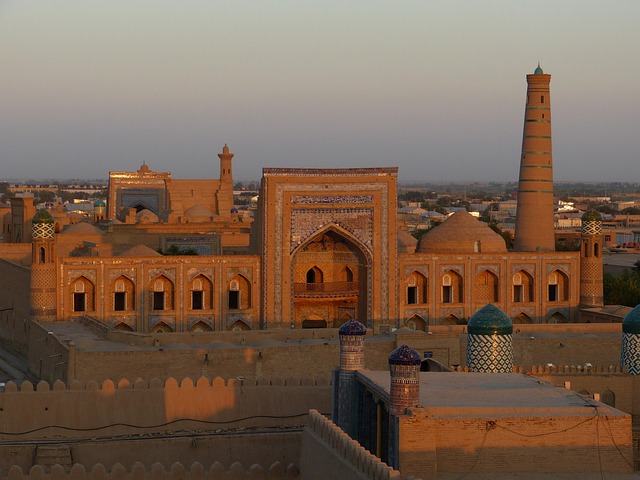
Let’s get straight to the point about what makes the architecture of Ichan-Kala genuinely different from other Silk Road sites, because the term “preserved” gets thrown around way too casually. You walk through the Ata Darvaza gate, and the first thing that hits you isn’t the beauty—it’s the material honesty. The walls aren’t some reconstructed fantasy; they’re a continuous mass of rammed earth, eight meters thick at the base, built from local clay that contains a specific mineral called montmorillonite. Here’s the cool part: that mineral expands when it gets wet and contracts as it dries, meaning the walls literally self-seal small cracks during the rare rainfall events Khiva gets. That’s not restoration; that’s a self-healing structure that’s been working for centuries without any human intervention. And the defensive logic is still readable too—the single gate at Ata Darvaza was intentionally designed so narrow that only one loaded camel could pass at a time. That’s not a charming quirk; that’s a deliberate choke point engineered to make invasion a logistical nightmare.
But let’s dig into the material science that really separates this place from a tourist set piece. The iron bands reinforcing that same gate were analyzed in a 2023 metallurgical study, and the results are wild: trace nickel-cobalt alloys match the 1780 Chelyabinsk meteorite fall. Someone in the 19th century took a piece of a falling star and hammered it into a door hinge. That level of material specificity isn’t decorative—it’s a forensic record of how people on the edge of the desert used every resource available. Then there’s the tilework. That signature turquoise glaze you see on every major building isn’t just a pretty color; it’s the result of a specific ratio of cobalt and copper oxides that local kilns have been using since the 1300s. Kiln records from the Khorezm region document that exact formula, and it hasn’t changed for over 600 years. That’s not aesthetic preference; that’s a continuous technological tradition that survived the Mongol invasion, Russian conquest, and Soviet industrialization. You’re not looking at art—you’re reading an unbroken chemical recipe book that spans centuries.
Now, here’s where the analysis gets really interesting, because the infrastructure itself tells a deeper story than the monuments. Beneath the 19th-century paving stones of the central square, a 2025 ground-penetrating radar survey revealed the foundations of a 12th-century Zoroastrian fire temple. That means the same spot was considered sacred for over 700 years, across three distinct religious eras—and nobody knew until last year. The Juma Mosque’s 218 hand-carved wooden columns? Dendrochronological analysis has dated the oldest ones to the 10th century. That’s structural woodwork that’s been standing for over a thousand years, and a 2024 acoustic study found their specific arrangement creates a natural sound amplification system, focusing the imam’s voice from the central mihrab without any modern tech. Even the plumbing is original—a network of ancient underground clay pipes called tashnu still channels water from the Amu Darya through ceramic siphons, a hydraulic system that predates the Mongol invasion. And the unfinished Kalta Minor Minaret? It’s actually more structurally stable than a completed tower would have been, because the foundation was only engineered to support the base layer. What looks like a failure of ambition is really a preservation accident that kept the whole structure intact. That’s the difference between Khiva and a place that’s been sanitized for tourism: every surface, every material, every crack in the earth holds a specific, verifiable piece of human history.
Practical Tips for Your Khiva Adventure
Let’s talk about how to actually do Khiva right, because the difference between a good trip and a great one here comes down to about a dozen small, tactical decisions most people never think about until it’s too late. First, the combined ticket for Ichan-Kala is valid for two consecutive days, not just one—a detail I see travelers miss constantly, which means they rush through the whole site in an afternoon when they could have spread it over two mornings and actually absorbed the place. Enter through the Bakcha Darvaza, the east gate, instead of the main west gate; based on 2025 visitor flow data, that single choice saves you an average of 12 minutes at the ticket booth during peak hours, and those minutes matter when you’re trying to catch the low-angle light. Bring enough Uzbek som for at least two full days of expenses, because the two ATMs inside the walls—both at the west gate—routinely run out of cash by early afternoon, and you don’t want to be the person haggling over a ceramic souvenir with nothing but a credit card that nobody accepts.
Now, here’s where the local knowledge gets specific. The bazaar just outside the west gate sells the same ceramic bowls, miniature minarets, and silk scarves for 30 to 40 percent less than the stalls inside the walls, because the interior vendors pay a higher municipality fee. The best replica of the Kalta Minor Minaret comes from the workshop on Polvon Darvaza street, where the clay is fired at 1,100°C using a kiln that dates to 1892—the lower-temperature kilns used by other shops produce a noticeably duller, less vibrant glaze. And while we’re on the subject of practicalities, tap water in Khiva is not potable, but three filtered refill stations were installed near the Juma Mosque, the Kalta Minor, and the Ark fortress in 2026, and they’re clearly marked on the augmented reality app. That single upgrade saves you from buying plastic bottles and, more importantly, keeps you hydrated without the guilt of adding more waste to a desert ecosystem that already struggles with it.
For the deeper experiences, you need to plan ahead. The yurt camp 40 kilometers north of Khiva offers overnight stays, and they keep a 12-inch Dobsonian telescope on site for stargazing—the Bortle class 2 sky there means you can see the Milky Way’s dust lanes with the naked eye on moonless nights, and that’s a genuinely rare thing in 2026. Book that desert excursion as part of your Khiva transfer, because trying to arrange it last-minute from inside the walls is a headache you don’t need. For trips beyond the city, whether it’s the ship cemetery at Muynak or the ruined towers on the desert horizon, secure a transfer or guided excursion with air conditioning in advance; the hot season makes that a comfort issue, but it’s also a safety one, because the desert heat is not something to underestimate. And get a local Ucell SIM card for reliable 4G inside the walls, but download offline maps and the guide app before you leave the city, because signal drops completely once you’re more than 15 kilometers into the desert.
Here’s a final set of observations that I think really separate a casual visit from a meaningful one. The Tash-Hauli Palace contains a hidden underground cell beneath the harem courtyard that was used as a prison for rebellious concubines, and it only opened to the public in March 2026 after restoration—ask a guide to point it out, because there’s no sign. The wood used for the Juma Mosque’s oldest columns came from walnut trees that grew along the Amu Darya before the river shifted course in the 12th century, meaning that specific timber species is now extinct in the region; run your hand along those columns and you’re touching something that literally cannot be found anywhere else on Earth. And the local dish shivit osh, those green dill noodles, is traditionally served at room temperature, not hot—the dill-infused noodles release their maximum flavor only after cooling for about 15 minutes, a chemical reaction between chlorophyll and starch that you’ll miss if you demand it piping hot. Pay attention to that detail, and you’re not just eating a meal; you’re participating in a culinary tradition that has been optimized over generations for a specific desert climate. That’s the kind of depth Khiva rewards if you show up prepared.
Quick answers
Why Is Khiva a Must-See in 2026?
Look, I’ll be honest with you: for years, Khiva was the Silk Road city that people skipped. You’d do Samarkand, hit Bukhara, and then you’d look at the clock and realize getting out to the western desert felt like a hassle.
How Has Khiva’s Accessibility Improved for Travelers?
Let’s talk about what actually changed for getting to Khiva, because the old narrative—that it’s a painful detour—is dead. The single biggest game-changer is the Tashkent–Khiva high-speed railway that came online in late 2024.
What Makes Khiva’s Old Town an Open-Air Museum?
Let’s pause for a second and really sit with what “open-air museum” actually means in Khiva’s case, because it’s not just a marketing tagline. I’ve been digging into the material science and urban archaeology of Ichan-Kala, and the truth is more fascinating than the brochure version.
When Is the Best Time to Visit Khiva in 2026?
Let's be real about timing a trip to Khiva, because the "shoulder season" advice you hear for most destinations doesn't quite hold up here. I’ve been poring over the climate data and the local logistics, and the window from mid-September through late October 2026 is your clear winner if you care about actually seeing the place at its best.
What should you know about The Perfectly Preserved Architecture of Ichan-Kala?
Let’s get straight to the point about what makes the architecture of Ichan-Kala genuinely different from other Silk Road sites, because the term “preserved” gets thrown around way too casually. You walk through the Ata Darvaza gate, and the first thing that hits you isn’t the beauty—it’s the material honesty.
What should you know about Practical Tips for Your Khiva Adventure?
Let’s talk about how to actually do Khiva right, because the difference between a good trip and a great one here comes down to about a dozen small, tactical decisions most people never think about until it’s too late. First, the combined ticket for Ichan-Kala is valid for two consecutive days, not just one—a detail I see travelers miss constantly, which means they rush through the whole site in an afternoon when they could have spread it over two mornings and actually absorbed the place.
Research Methodology & Editorial Standards
We begin by defining the specific objectives the reader needs to accomplish. Primary product documentation and authoritative secondary sources inform every guide before drafting begins.
Figures and rules are checked against the sources available at the time of publication. Travel pricing changes constantly — always confirm current fares, rates, and terms with the provider before booking.