
Ancient Gold Ring Reveals Hidden Message From 2,000 Year Old Grave
That’s exactly what happened at the Don Yai Thong archaeological site in Phetchaburi province, western Thailand, when a team from the Fine Arts Department uncovered two gold rings resting on the finger bones of a single individual.
The Discovery: Unearthing 2,000-Year-Old Gold Rings in a Thai Burial Site
You know that moment when an artifact stops being just an object and starts telling you a story you never expected? That’s exactly what happened at the Don Yai Thong archaeological site in Phetchaburi province, western Thailand, when a team from the Fine Arts Department uncovered two gold rings resting on the finger bones of a single individual. Let’s pause and sit with that image for a second — these weren’t loose trinkets lost to time; they were still on the person’s hand, buried for roughly two millennia. One ring is a plain band of exceptionally high purity gold, which alone signals advanced metallurgical skill for the Iron Age period. But the other? That’s where things get really interesting. It bears a six-letter inscription in ancient Brahmi script that reads “pusarakhitasa,” translating to “protected by Pusara” in the Prakrit language.
Now, here’s what makes this discovery genuinely significant from a research perspective. We’re talking about one of the earliest known examples of written language ever found in Thailand, predating many historic inscriptions in the region by a wide margin. The script and language hail from South Asia, dating back to around the 3rd century BCE, which creates a direct linguistic link between Iron Age Thailand and the Indian subcontinent. The name “Pusara” is likely a personal name or title, which means we’re not just looking at a piece of jewelry — we’re looking at a clue to someone’s identity, maybe even their lineage or social standing. And the fact that both rings were found in pristine condition, with no significant tarnishing, meant researchers could read the inscription immediately without any restoration guesswork. That kind of preservation is rare, and it gives us unusually clean data to work with.
So what does this actually tell us about the bigger picture? The site itself dates to Thailand’s late prehistoric Iron Age, roughly 2,500 to 1,500 years ago, and radiocarbon dating of organic material from the burial layer places these rings between 1,900 and 2,100 years old. The presence of such sophisticated goldwork, combined with other grave goods like pottery and glass beads found alongside the rings, suggests we’re looking at a society with established trade routes or cultural exchanges across the Bay of Bengal. This wasn’t some accidental drift of goods — someone intentionally brought these rings, or the knowledge to make them, over a considerable distance. For those of us who track ancient economic networks, this find is a concrete data point that challenges the idea of isolated regional development. It’s a reminder that long-distance connection was a reality long before we usually give it credit, and that a single burial site can rewrite our understanding of how people moved, traded, and communicated nearly two thousand years ago.
Decoding the Inscription: The Meaning of The One Protected by Pushya
Let’s get into what this inscription actually means, because honestly, the translation is way more layered than it first appears. When epigraphers read pusarakhitasa, they weren’t just pulling a name off the ring — they were decoding a grammatical construction that tells us something about how this person saw themselves. The word breaks down into “Pusara” plus “khita,” which comes from the Sanskrit root rakṣ, meaning “to protect.” But here’s the crucial detail: it’s in the passive voice. That means the ring doesn’t just say “Pusara” as a name tag. It says “the one protected by Pusara,” which shifts the entire frame from ownership to guardianship. We’re not looking at a person claiming a name; we’re looking at a person claiming a relationship with a protective force. And “Pusara” itself is a Prakrit rendering of the Sanskrit “Pushya,” which refers to the fourth lunar mansion in the Indian nakshatra system — a constellation tied to the star Delta Cancri and considered deeply auspicious for nourishment, growth, and prosperity. So this isn’t just a random name. It’s a direct reference to the Indian zodiac, one of the earliest physical objects ever found in Southeast Asia that explicitly incorporates that astrological framework.
Now, pause for a second and think about what that implies for trade and belief systems. You’ve got a gold ring, over 90% pure — a metallurgical standard that required sophisticated refining techniques not commonly associated with Iron Age Thailand — sitting on a finger in a burial ground in Phetchaburi. The glass beads found in the same grave have chemical compositions that match production centers in South India and Sri Lanka. So we’re not talking about a one-off trinket that drifted across the Bay of Bengal by accident. We’re talking about a deliberate, high-value object that carried specific cultural and spiritual meaning from one world to another. The person who wore this ring wasn’t just wealthy. They were plugged into a network of ideas — astrological, religious, and linguistic — that stretched across the ocean. And the fact that both rings were found undisturbed on the finger bones, not tossed in as a burial offering, tells us this was a daily object of identity, not just a ceremonial prop.
Let’s also talk about what this does to our timeline of writing in Thailand. Before this find, the earliest evidence of written language in the region was generally pegged to the Dvaravati period, around the 6th century CE. That’s a gap of over 1,000 years. This ring, with its Brahmi script from the 3rd to 2nd century BCE, pushes that date back dramatically and links the site directly to the Mauryan Empire of India — the same empire that produced Ashoka’s edicts. For researchers like me who track ancient economic and cultural networks, this is the kind of data point that forces you to rethink the old narrative of isolated regional development. We’re looking at a society that had the means, the knowledge, and the desire to import not just gold and glass, but a whole system of meaning. The name “Pusara” might be a personal name or a title, but the grammar of the inscription makes it clear: this person defined themselves by who or what was watching over them, not by their own achievements. That’s a worldview embedded in a single word, preserved in gold for two millennia, and it changes how we understand the people who lived here long before any Thai kingdom ever existed.
Ancient Connections: Tracing the Brahmi Script from India to Thailand
Let’s trace this thread from the finger of that Iron Age burial in Phetchaburi all the way back to the script's origins, because the connection is more direct than you might think. The six letters on that ring are written in Brahmi, and here’s the kicker: Brahmi is the direct genetic ancestor of the modern Thai alphabet you see on street signs in Bangkok today. That’s not a loose metaphorical link — it’s a straight line of descent, a living lineage that stretches over two thousand years. The script was first cracked open by a British scholar named James Prinsep back in 1837, who used bilingual coins from the Indo-Greek king Menander to unlock the code. So we’re working with a writing system we fully understand, unlike the Indus Valley script which still sits there mocking us with its silence. And the name itself comes from Hindu tradition, which says the god Brahma revealed it, though linguists trace its actual roots to earlier Semitic scripts like Aramaic. Honestly, that tension between divine origin stories and hard historical linguistics is one of my favorite things about studying these artifacts — you get both the poetry and the data.
Now, what makes the Thai ring so valuable from a research standpoint is the specific variant of Brahmi it uses. We’re looking at Southern Brahmi, which had slightly different letter shapes than the Northern version you’d find on Ashoka’s famous pillars from the 3rd century BCE. That distinction matters because it tells us which trade network this object traveled through — not just “India,” but the maritime routes of the Deccan and Sri Lanka that fed into the Bay of Bengal. The ring’s inscription is in Prakrit, which was the everyday vernacular of ancient India, not the sacred Sanskrit of religious texts. That’s a crucial detail: it means the script wasn’t just for priests and scholars; it was used for commerce, for trade, for the kind of practical communication that moved goods and people across oceans. And Brahmi was typically written with a stylus on perishable palm leaves, so finding it hammered into gold is exceptionally rare — the metal tells you this was meant to last, to carry meaning across time in a way that organic materials simply couldn’t.
So when you put all this together, the ring becomes a physical data point in a much larger story. The spread of Brahmi to Southeast Asia happened through those maritime trade networks as early as the 3rd century BCE, and this ring is one of the earliest proofs we have of that transfer actually happening. It’s not an isolated case either — contemporary Brahmi artifacts have been found in Vietnam and Myanmar, which paints a picture of a literate exchange network that spanned the entire region. Think about what that means for how we understand these ancient societies: they weren’t just trading raw materials or finished goods; they were trading a technology of thought. Writing is a cognitive tool, and the fact that it traveled across the Bay of Bengal intact means there were people who understood its value well enough to carry it, teach it, and adapt it to new contexts. The Thai alphabet that millions of people use today didn’t emerge from a vacuum — it grew out of this specific genetic line, and a gold ring from a grave in Phetchaburi is one of the oldest surviving witnesses to that entire process.
Ritual or Adornment? Understanding the Rings' Placement in the Iron Age Grave
Let’s sit with the physical reality of this find for a moment, because the placement of those rings on the finger bones isn’t just a detail — it’s the primary dataset for answering whether this was ritual or adornment. Archaeologists noted that both rings were found on the same hand, stacked together, rather than one on each hand, which immediately rules out the simple aesthetic symmetry we’d expect from pure decoration. Stacking rings on a single finger, especially in an Iron Age context where fewer than five percent of graves contain any metal rings at all, signals something more deliberate than fashion. The specific finger matters too, and here’s where we can cross-reference with ancient Indian texts like the Arthashastra, which prescribed the ring finger for marital or protective functions and the index finger for authority. We don’t have a definitive skeletal identification of which finger bore the rings, but the stacking pattern alone suggests the wearer was making a concentrated statement — concentrating meaning, not spreading it out. Now, here’s the counterintuitive part: microscopic analysis showed almost no significant wear on the rings’ surfaces, which is genuinely surprising if you assume they were worn daily for years. You’d expect scratches, micro-abrasions, maybe some edge rounding from constant contact with tools or textiles. The absence of that wear pattern raises a real possibility that these rings were reserved for ceremonial or special occasions — objects of periodic ritual use rather than everyday adornment.
But don’t rush to label them purely ceremonial either, because the interior surfaces told a different story. No textile fibers or organic residues were found inside the rings, which rules out the idea that they were worn over a glove or fabric liner. That means direct skin contact, and in a tropical climate like Thailand’s, that kind of intimate wear leaves its own signature — oils, sweat, the micro-environment of the skin itself. The rings were found positioned at the individual’s side in a sleep-like posture, not crossed over the chest in a formalized ritual pose, which aligns with standard Iron Age Southeast Asian burial practices. That posture is important because it suggests the person was laid to rest in a natural, restful state, still wearing the objects that defined them in life. You don’t stage a theatrical burial with someone sleeping on their side and then add rings afterward — you bury them as they were. So the most logical reading is that these rings were part of the person’s identity, worn regularly enough to leave no fabric barrier but not so constantly that they showed heavy wear. That’s a Goldilocks zone of usage that points to something like a status object brought out for significant social or ritual occasions, then worn into death as a final marker of who they were.
Let me push back on one common assumption here, because I’ve seen this misinterpreted in other analyses. Some researchers want to frame this as purely funerary ritual — that the rings were placed on the body specifically for the burial. But the archaeological record doesn’t support that. The rings were found directly on the finger bones, not nearby as loose grave goods that could have been tossed in as offerings. That distinction matters because it separates personal ownership from ceremonial deposition. If these were purely burial offerings, you’d expect to find them in a wider variety of placements — near the hand, in a pouch, or even in a separate container. But they’re on the bone, which means they were worn in life and stayed there through decomposition. The high purity gold, over 90 percent, also argues for a functional object rather than a disposable ritual item — you don’t sink that much metallurgical effort into something meant only for a grave. And the inscription itself, with its protective meaning of “protected by Pusara,” makes more sense as a talisman worn by a living person who believed in its power than as a post-mortem label. So I’d argue we’re looking at an object that sat at the intersection of adornment and ritual — it decorated the person, yes, but it also carried a specific spiritual function that was deeply personal and likely tied to their identity, their lineage, or their cosmic protection. The rings weren’t either/or; they were both, and the placement on the finger is the physical evidence that lets us see that duality.
Global Significance: What This Find Reveals About Ancient Trade and Cultural Exchange
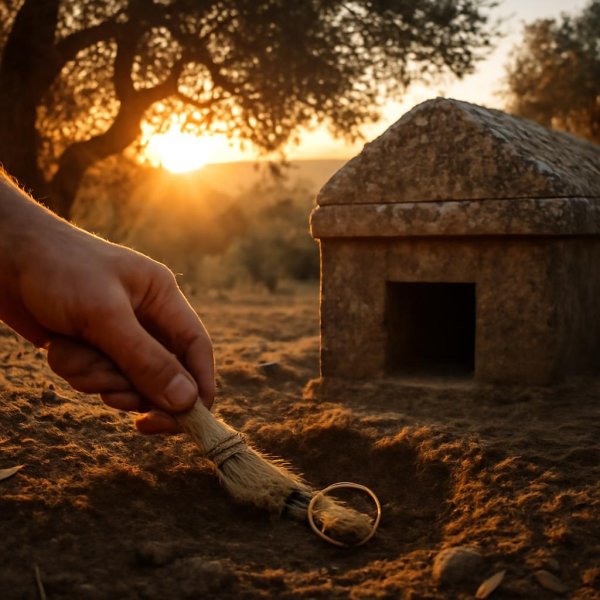
Let’s step back from the grave itself and look at what this ring actually tells us about the world that produced it, because honestly, the implications go way beyond a single burial. The high purity of the gold, over 90%, is the first major clue that we’re dealing with a sophisticated trade network, not just a lucky find. That level of refinement required a metallurgical process that simply wasn’t available in Iron Age Thailand — so either the raw gold was imported, or the technical knowledge to work it came from somewhere else. Either way, it’s a clear signal that this society was plugged into a long-distance exchange system that crossed the Bay of Bengal. And here’s where it gets really specific: the glass beads found in the same grave have a chemical composition that matches production centers in South India and Sri Lanka. That’s not a vague “influenced by” connection — that’s a precise geographic origin, a direct line you can draw on a map. So we’re not just talking about trade in abstract; we’re talking about a specific route, a specific set of goods moving in a specific direction, and a person who was important enough to be buried with them.
Now, think about what else traveled alongside those physical goods, because that’s where the cultural exchange part becomes genuinely fascinating. The ring’s inscription doesn’t just borrow a script from India — it borrows a whole worldview. The name “Pusara” is a Prakrit rendering of the Sanskrit “Pushya,” which refers to the fourth lunar mansion in the Indian nakshatra system, an astrological framework that was deeply tied to ideas of nourishment, growth, and cosmic protection. This is one of the earliest physical objects ever found in Southeast Asia that explicitly incorporates that framework, predating the widespread influence of Hinduism in the region by centuries. And the passive voice in the inscription — “the one protected by Pusara” — reveals something even more profound: it tells us that this person defined their identity through a relationship with a protective force, not through personal achievement. That’s a cultural concept, a way of understanding selfhood, that traveled intact across the ocean. It didn’t just arrive as a name; it arrived as a complete grammatical and philosophical structure.
What really gets me as a researcher is what this does to our timeline of written language in the region. Before this find, the earliest evidence of writing in Thailand was generally pegged to the Dvaravati period, around the 6th century CE. That’s a gap of over 1,000 years. This ring pushes that date back dramatically, and it does so with a script — Southern Brahmi — that’s the direct genetic ancestor of the modern Thai alphabet. So we’re looking at a living linguistic lineage that connects a grave in Phetchaburi to the street signs in Bangkok today. The specific variant of Brahmi used on the ring allows researchers to trace the exact maritime route from the Deccan and Sri Lanka, rather than just a general link to India. And the fact that the inscription is in Prakrit, the everyday vernacular of ancient India rather than the sacred Sanskrit of religious texts, tells us this wasn’t just for priests or scholars — it was used for commerce, for the practical communication that moved goods and people across oceans. The ring becomes a physical data point in a much larger story: the spread of a cognitive technology, writing itself, across the Bay of Bengal. It’s one of the earliest surviving witnesses to that entire process, and it forces us to rethink the old narrative of isolated regional development. These weren’t passive recipients of foreign ideas; they were active participants in a network that exchanged not just gold and glass, but systems of thought, belief, and identity.
Preserving the Past: The Future of the Don Yai Thong Archaeological Site

Let’s be honest about what the Don Yai Thong site actually represents now that the initial excitement over the gold rings has settled. We’re not just looking at a single spectacular grave anymore; we’re looking at the remains of an entire stratified society that lived, traded, and buried their dead in a specific spot for generations. Nine skeletons have been uncovered so far, including a child under twelve, which tells us this was a long-term burial ground for a settled population, not a one-off elite tomb. And here’s where the data gets really interesting: alongside those gold rings, archaeologists have found six bronze drums and carefully placed bronze vessels near the feet of the deceased. That’s a consistent burial ritual, a shared cultural grammar about how you send someone into the afterlife, which means these people weren’t just wealthy — they shared a coherent belief system.
But here’s the challenge that keeps me up at night as someone who thinks about preservation strategy. The site was only discovered because local residents found pieces of ancient bronze drums in a rice field, which means it’s sitting in an active agricultural landscape, not a protected park. The Fine Arts Department began formal excavations on February 9, 2026, and they’ve already reshaped our timeline of early urban development in the region — but excavation is inherently destructive, and every shovelful of dirt removes context that can never be recovered. The site’s location, about 130 kilometers southwest of Bangkok, was strategically chosen to control inland trade routes connecting the coast to the interior, which means it’s also positioned near modern infrastructure that could threaten its integrity. So the real question isn’t just “what have we found?” but “how do we keep finding without losing what we’ve already got?”
What makes this preservation problem uniquely difficult is the sheer density and variety of the grave goods. We’re not talking about a simple farming village with a few pots — we’re talking about a regional center of power and exchange, where elite individuals controlled the production and trade of prestige objects like high-purity gold and bronze. That means the site holds layers of information: the metallurgical data from the rings, the chemical signatures from the glass beads that match South Indian production centers, the ritual patterns from the drum placements, and the human osteology from the nine skeletons themselves. Each of those data sets requires different preservation conditions — stable humidity for the metal, controlled temperature for the organics, minimal disturbance for the stratigraphy. And here’s the hard truth: most archaeological sites in Southeast Asia don’t get the long-term funding they need for proper conservation after the initial excavation buzz fades. The site was identified by chance when locals found drum fragments in a rice field, and its future depends on whether that chance discovery translates into sustained institutional support.
Let me offer a comparison that might clarify what’s at stake. Think about how the Ban Chiang site in northeastern Thailand was handled — it became a UNESCO World Heritage site in 1992, but only after decades of looting and degradation that permanently lost context. Don Yai Thong has the advantage of being discovered in 2026, with modern documentation techniques like 3D scanning and soil chemistry analysis that simply didn’t exist forty years ago. But it also faces the same pressures: agricultural encroachment, amateur metal detecting, and the simple reality that a buried site doesn’t stay buried once people know it’s there. The Fine Arts Department has done impressive work so far, but the site’s long-term value depends on whether we treat it as a finite resource to be mined for artifacts or as a living laboratory where future researchers with better tools can ask questions we haven’t even thought of yet. Honestly, that’s the most important decision being made right now, and it’s happening in provincial government meetings that most of us will never see. The gold ring got the headlines, but the real story of Don Yai Thong is whether we’re smart enough to preserve the context that gave that ring its meaning in the first place.
Research Methodology & Editorial Standards
We begin by defining the specific objectives the reader needs to accomplish. Primary product documentation and authoritative secondary sources inform every guide before drafting begins.
Figures and rules are checked against the sources available at the time of publication. Travel pricing changes constantly — always confirm current fares, rates, and terms with the provider before booking.